Understand any stock in simple English
Enter a ticker to learn what the company does and how it makes money.
Beijing Tianbing Technology Co., Ltd.
Space Pioneer builds reusable rockets and liquid rocket engines and sells satellite launch services.
Space Pioneer is a Chinese rocket company. It builds its own rockets, its own engines, and then sells launches to customers who need to put things into orbit—mostly satellite constellation operators and government agencies. The bet is simple: if you can make a rocket that flies again and again instead of throwing itself away after one flight, you can launch far more often and at a much lower price.
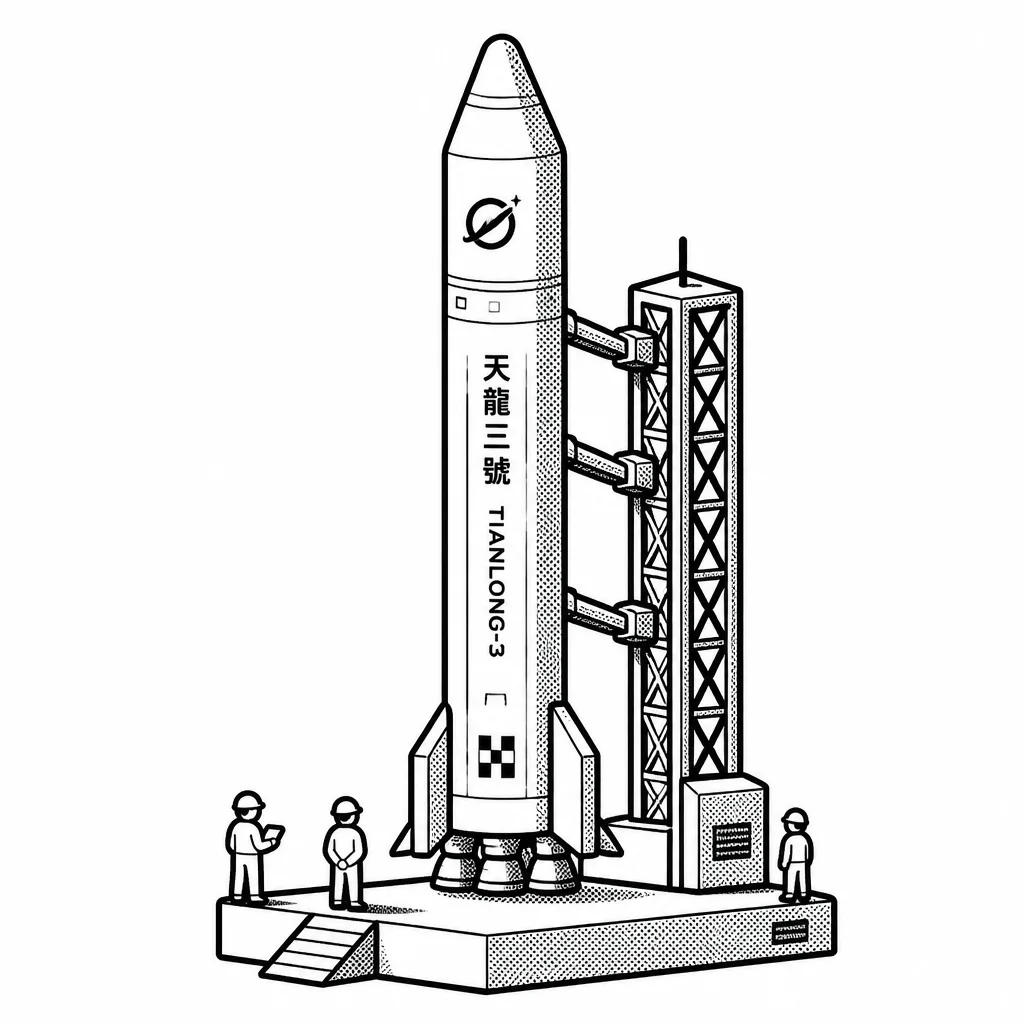
Its flagship is the Tianlong-3, a reusable liquid-fueled rocket designed to land back on Earth after boosting a payload toward orbit, similar in spirit to what SpaceX does with Falcon 9. The company also builds the liquid engines that power these rockets in-house, which matters because engines are the hardest and most expensive part of a rocket. In 2023, Space Pioneer made history by becoming the first Chinese private company to reach orbit with a liquid-fueled rocket, the Tianlong-2. The money comes from launch contracts. Satellite constellation builders—the companies planning thousands of small satellites for internet and Earth observation—need cheap, frequent rides to orbit, and governments need them too. Reusability is the whole pitch: land the booster, inspect it, refuel it, fly it again, and spread the cost across many missions instead of one. That is why the company's development of a reusable rocket is the thing the market watches most closely. It is not a smooth ride. In June 2024, a static fire test of the Tianlong-3 went wrong: the rocket tore loose from its test stand and launched unintentionally before crashing nearby. Nobody was hurt, but it was an embarrassing and costly setback that showed how unforgiving rocket testing is. Reusable rockets are hard, and Space Pioneer is still proving it can deliver on the promise rather than just talk about it.
Space Pioneer is privately held, backed by Chinese investors, and based in Beijing. It sits in a crowded field of Chinese private launch startups all racing toward the same goal of cheap, frequent, reusable access to space—and competing for the same constellation and government contracts.
Saved answer · last researched 13 Nov 2026
Timeline
Kang Yonglai Starts Space Pioneer
In 2019, Kang Yonglai walked away from his job as chief technology officer at LandSpace, one of China's most prominent private rocket companies, to start his own. His new company, Space Pioneer, had a simple but expensive goal: build reusable orbital rockets and liquid-fueled engines so that putting things in space could cost far less. Reusability was the whole bet. A rocket you throw away after one flight is like an airline that scraps the plane after every trip.
Thirty Million for Tianlong-1
Two years in, investors put thirty million dollars into the company. The money went toward finishing the design and early work on Tianlong-1, the company's first reusable rocket. It was a vote of confidence, but the real test was still ahead: nobody had proven the company could actually fly.
Tianlong-2 Reaches Orbit
Then came April 2023, and Tianlong-2 lifted off and reached orbit, carrying a small satellite. That made Space Pioneer the first Chinese private company to reach orbit with a liquid-fueled rocket, and, remarkably, the first startup anywhere in the world to succeed on its very first launch attempt. For a young company, it was close to a perfect debut.
A Big C-Round for Tianlong-3
The success loosened wallets. That July, the company raised hundreds of millions of yuan in a C round, bringing its total funding to roughly four hundred million dollars. The money was aimed squarely at Tianlong-3, the bigger reusable rocket meant to carry real commercial payloads. Space Pioneer now looked like a serious contender.
Tianlong-3 Escapes the Test Stand
What happened next became the company's most infamous moment. In June 2024, a Tianlong-3 first stage was being tested on the ground when a structural failure caused it to tear loose from its test stand. The rocket, meant only to fire while bolted down, unintentionally launched itself and exploded in the mountains near Gongyi. Nobody was hurt, but the launch plans slipped.
A Sea-Platform Static Fire
The company did not hide from the accident. It went through a long corrective process, adopting 127 fixes, including doubling the number of hold-down arms that keep a rocket attached to its stand. By September 2025 it had successfully static fired a Tianlong-3 first stage on a sea launch platform, a quiet sign that the program was moving again.
Tianlong-3 Fails at Liftoff
The big test finally came in April 2026, when Tianlong-3 made its maiden flight from Jiuquan. It failed shortly after liftoff. The setback was a sharp reminder of just how far Chinese private firms still lagged behind SpaceX in making reusable rockets actually work.
Grounded While LandSpace Flies
After that failure, Space Pioneer had no flying rocket and no launch revenue, with Tianlong-3 grounded. Meanwhile its old rival LandSpace, the company its founder once helped lead, flew Zhuque-3 again and recovered its booster on land in August 2026. Space Pioneer, once the promising newcomer, now found itself roughly a year to a year and a half behind.