Understand any stock in simple English
Enter a ticker to learn what the company does and how it makes money.
N26 SE
N26 is a German digital bank that lets people manage money through a smartphone app instead of visiting a branch.
N26 is a bank you carry in your pocket. It has no branches and no teller windows — just an app where you open an account, get a debit card, send money, and track your spending. It is one of Europe's best-known "neobanks," a breed of startup that tries to do to banking what Spotify did to music: strip out the physical overhead and make everything happen on your phone.
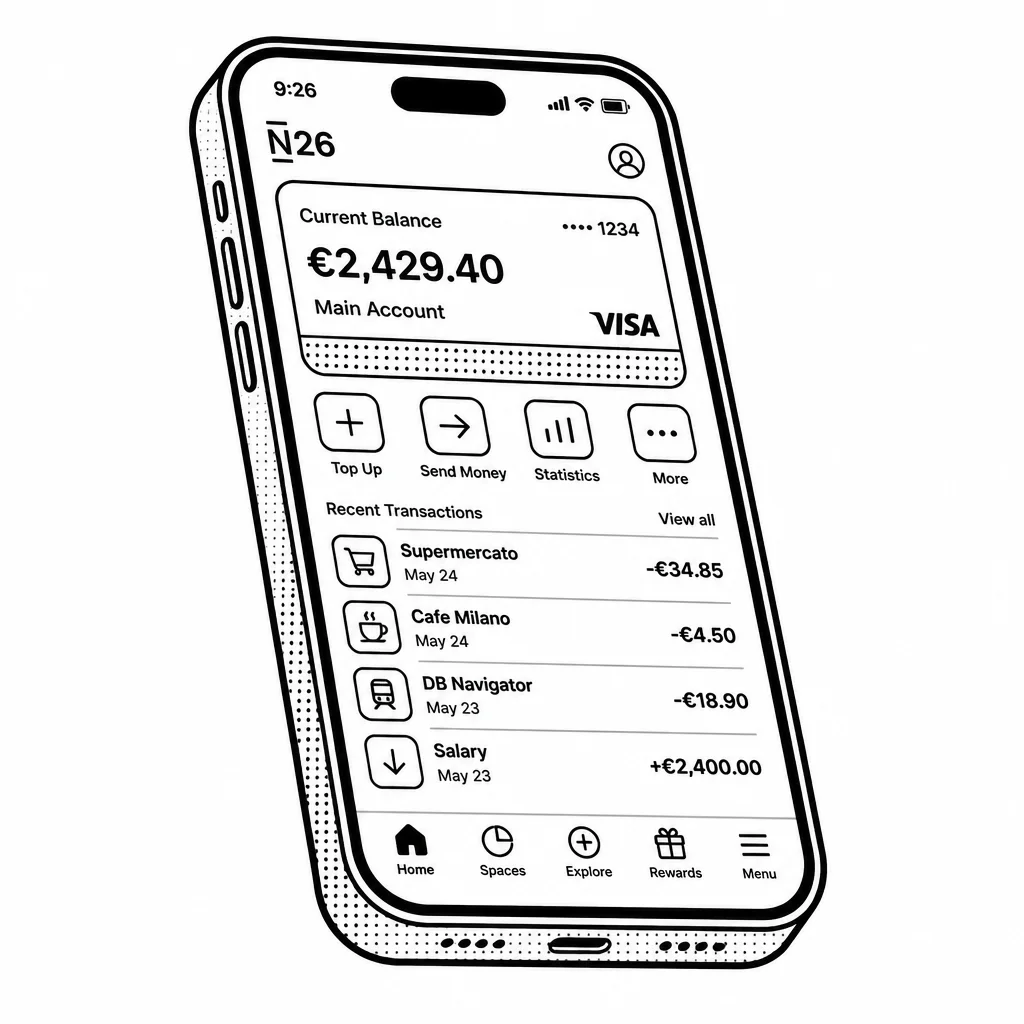
The core product is a personal current account, the everyday account where your salary lands and your bills get paid. Customers pay for it in two ways. The basic account is free, and N26 makes money from the slice of money the bank earns by holding customer deposits and lending them out, plus the fees merchants pay when you swipe your card. Then there are paid tiers — metal cards, travel insurance, extra savings features — which customers subscribe to monthly, and those subscription fees are an increasingly important part of the pitch because they are steady and predictable. The appeal for customers is speed and simplicity. Opening an account takes minutes from a couch, the app is clean, and the card works across Europe. That pulled in millions of customers, mostly in Germany, France, Italy, and Spain. The problem is that "free and convenient" is easy to copy. Rivals like Revolut chase the same customers, and traditional banks have built decent apps too, so N26 has to keep spending on marketing and product features to stay in the race — which is why the paid subscription tiers matter so much.
N26 has also had a rougher ride than its early hype suggested. German regulators capped how many new customers it could take on for a stretch while it fixed money-laundering controls, a painful and expensive episode that slowed growth. The company was once valued at over $9 billion, and it has burned through cash building the business while aiming to turn a profit. That tension — a slick app loved by young customers, but a company still proving it can make money and satisfy strict banking supervisors — is the real story of N26.
Saved answer · last researched 4 Nov 2026
BIG PICTURE
Among German freelancers, nearly one in three links an N26 account
- 31% Freelancers who connected an N26 account
- 69% Freelancers with other banks
Germany is where N26 earns most of its money, and freelancers are a group it has quietly won. About 31 percent of self-employed freelancers in a German accounting-tool sample connected an N26 account, more than the roughly 10 to 12 percent who linked a Sparkasse or Volksbank. Those steady business accounts feed the fees and card spending N26 lives on. Source: Norman Finance, data from 2026
Timeline
Two Founders Start Papayer
Valentin Stalf and Maximilian Tayenthal started a company called Papayer with a prepaid card and app meant for teenagers, a simple way for young people to hold and spend money. But when they looked at who actually used it, they found the parents were more engaged than the kids. So they changed the model and the name, chasing the customers who really showed up.
Number26 Moves to Berlin
Rebranded as NUMBER26, the company left Vienna for Berlin, a bigger stage with a deeper pool of tech talent and investors. To offer adult customers a MasterCard, it teamed up with Wirecard — a partnership that would quietly matter a lot later.
Europe's First Mobile Bank Account
Then came the real bet: Europe's first mobile bank account, where your money lived on your phone and managing it felt simple and transparent. That was the pitch — banking that didn't feel like a trip to a branch.
A Full German Banking License
The next step changed everything. N26 became the first digital bank to get a full German banking license, which meant it could build its own products instead of renting someone else's, and customer deposits were protected up to a hundred thousand euros. It also shortened its name to N26, a nod to its growing international crowd.
N26 Leaves the UK
Not every market worked. In April 2020 the bank shut its UK business, blaming Brexit: it simply couldn't keep operating there on its German EU license.
Germany's Most Valuable Fintech
The growth story hit its peak when N26 raised a huge funding round that valued it at over nine billion dollars, making it Germany's most valuable fintech. On paper, it looked unstoppable.
Regulators Push Back
But the cracks were showing. Germany's financial regulator, BaFin, fined the bank millions for weak anti-money-laundering controls and installed a supervisor, then capped how many new customers it could take on. Around the same time, N26 pulled out of the US, closing roughly half a million accounts to focus on Europe.
The Founders Step Back
The pressure had consequences. In 2025 co-founder Valentin Stalf stepped down as co-CEO amid investor frustration over repeated BaFin sanctions, and Maximilian Tayenthal left operations by year's end. Regulators piled on more restrictions, including a Dutch mortgage ban and higher capital requirements.
First Full-Year Profit
Yet the same year brought a milestone: N26 posted its first full-year net profit, a modest one and a half million euros on about five hundred million in revenue, reversing a forty-two million euro loss. Small, but it was the first time the math worked.
Mike Dargan Takes Over
In April 2026, Mike Dargan, formerly of UBS, became CEO, completing the shift from founder-led startup to a professionally run bank. His job: a strategic cleanup after years of regulatory trouble.