Understand any stock in simple English
Enter a ticker to learn what the company does and how it makes money.
Monzo Bank Limited
Monzo is a digital bank that lets people manage their money through a smartphone app, earning money mostly from card swipe fees, subscriptions, and lending.
Monzo is a British digital bank that lives entirely on your phone. There are no branches and no paperwork — you sign up in minutes, get a bright coral-pink debit card in the post, and do everything from a slick app: checking your balance, splitting a bill with friends, setting spending budgets, and freezing your card if it goes missing. It serves ordinary people who want a bank account, plus a growing number of small businesses, and it makes its money in a few main ways: a small cut every time you use your card (paid by the merchant's bank, not you), interest and fees from overdrafts and personal loans, and monthly fees from paid subscription tiers with extra features.
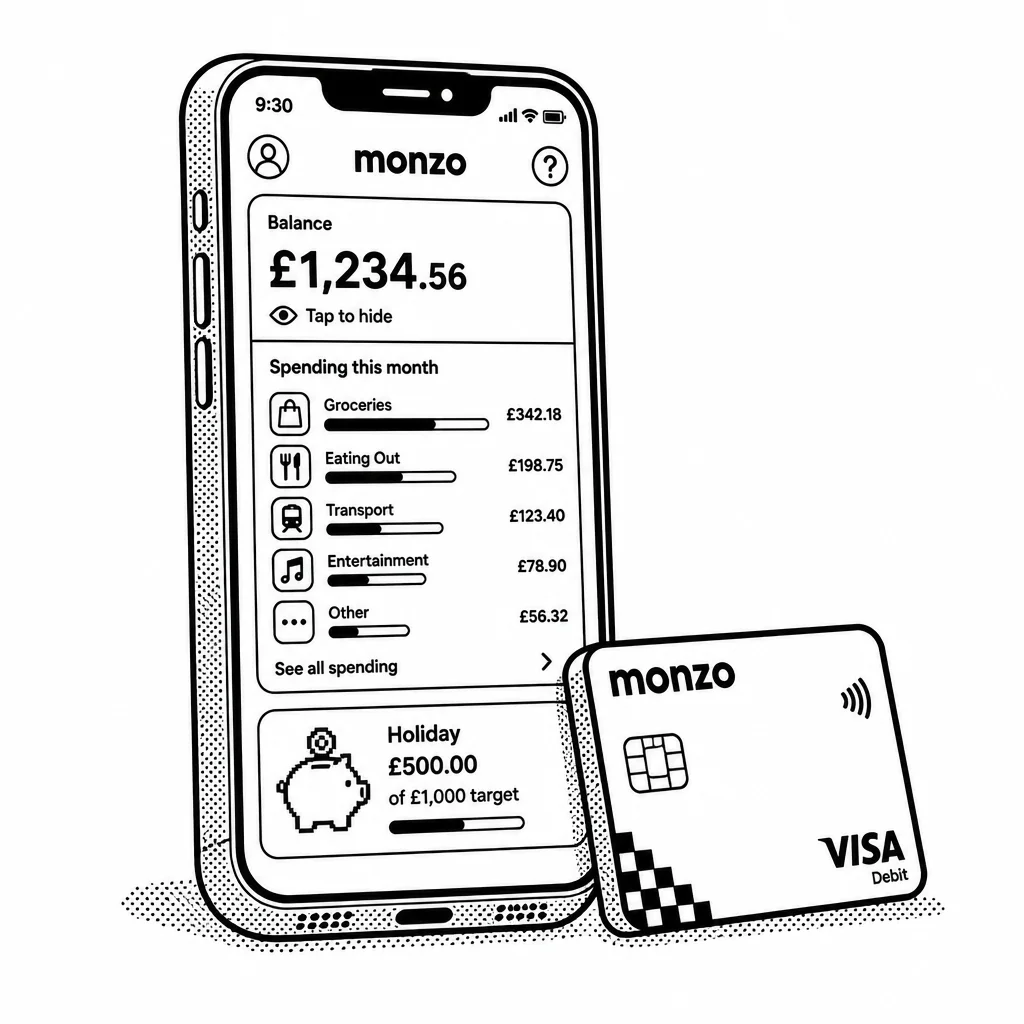
The pitch to customers is simple: big old banks felt clunky and expensive, so Monzo built something faster and friendlier. Its app shows spending instantly, sorts purchases into categories, and lets you set money aside in "pots" — little jars for rent, holidays, or a rainy day. That clarity is the hook. Customers stay because switching banks is annoying and Monzo makes the everyday stuff feel easy. It's a classic case of winning on user experience rather than on price, though its free account is competitive too. Monzo launched in 2015 and grew fast on word of mouth, but growth came with pain. It burned through cash for years and was investigated by the UK financial regulator over anti-money-laundering controls, which resulted in a fine in 2024. The turning point was finally reaching profitability: the bank reported its first full-year profit in the year to March 2024 and has kept growing since, with revenue climbing sharply as more customers take out loans and pay for subscriptions. Lending is now a serious part of the business, not just a side dish — and lending is where banks make real money, but also where they take real risk if borrowers stop paying.
Its main rivals are other app-first banks like Revolut and Starling Bank, plus the giant incumbents such as Lloyds Banking Group and NatWest Group, which have poured money into their own apps to stop customers leaving. Monzo's edge is a loyal, young customer base and a brand people actually like — rare for a bank. Its vulnerability is that switching is getting easier and the big banks are catching up, so it has to keep adding products people want, like loans, savings, and investing, to earn more from each customer rather than just signing up new ones. A US expansion is the long-term bet, but it's early days and expensive.
Saved answer · last researched 4 Nov 2026
BIG PICTURE
Monzo makes 70% of its money from interest, so it profits like a traditional bank
- 70% Interest income from deposits, loans and bonds
- 30% Fees from payments and subscriptions
Monzo is usually pictured as an app, but most of its income comes from the oldest trick in banking: the gap between what it pays savers and what it earns lending or parking money. Interest on deposits, loans and government bonds brought in 70% of revenue in the year to March 2026. Card fees and subscriptions made up the rest. Source: Foresight News, data from 2026
Timeline
A Bank That Lives on Your Phone
In 2015, Tom Blomfield and a small team started a bank called Mondo. His pitch was simple: banking was clunky and confusing, so he wanted a current account that sat on your smartphone and put you in charge of your money. It began small, with a prepaid card and a few thousand early users testing it out.
A Name Change to Monzo
The name Mondo turned out to be a problem, because another company with a similar name challenged it legally. So the team asked its customers to help pick a new one, and about ten thousand people sent in suggestions. The winner was Monzo, registered in the summer of 2016.
A Record-Breaking Fundraise
That same year, Monzo pulled off something remarkable: it raised a million pounds from its own customers through crowdfunding in just 96 seconds. It was the fastest campaign of its kind in history, and a sign of how much people believed in the idea.
The Full Banking Licence
For a while Monzo could only offer prepaid cards, not real bank accounts. That changed in April 2017, when it was granted a full banking licence, opening the door to proper current accounts. By that autumn the full current account had launched, and prepaid users were asked to switch over.
Monzo Heads to America
In 2019, Monzo announced it would try its luck in the United States, handing out a couple of thousand debit cards to early prospects. To get there it applied for a full US banking licence, working through a partnership with Sutton Bank.
A New CEO Takes Over
In 2020, founder Tom Blomfield stepped back from running the company day to day, moving into a president role, and TS Anil became CEO. Blomfield left the company entirely in early 2021, saying personal pressures had been made worse by the pandemic.
The US Licence Falls Through
American regulators made it clear the banking licence was unlikely to be approved, so Monzo withdrew its application in late 2021. The US business carried on without a licence, still working through Sutton Bank, and fully launched to the public in early 2022. The dream of an American bank stayed alive, but on shakier ground.
Monzo Turns a Profit
Years of spending finally gave way to something new in 2023: Monzo announced it had become profitable for the first time. The following year it reported its first annual profit of about 15 million pounds, a huge swing from the previous year's big loss. Revenue more than doubled as lending and savings products took off, and the company announced an office in Ireland to push into Europe.
The Board Ousts Its CEO
Success brought its own drama. The board pushed out CEO TS Anil, triggering a shareholder rebellion that demanded he be reinstated and called for the chair to go too. The board wanted to grow first and chase a listing later, while Anil was seen as fixated on racing to an IPO. Anil was set to stay on as a non-executive director, with former Google executive Diana Layfield taking the top job.
Monzo Leaves the US
In early 2026, Monzo announced it would exit the US market, choosing to focus on its core markets and grow faster in the UK and Europe. It had just secured a full banking licence from the Central Bank of Ireland and the European Central Bank, letting it expand into Ireland. Europe, not America, would be the growth engine now.
Monzo Buys Habito
Looking for new ways to grow, Monzo agreed to buy the online mortgage broker Habito, a company of about a hundred people. The plan was to fold mortgage advice and broking right into the mobile app. It was Monzo's first major acquisition, part of building an all-in-one superapp.
Britain's Largest Digital Bank
The results of this strategy showed up in the numbers. For the year to March 2026, Monzo reported pre-tax profits of about 87 million pounds, up 44%, on revenue up 39% to 1.7 billion. It added a record 3 million customers to reach 15.2 million, making it the UK's largest digital bank, with deposits up 55% to over 25 billion.
Nubank Walks Away
Rumours in late 2026 said Nubank might buy Monzo for 8 to 10 billion pounds, but Nubank's own shares fell about 10% on the news. On the last day of September, Nubank said it was not pursuing a deal, and the takeover path closed. Attention swung back to a London listing or selling a minority stake, leaving Monzo independent and profitable as it pushes into Europe.