Understand any stock in simple English
Enter a ticker to learn what the company does and how it makes money.
Stingray Marine Solutions AS
Stingray Marine Solutions makes laser-equipped underwater robots that kill sea lice on farmed salmon without chemicals or handling the fish.
Stingray Marine Solutions builds underwater robots that shoot sea lice with lasers. The customers are salmon farmers along the coasts of Norway, Scotland, and Chile, and what they buy is a way to keep their fish healthy without dousing them in chemicals or pumping them through expensive treatment machines.
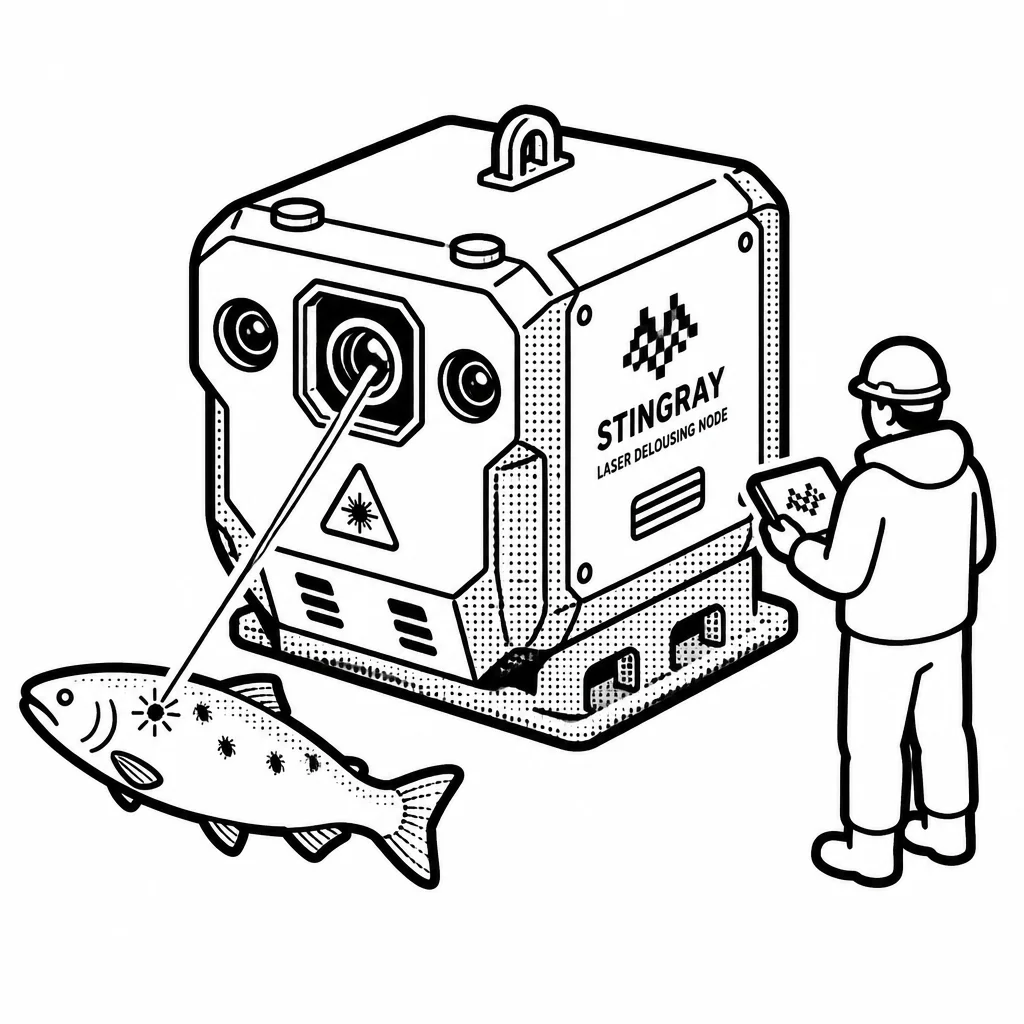
The problem it solves is one of the biggest headaches in salmon farming. Sea lice are tiny parasites that latch onto salmon, chew at their skin, and can eventually kill them — and a heavy lice load can force a farmer to harvest early or write off a crop. The old answers were medicated feed, chemical baths, or flushing the fish through warm water. Those are costly, stressful to the fish, and increasingly the lice evolve resistance to them. Stingray's answer is a robot that hovers over the net pen, tracks each fish with cameras and machine vision, and fires a low-powered laser at a louse while leaving the fish unharmed. It works around the clock without touching the fish, and the fish never leave the water. The company came out of the Norwegian research world around 2012, and it is a genuinely Norwegian story: Norway is the world's largest salmon producer, so a lice fix invented there has a huge home market. Stingray is privately held, and its machines are sold or leased to farmers rather than operated by Stingray itself. The business is tied to the health of the salmon-farming industry, which makes it cyclical in a sense — when salmon prices are high and farmers are expanding, demand for lice control goes up, and when regulators crack down on lice counts, the pressure to buy a solution goes up too.
The risk is competition. Other players sell chemical-free lice treatment, and the industry keeps testing new approaches. But the core appeal of Stingray's product is simple and hard to beat: it removes lice continuously, without stressing the fish, and without a chemical bill. For a farmer watching lice numbers and regulations, that is a tool that pays for itself in fewer lost fish and fewer emergency treatments.
Saved answer · last researched 10 Nov 2026
BIG PICTURE
Laser robots now patrol about 30% of Norway's salmon pens
- 30% Norwegian salmon pens using Stingray's laser systems
- 70% Pens without Stingray systems
Roughly three in ten Norwegian salmon pens now hold Stingray's laser robots, which spot sea lice on a fish and zap them without chemicals or handling. Norway farms most of its salmon in open pens, so that reach is the core of the business. Each pen pays for a system meant to keep lice counts down and fish healthier. Source: Paretosec, data from 2026
Timeline
Esben Beck's Basement Idea
Before Stingray existed, Esben Beck had a strange idea: use cameras and lasers to remove salmon lice from fish. He patented it in 2010, and in 2012 he incorporated the company in Norway, based in Oslo. It was a bold bet, built on years of tinkering that started back in his basement workshop in 1999.
First Paying Customer
In 2014 the idea became a real business when Sulefisk AS in Norway became the first paying customer. The system worked: it gently zapped lice off salmon without drugs or chemicals, giving fish farmers a new option. The concept was proven, but the world would take its time catching on.
Stingray Aqua Launched
As the laser business matured, Stingray spread its wings. It launched Stingray Aqua as a fourth business area, moving beyond delousing into customer support, biological monitoring, and research and development. What had been one clever machine was becoming a broader aquaculture partner.
Novo Holdings Buys In
Then came the big endorsement. Novo Holdings agreed to buy about 80 percent of Stingray, with management and employees keeping the rest. It was the first aquaculture technology bet for Novo's planetary health team, and the CEO called it a milestone that gave the company financial security and long-term backing for ambitious plans.
A Step-Change Year
With backing in place, the numbers exploded. Revenue jumped by nearly half a billion kroner to 831 million, and operating profit swung from negative to over 112 million. Production nearly doubled to 740 units, with more than 2,000 nodes in the sea. After ten years of grinding away, the CEO described it as a step-change, as the big players finally embraced the solution.
Revenue Passes a Billion
The growth didn't slow down. Revenue rose about 70 percent to 1.42 billion kroner, and operating profit tripled to 350 million. Production climbed past 1,250 units, with around 2,565 units installed at customer sites. To keep up, the company started building a 4,000-square-metre production facility.
New Chair for Expansion
With the business now running at scale, Stingray turned to its next chapter: going international. Kristin Skogen Lund was appointed Chair of the Board, with Karl Johan Lier joining the board to help drive expansion. The CEO said Novo ownership opened opportunities they could only dream of before.