Understand any stock in simple English
Enter a ticker to learn what the company does and how it makes money.
Dassault Systèmes SE
Dassault Systèmes makes the software that companies use to design, simulate, and manage products and factories before anything is physically built.
Dassault Systèmes sells software that lets companies design things in a virtual world before building them in the real one. If you have ever wondered how a new car, a jet engine, or a bottle of shampoo gets designed and tested without endless physical prototypes, this is one of the companies that makes that possible. Its core platform, called 3DEXPERIENCE, is a set of connected tools for modeling a product in three dimensions, simulating how it will behave, and managing all the data and people involved in making it.
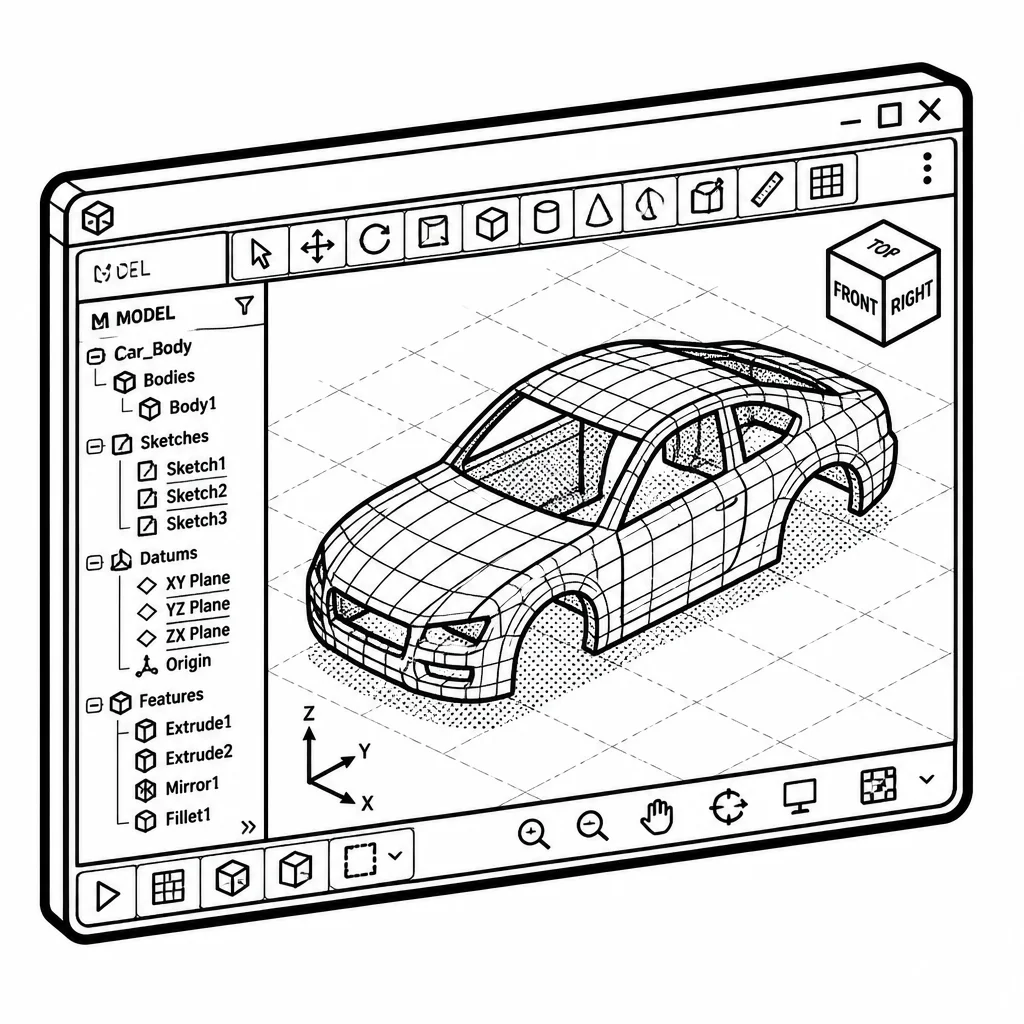
The business has two big engines. The first is software licenses and subscriptions: customers pay for the right to use tools like CATIA for design and SIMULIA for simulation. The second, and increasingly the important one, is recurring revenue from subscriptions and cloud services, where customers pay again and again instead of buying once. Its customers are engineers and manufacturers in serious industries — aerospace, automotive, industrial equipment, and life sciences — and they pay for software that is deeply woven into how they work. Switching away is painful, which is exactly why the business is so sticky. Planes and cars are not designed overnight, and once a company's engineering data lives inside this system, ripping it out is a huge, risky project. Dassault Systèmes is French and headquartered near Paris, but its reach is global. It is a major supplier to aerospace and automotive companies, and its software sits behind a lot of the engineering work done by Boeing, Airbus and many automakers. It competes with big engineering software players such as Siemens and Autodesk, and it is not cheap — the software is powerful and the customers are large. The company also pushes into life sciences, helping drugmakers and medical device firms manage their data and manufacturing, which is a newer growth area beyond its industrial roots.
The most interesting thing about the business is how it makes money: roughly recurring, subscription-heavy revenue that keeps coming back as long as customers keep designing and building things. That predictability is a real strength, and it lets the company keep investing in new products and buying smaller software firms to fill gaps. The flip side is that growth depends on big industrial customers having budgets and on the slow, steady adoption of cloud and simulation tools. It is not a flashy consumer business — it is a quiet toll booth on the world's engineering work.
Saved answer · last researched 10 Nov 2026
Timeline
Engineers Spin Off to Design in 3D
In 1981, a team of engineers split off from Dassault Aviation, the French planemaker, with a simple mission: design products in three dimensions on a computer. Planes were getting more complex, and the old drafting tools could not keep up. Their answer was CATIA, a flagship brand for computer-aided design, which they took to market through a worldwide sales and support deal with IBM. That pairing of deep engineering know-how with IBM's reach gave the young company a running start.
Dassault Systèmes Goes Public
By 1996 the company was ready to sell shares to the public, listing on both the Nasdaq and the Paris Bourse. Investors wanted in badly: the offering was oversubscribed many times over. It was a loud signal that the market believed in the business of designing things in 3D.
Buying SOLIDWORKS
A year later came the company's first big acquisition, SOLIDWORKS, which brought easy-to-use 3D modeling to a much broader audience. Until then Dassault's tools were built for the most complex products, like aircraft. SOLIDWORKS let the company serve simpler design work too, so it could meet customers at every level of complexity. The bet paid off: SOLIDWORKS grew into one of the leading CAD providers in the world.
The 3DEXPERIENCE Platform
In 2012 the company launched the 3DEXPERIENCE platform, a single hub where design, engineering, modeling and simulation all live together. It was billed as a fifth generation of the company's technology, less about drawing products and more about experiencing them. New brands like NETVIBES, GEOVIA and EXALEAD joined the fold around the same time.
MEDIDATA and a Move into Healthcare
With its purchase of MEDIDATA in 2019, Dassault Systèmes stepped into a brand-new world: life sciences and healthcare. The idea was to use clinical expertise and cloud tools to push toward personalized medicine and care built around the patient. It was a shift the company described as going from things to life, and healthcare became a cornerstone of its strategy.
Pascal Daloz Takes the Helm
In 2024, Pascal Daloz became chief executive, succeeding Bernard Charlès. Daloz was no outsider; he had joined back in 2001 and spent more than two decades working his way up. His job now is to steer the company toward what it calls the Generative Economy by 2040.
Industrial AI Becomes the Compass
At its Capital Markets Day in 2025, the company unveiled its biggest strategic shift yet, putting industrial AI at the center of everything. It introduced 3D UNIV+RSES, a next-generation offering that blends the virtual and the real, and set a goal of doubling earnings per share by 2029. The 3DEXPERIENCE platform was cast as the engine of the Generative Economy.
A Brutal Day on the Market
Then came a shock. After results published in February 2026, the stock fell more than 20% in a single session, its worst trading day on record. Revenue growth in the final quarter was barely 1%, and the guidance for the year ahead fell short of what investors expected. The plunge was part of a wider repricing of industrial software, as fears spread that AI could upend the traditional software business model.