Understand any stock in simple English
Enter a ticker to learn what the company does and how it makes money.
Bentley Systems, Incorporated
Bentley Systems makes software that engineers and construction firms use to design, build, and manage large physical projects like roads, bridges, water systems, and factories.
Bentley Systems sells software for people who build big things in the physical world. Its customers are engineers, architects, and construction firms working on roads, bridges, railways, water networks, power plants, and factories. The software helps them design a project in 3D, see how different pieces fit together, catch problems before construction starts, and then keep track of the finished asset for decades afterward.
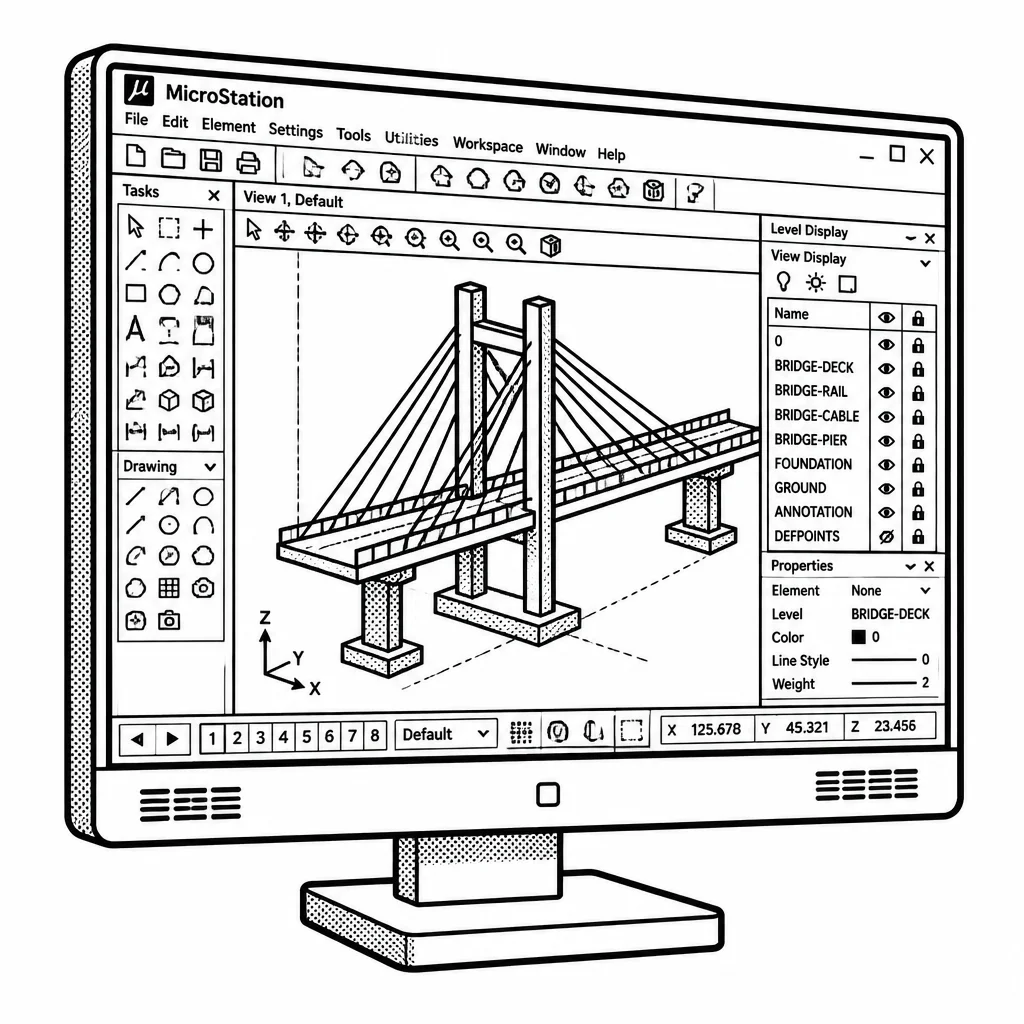
The business has two main parts. One sells design and modeling software, where an engineer builds a digital version of a bridge or a water plant and tests how it will work. The other connects that digital model to the real world — feeding in data from sensors and maintenance records so the owner of the asset can run it safely and fix things before they break. This second part is the faster-growing piece and the one Bentley talks about most, because once a road or a water system is built, somebody has to manage it for the next fifty years. Bentley's edge comes from being deeply embedded in engineering workflows that are slow to change. Its tools are the industry standard for certain kinds of infrastructure design, and switching would mean retraining whole teams. That gives it steady, subscription-style revenue and loyal customers. Its main rival is Autodesk, which is stronger in building design and media, while Bentley leans toward heavy civil and infrastructure work. It also competes with Trimble in construction technology and with smaller specialist firms.
The company is controlled by the Bentley family, whose roots go back to a road-building equipment business. It is based near Philadelphia and has been public since 2020. Bentley spends heavily on research and development and buys smaller software companies to fill gaps in its product line. Because most of its revenue is recurring subscriptions rather than one-time license sales, the business tends to be predictable — which is exactly what investors like about infrastructure software: the world keeps needing bridges, pipes, and power grids, and somebody has to design and maintain them.
Saved answer · last researched 9 Nov 2026
Timeline
Four Brothers Start Bentley Systems
In the early 1980s, engineers who wanted to work with computer-aided design drawings often had to sit at big, expensive graphics workstations. Keith Bentley, a programmer at DuPont, wrote software that let them use cheaper terminals instead. He joined his brother Barry's struggling chemistry-software startup, and the two saw that the CAD market was a much bigger opportunity. Along with brothers Scott and Ray, they launched Bentley Systems in 1984 and built MicroStation, the product their success would rest on.
ProjectWise Becomes the Delivery Tool
Bentley grew around the world, partly by buying up other software companies as revenue climbed through the late 1990s. One of those deals, the purchase of Finland's Opti Inter-Consult, brought in a product called TeamMate, which Bentley turned into ProjectWise. Launched in 1999, the project-delivery software became something close to a standard; today it is used by 46 U.S. state departments of transportation.
Bentley Files for an IPO
In 2002, Bentley took a step toward the stock market and filed for an initial public offering. It never happened. The company pulled the filing before it took effect and stayed private.
Siemens Buys a Stake
Years later, Germany's Siemens paid about $76 million for a minority stake in Bentley, a move tied to a coming public offering. Siemens also put money into building joint software with Bentley, deepening the partnership.
Bentley Goes Public
After decades as a private, family-led company, Bentley finally went public, raising roughly $237 million and valuing the business at about $4.96 billion. It was a new chapter for a firm that had once walked away from the public markets.
Seequent Joins Bentley
Bentley bought Seequent, a business that makes 3D models of what lies underground. The deal turned into a platform acquisition, a business that grew many times over under Bentley's ownership and now makes up more than a fifth of the company.
A Non-Family CEO Takes Over
Nicholas Cumins became CEO, with Greg Bentley moving up to Executive Chair. For the first time in its 40-year history, the top job went to someone outside the Bentley family. Cumins laid out a vision for resilient infrastructure, powered by AI-built digital twins focused on the phase when roads, bridges and water systems are actually running.
Bentley Buys Two Inspection Firms
Bentley closed the year by acquiring Talon Aerolytics and Pointivo Technology, adding AI-powered tools that inspect and analyze infrastructure. The deals brought no-code machine learning workflows for automated inspection insights, strengthening the company's asset analytics business.