Understand any stock in simple English
Enter a ticker to learn what the company does and how it makes money.
Casio Computer Co., Ltd.
Casio makes and sells watches, calculators, electronic dictionaries, musical instruments, cameras, and system equipment to retailers and distributors.
Casio is the Japanese company behind a strange and wonderful grab bag of everyday gadgets: cheap digital watches, scientific calculators, electronic dictionaries, keyboards, and cameras. If you have ever owned a $15 plastic watch with a stopwatch and an alarm, there is a good chance it was a Casio. The company sells these things to retailers and distributors around the world, who put them on shelves where shoppers pick them up.
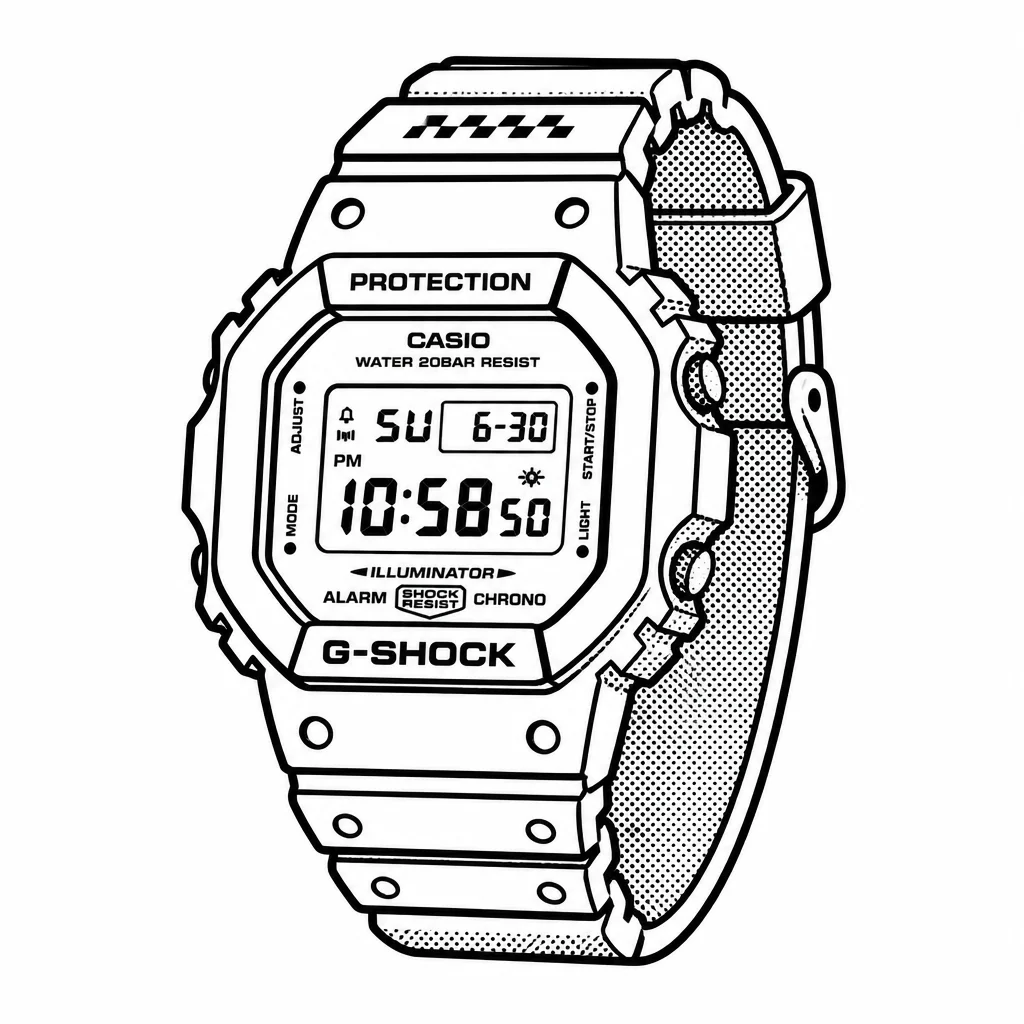
The heart of the business is a simple idea: make useful electronics that are sturdy, affordable, and just clever enough to feel like a small treat. Its G-Shock watches are the famous example—tough digital watches that survive drops, shocks, and water, sold in huge numbers. Calculators and electronic dictionaries are quieter cash cows, steady sellers to students and offices. Musical instruments, including digital pianos and keyboards, round out the lineup, along with cameras and system equipment like cash registers and handheld terminals for shops. Casio has been around since the 1940s and built its name on a string of firsts in calculators. That long track record helps it keep shelf space at big retailers, but it also means it competes in crowded, low-margin categories against much larger electronics makers. Watches are a fashion and hobby market as much as a tool market, and cheap calculators face pressure from phones.
What the company does well is turn ordinary items into products people trust. A calculator that lasts ten years, a watch that survives a construction site—those are small promises that customers keep coming back for. The business is not glamorous, but it sells millions of small, useful objects every year to people who want them to simply work.
Saved answer · last researched 14 Nov 2026
BIG PICTURE
G-Shock now makes up just 42% of Casio's watch sales as the cheaper Casio Watch line takes over
- 42% G-Shock share of Casio watch sales
- 58% Other Casio brands, led by Casio Watch
In the first quarter of 2026, G-Shock made up 42% of Casio's watch sales. That is down 2 percentage points from a year earlier, while the other brands, mostly the plain Casio Watch line, took the rest. It matters because watches are the business: timepieces brought in 185 billion yen of the group's 276 billion yen in the year to March 2026. Source: Vietnam.vn citing Nikkei, data from 2026
Timeline
Two Brothers Build a Business
After the war, Japan was short of almost everything, so Tadao Kashio started a tiny workshop outside Tokyo making gears and parts for microscopes. Money was tight, but his brother Toshio came up with a small winner: a cigarette holder you wore on your finger, which sold well enough to bankroll a much bigger idea.
The 14-A Changes the Math
The brothers used that money to build the 14-A, the world's first compact all-electric calculator. Instead of clunky gears, it ran on hundreds of electrical relays, and instead of a giant keypad it used ten number keys like the calculators we know today. It was quiet, desk-sized, and good enough that the brothers turned their workshop into a real company, Casio Computer, with their father as president.
Casio Goes Electronic
For a while Casio stuck with relay calculators, but when rivals started shipping electronic ones, it faced a simple choice: catch up or fade. Its answer was the 001, named to signal a fresh start from zero in the electronic age.
Casio Goes Abroad
The next move was to sell outside Japan. Casio built a calculator for overseas buyers, shipped to Australia, then opened offices in Switzerland, Germany, and the United States. That was the start of Casio as a global company rather than a Japanese one.
The Calculator You Could Program
The AL-1000 let people type in programs on the keyboard instead of rewiring the machine, and it cost only a little more than a normal calculator. It sold well in Japan, Europe, and North America, showing Casio could lead on clever engineering, not just price.
Casio Lists on the Tokyo Exchange
The company went public on the Tokyo Stock Exchange, and a couple of years later its shares moved up to the main section. Going public gave Casio a bigger stage and the capital to keep growing.
The Calculator in Everyone's Pocket
Casio's Casio Mini was the first personal electronic calculator, and it was cheap enough that ordinary people could buy one for themselves. It was a huge hit, selling more than ten million across the series and planting calculators in homes and offices everywhere.
The Watch That Wouldn't Break
Casio's next leap came from a simple frustration: watches were treated as fragile precision instruments. The G-SHOCK solved that by letting the inner workings float inside a hollow, jointed case, so drops and shocks didn't kill it. It became a global hit and grew into Casio's signature brand.
A Watch Business Reinvents Itself
After the first G-SHOCK boom faded, watch sales fell to a third of their peak and the business was barely breaking even. Yuichi Masuda pushed a bold shift: from digital to analog, from resin to metal, and from cheap wrist gadgets to proper watches. That gave Casio metal and hybrid G-SHOCKs plus new all-metal lines, EDIFICE and OCEANUS.
Casio Buys Into Education
Casio made the education company Libry a subsidiary, taking a majority stake as the first step of a large investment plan for alliances and acquisitions. The point was to combine Libry's apps with Casio's own classroom learning platform and squeeze more out of both.
A Ransomware Attack Hits the Numbers
A ransomware attack late in the year hurt sales and profit across every part of the business and forced the company to lower its forecasts. Even so, Casio kept its full-year operating profit target and expected things to get back to normal by the final quarter.
Casio Cuts the Extra Weight
Under its plan for 2030, Casio began shutting down or shrinking businesses that lost money and putting its resources behind consumer products. It announced it would stop new development of electronic dictionaries and scale back production and sales, after years of trimming the portfolio and reworking how the company ran itself.
Watches Carry Casio Back to Growth
The two-brand watch strategy, G-SHOCK and CASIO WATCH, finally paid off: the watch business reached a 21.5% operating margin in the first half. Casio raised its full-year outlook on strong global watch demand, and after all the restructuring, watches had become the engine pulling the whole company back to growth.