Understand any stock in simple English
Enter a ticker to learn what the company does and how it makes money.
Rippling People Center, Inc.
Rippling sells businesses one system to manage their employees — payroll, benefits, devices, and apps — all in one place.
Rippling is a software company that handles the boring but essential machinery of running a workplace: paying people, giving them health insurance, setting up their laptops, and controlling which apps they can log into. A company signs up, and Rippling becomes the single dashboard for hiring someone, onboarding them, running payroll, and shutting off their accounts when they leave. It sells mostly to small and mid-sized businesses, though it increasingly serves larger ones too, and it makes money by charging per employee per month for its software, plus fees when it acts as the official payroll processor or insurance broker.
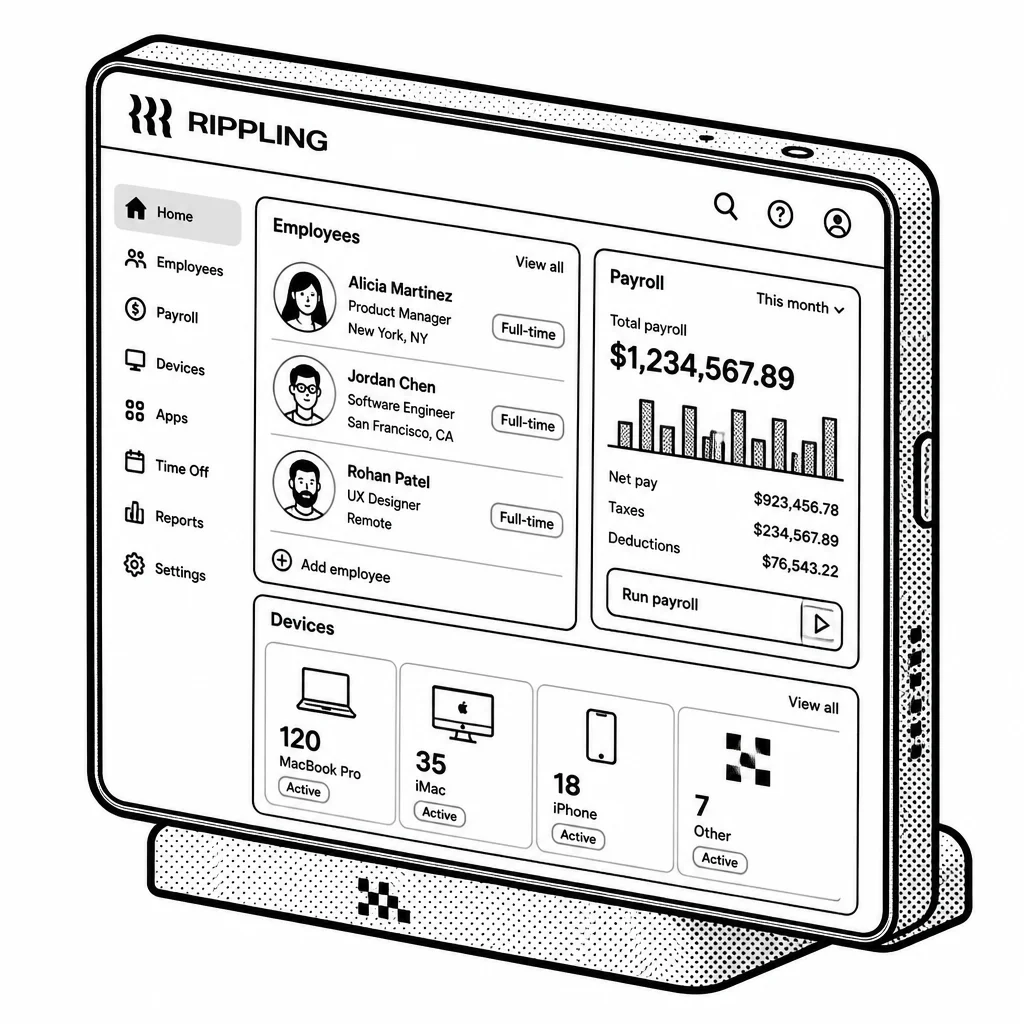
The clever part is that all these tools sit on one shared database of employee information. When you hire someone in Rippling, the same record can trigger their payroll setup, ship them a laptop, and grant them access to Slack and email — no re-typing the same details into five different systems. That single source of truth is Rippling's main selling point against a crowd of point solutions, and it lets the company keep bolting on new products: expense cards, spend management, recruiting, and even a corporate card. Rippling also acts as a "professional employer organization," meaning it can formally employ workers on a client's behalf so that small companies can offer big-company benefits.
The company was founded in 2016 by Parker Conrad, who had previously started Zenefits and was pushed out amid a compliance scandal. Rippling was his do-over, built deliberately with tight controls. It has grown fast and raised billions in venture capital, reaching a valuation above $13 billion in 2024. It competes with payroll incumbents like Automatic Data Processing and Paycom, HR platforms like Workday, and a swarm of smaller startups, and it has been aggressive about expanding abroad. The main risks are the crowded market, the cost of building so many products at once, and the fact that payroll is a business where a single mistake can cost a customer real money and trust.
Saved answer · last researched 4 Nov 2026
BIG PICTURE
When AI picks one best HR tool, Rippling takes the top spot 19 times; its next rival manages 6
- 11.7% Observations where Rippling ranked #1
- 88.3% Observations where another tool ranked #1
Ask ChatGPT, Copilot or Gemini for the single best HR software and Rippling comes back first more often than anyone else. It took the top slot in 19 of 163 tracked answers, more than three times as often as BambooHR, its closest rival. Searches like these now shape which payroll and HR systems small businesses even consider buying, so ranking first is another way Rippling gets in front of the people who pay it. Source: CiteWorks Studio, data from 2026
Timeline
Parker Conrad Starts Rippling
Parker Conrad had already built a payroll company called Zenefits, and then lost it after compliance problems forced him out. He started Rippling in San Francisco with Prasanna Sankar and a simple idea: most companies buy a pile of separate tools for HR, IT and payroll, and those tools don't talk to each other. Rippling would keep one shared layer of employee data and run all of it from one place, so when a person gets hired or leaves, everything updates at once.
First Customers and Fast Growth
Rippling went live with customers in 2018 and grew its subscription revenue by roughly 20% every month for its first eight months — a pace most startups never see. It then sped up even more, to about 25% and then 29% a month, which showed the one-platform idea was actually catching on.
A Big Series A
In 2019, Kleiner Perkins led a $45 million Series A round at a $270 million valuation, which was unusually large for a company at that early stage. The money went into engineering and research, betting that a better product could beat the older, bigger competitors.
A $6.5 Billion Valuation
By 2021, with Sequoia joining, Rippling raised a $250 million Series C at a $6.5 billion valuation — a giant leap from that first round two years earlier.
Payroll Saved in Twelve Hours
When Silicon Valley Bank collapsed in 2023, Rippling raised a $500 million Series E in just 12 hours, because more than 55,000 employees were set to be paid that Friday and hundreds of millions in payroll money was tied up. It was a practical emergency move, and also a kind of redemption for Conrad, whose earlier company had been undone by money-handling failures.
A $13.5 Billion Valuation
Rippling raised a $200 million Series F led by Coatue in 2024 at a $13.5 billion valuation, bringing total funding to $2 billion. The round came right after its annual recurring revenue more than doubled to over $350 million, even though the company was still burning about $100 million a year.
Past $1 Billion in Revenue
In 2025, Rippling crossed $1 billion in annual recurring revenue and closed a $450 million Series G at a $16.8 billion valuation. It launched Rippling AI, which runs directly on the company's organized employee data and can take actions across the connected systems, and Conrad called it the most successful launch the company had ever had, with revenue growing 78% year over year.
Rippling Sues Deel
Also in 2025, Rippling sued competitor Deel, claiming Deel planted a spy to steal confidential information, and Deel countersued with similar claims. The fight stayed tight, with Deel's funding valuation still ahead of Rippling's most recent one.