Understand any stock in simple English
Enter a ticker to learn what the company does and how it makes money.
Gusto, Inc.
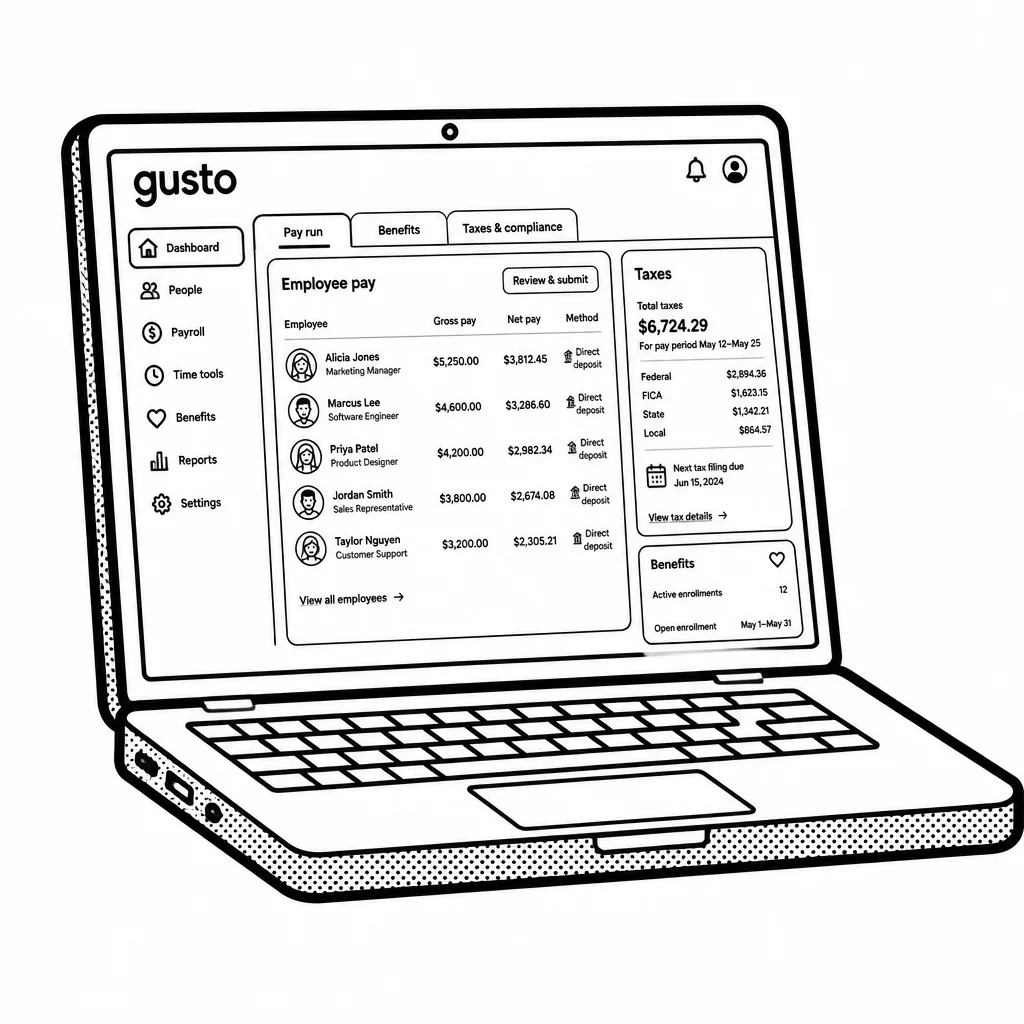
Gusto sells cloud software that handles payroll, benefits, and HR paperwork for small businesses.
Gusto is a software company that takes the headache out of paying people. When a small business hires its first employees, it suddenly has to calculate paychecks, withhold the right taxes, file forms with the government, and offer things like health insurance. Gusto bundles all of that into one friendly web app. A restaurant owner or a two-person design shop can run payroll in a few clicks, and Gusto quietly handles the tax math and government filings in the background.
The company makes money by charging a monthly subscription, with tiers that add more features as a business grows, plus a per-person fee on top. It earns extra revenue when customers use it to buy workers' compensation insurance or to administer health benefits and retirement plans, where Gusto acts as the middleman and takes a cut. Its customers are small businesses, generally those with fewer than a hundred or so employees, and the pitch is simple: you are not an HR department, so rent one instead of building one. Gusto was founded in 2011 as ZenPayroll by Joshua Reeves, Tomer London, and Edward Kim, and it rebranded to Gusto in 2015 as it expanded beyond payroll into benefits and HR. It is a private company based in San Francisco, backed by venture capital, and it has grown into one of the better-known names in small-business software. Its main rivals are other payroll and HR platforms chasing the same small customers, including Paycom, Paylocity, and Intuit, whose QuickBooks payroll sits close to the accounting tools many small firms already use.
The business is sticky in a quiet way. Switching payroll providers is annoying, and once a company's employee and tax records live inside Gusto, leaving takes real effort, which gives it steady recurring revenue. The flip side is that this is a crowded, price-sensitive market, and the biggest threat is not a rival product but the slow grind of small businesses failing or staying tiny. Gusto's bet is that as its customers add employees, they grow into bigger, more valuable subscribers without Gusto having to win them twice.
Saved answer · last researched 4 Nov 2026
Timeline
Three Founders Start ZenPayroll
In 2011, Joshua Reeves, Eddie Kim and Tomer London started a company called ZenPayroll from a house in Palo Alto — Kim even moved into a closet there. All three came from immigrant families, and they wanted to make payroll and HR simple for small business owners like their parents, leveling a playing field that had always favored big companies. They believed in the idea so much that they didn't pay themselves until the product could run their own payroll.
ZenPayroll Launches in California
The company joined Y Combinator's Winter 2012 batch and raised $6.1 million, the biggest seed round a YC startup had ever seen at the time. That December, the service officially launched in California. One of its first customers, Farmgirl Flowers, was stunned when the founders showed up at a flower market to set up payroll for a single employee — a small sign of how far they would go for small businesses.
One Million in Revenue
By 2014, ZenPayroll had reached $1 million in revenue from about 5,000 customers, proof that the business was real and could win customers without burning piles of cash. It was also an emotional moment: the founders no longer knew every customer by name.
ZenPayroll Becomes Gusto
In 2015, the company changed its name to Gusto and widened its focus beyond payroll, adding health benefits and workers' compensation into the same software. The rebrand marked the shift from a single payroll tool to a one-stop shop for payroll, benefits and HR.
Gusto Becomes a Unicorn
That same year, Gusto raised $50 million and hit a $1 billion valuation, making it a unicorn — a private startup worth more than a billion dollars.
A Bigger Round and a New York Office
In 2019, Gusto raised $200 million at a $3.8 billion valuation, and it opened its third office, in New York City.
A Nine-Billion-Dollar Bet on Going Public
In 2021, Gusto announced a $175 million funding round led by T. Rowe Price at a $9.5 billion valuation, ahead of a possible IPO the following year. CEO Josh Reeves made the goal clear: Gusto would go public rather than sell itself to a bigger company.
Gusto Goes Global with Remote.com
In 2023, Gusto partnered with international payroll provider Remote.com to soon offer payroll in more than 75 countries, a move aimed at beating rivals like Rippling as remote work spread. The company said it had no plans to raise more outside money, with its eyes on an IPO and revenue at $500 million.
Gusto Buys Guideline
In 2025, Gusto announced it would buy Guideline, a 401(k) provider for small businesses, for about $600 million — its largest acquisition ever. Gusto had offered retirement plans through Guideline since 2016, and as states began requiring employers to offer retirement plans, it decided to bring them in-house.
Gusto Passes a Billion in Revenue
By early 2026, Gusto had passed $1 billion in yearly revenue, with more than 500,000 small-business customers and five straight quarters of accelerating growth. It bought Mosey, a multi-state compliance startup, to power a new compliance offering, and AI now writes half of its new code and handles about half of customer support cases. All of that left Gusto well positioned for a fundraise or an IPO.