Understand any stock in simple English
Enter a ticker to learn what the company does and how it makes money.
Deel, Inc.
Deel helps companies hire and pay workers in other countries without setting up local offices there.
Deel is a software company that handles the boring but risky parts of hiring people around the world. If a company in New York wants to hire an engineer in Brazil, it usually needs a legal entity in Brazil, local payroll, tax filings, and someone who understands Brazilian labor law. Deel sells all of that as a service. Employers sign a contract with Deel, Deel signs a local contract with the worker, and Deel pays the worker on time in their own currency while handling taxes and compliance.
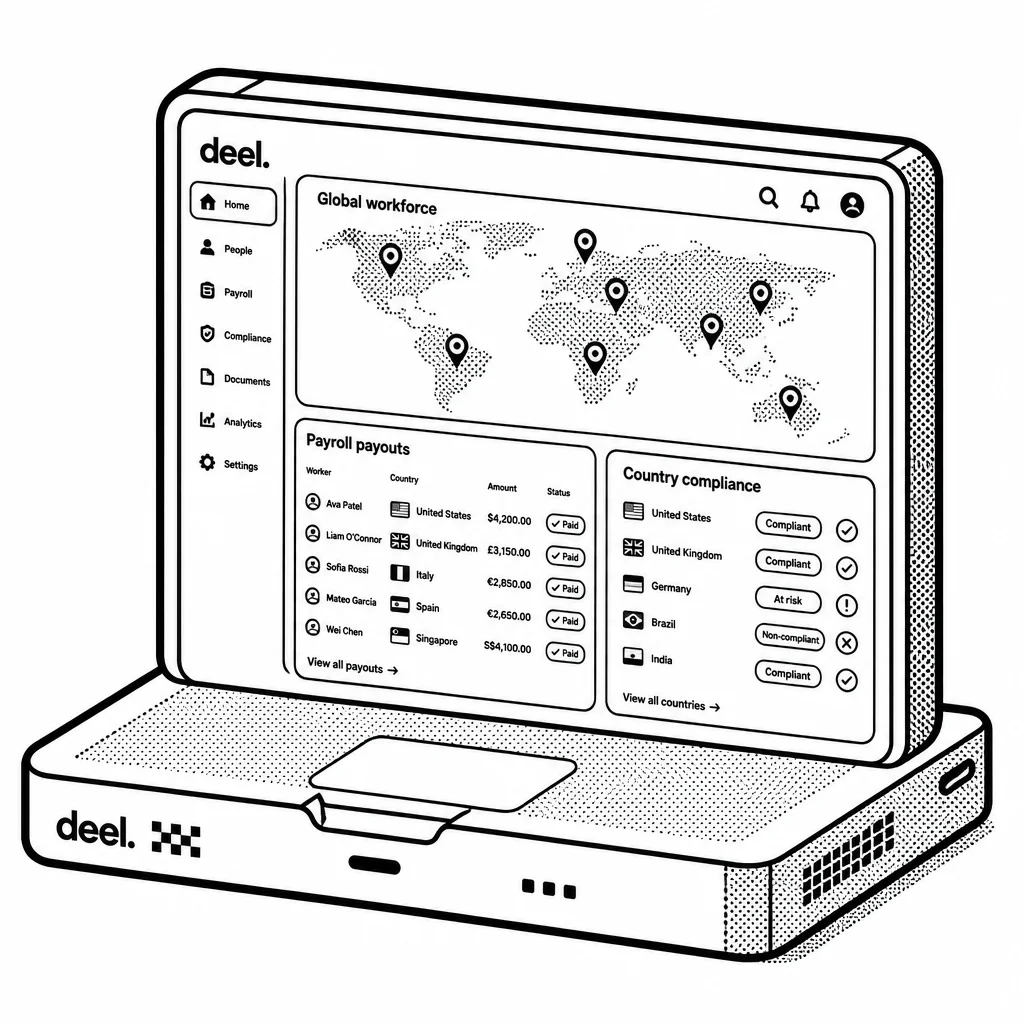
The pitch is simple: instead of spending months and piles of money setting up a legal entity in every country, a company can flip a switch and hire there. Deel makes money by charging a fee per worker per month for that "employer of record" service, and it also sells its own payroll software for companies that already have local entities and just want a better system to run pay. It offers contractor management too, so a business can pay freelancers in many countries and keep the paperwork straight. Customers choose Deel over rivals like Remote or older payroll firms because it is fast, works in many countries, and lets a finance team see everything in one place. The company was founded in 2019 by Alex Bouaziz and Shuo Wang, and it grew explosively during the remote-work boom. Revenue reportedly crossed $1 billion in annual recurring revenue in 2025, a remarkable climb for a company only a few years old. It has raised billions from investors and bought other businesses to widen its product, including payroll and HR tools. Deel is private, so its shares do not trade on an exchange, and its finances are not public the way a listed company's are.
That speed brings real risks. Deel has faced lawsuits and public accusations over its past compliance practices, including a dispute with a competitor, and regulators in the employer-of-record industry have grown more watchful. Its core business also depends on a patchwork of local laws, so a change in one country can ripple through many customers. Still, the basic idea is powerful: global hiring used to be a legal headache, and Deel turned it into a subscription.
Saved answer · last researched 4 Nov 2026
BIG PICTURE
21% of young Singapore workers want to work abroad within 10 years
- 21% Young Singapore workers who see overseas work as a 10-year goal
- 79% Young Singapore workers without that goal
Among Singaporeans aged 18 to 29, 21% say working in another country is a goal for the next decade. Deel sells the machinery for exactly that move: a company can hire someone abroad without opening an office there. When young workers already picture themselves leaving, the paperwork and payroll rules that Deel handles become the thing standing between them and the job. Source: Deel study, What Gen Z Workers Want 2026 – Singapore (with YouGov and ThinkerTank), data from 2026
Timeline
Two Founders and a Hiring Problem
Alex Bouaziz and Shuo Wang met at MIT, and like a lot of founders they first built the wrong thing: a tool to hold money safely between clients and freelancers across borders. The real problem showed up when they tried to hire people in other countries for their own ventures and found it nearly impossible to do legally. So they switched to building what they needed themselves: paperwork, contracts, tax forms and payments that let a company hire someone anywhere without opening an office there.
Deel Joins Y Combinator
Getting into Y Combinator's winter batch in 2019 gave the founders their first outside money and, more importantly, a clearer pitch: a platform to hire and pay contractors and employees anywhere without setting up local companies. That story worked. It led straight to a seed round and then a much larger investment led by Andreessen Horowitz, which gave Deel the money to grow fast.
Deel Buys Zeitgold
With fresh funding in hand, Deel made its first acquisition: Zeitgold, a German payroll and bookkeeping company. It brought in software that automated payroll and helped independent contractors handle setup, bookkeeping and taxes, and it set the pattern for a long run of buying companies rather than building everything from scratch.
Eleven Companies in One Year
The buying spree got serious. By the end of 2024 Deel had scooped up eleven companies, including Paygroup, PaySpace, Hofy and the payroll division of Safeguard Global. Each deal added something Deel could own and run itself, from African payroll to managing laptops for remote workers, and pushed it into new markets and products.
Rippling Lawsuit
In March 2025 rival Rippling sued Deel, accusing it of corporate espionage; Deel denied it and fired back with its own claims that Rippling stole its employer-of-record product. The fight escalated, with reports of a US criminal investigation and Deel suing Rippling over espionage. Two companies selling similar tools to the same customers were now fighting in court as much as in the market.
Deel Passes $1 Billion
In the first quarter of 2025, Deel crossed a billion dollars in annual revenue, growing 75 percent from the year before and getting there faster than most high-growth tech companies. The contractor-hiring tool had become a big payroll and HR platform.
A $17 Billion Valuation
In October 2025 Deel raised $300 million from investors led by Ribbit Capital and Andreessen Horowitz, valuing it at about $17 billion. Soon after, it brought in a former Intuit executive as President and CFO, a classic sign a company is getting ready to go public — something the CEO had already said could happen in 2026 or later.
Deel Buys Clarity
Deel's fifteenth acquisition was Clarity, an Israeli cybersecurity firm using AI to verify identity and spot deepfakes during hiring. The deal came as Deel announced it had passed $1.5 billion in annual recurring revenue in the first half of 2026, and Clarity's team and technology were folded into the platform.
Deel AI Launches
At its 2026 customer event, Deel unveiled Deel AI and a set of AI agents that handle hiring, onboarding, payroll, IT and compliance on their own, with Deel HR pitched as a single AI-native home for all workforce data. By then more than 40,000 companies across over 150 countries were using the platform.