Understand any stock in simple English
Enter a ticker to learn what the company does and how it makes money.
Richard Mille Group
Richard Mille makes very expensive luxury watches and sells them to wealthy buyers around the world.
Richard Mille makes luxury watches — the kind that cost as much as a house and are worn by billionaires, elite athletes, and celebrities. The watches are famous for looking like nothing else: open-worked faces where you can see the movement inside, tonneau-shaped cases, and materials borrowed from aerospace and racing, like titanium, carbon composites, and sapphire. People don't buy one to tell the time. Their phone does that. They buy one as a status symbol, a piece of mechanical art, and a membership card to a very small club.
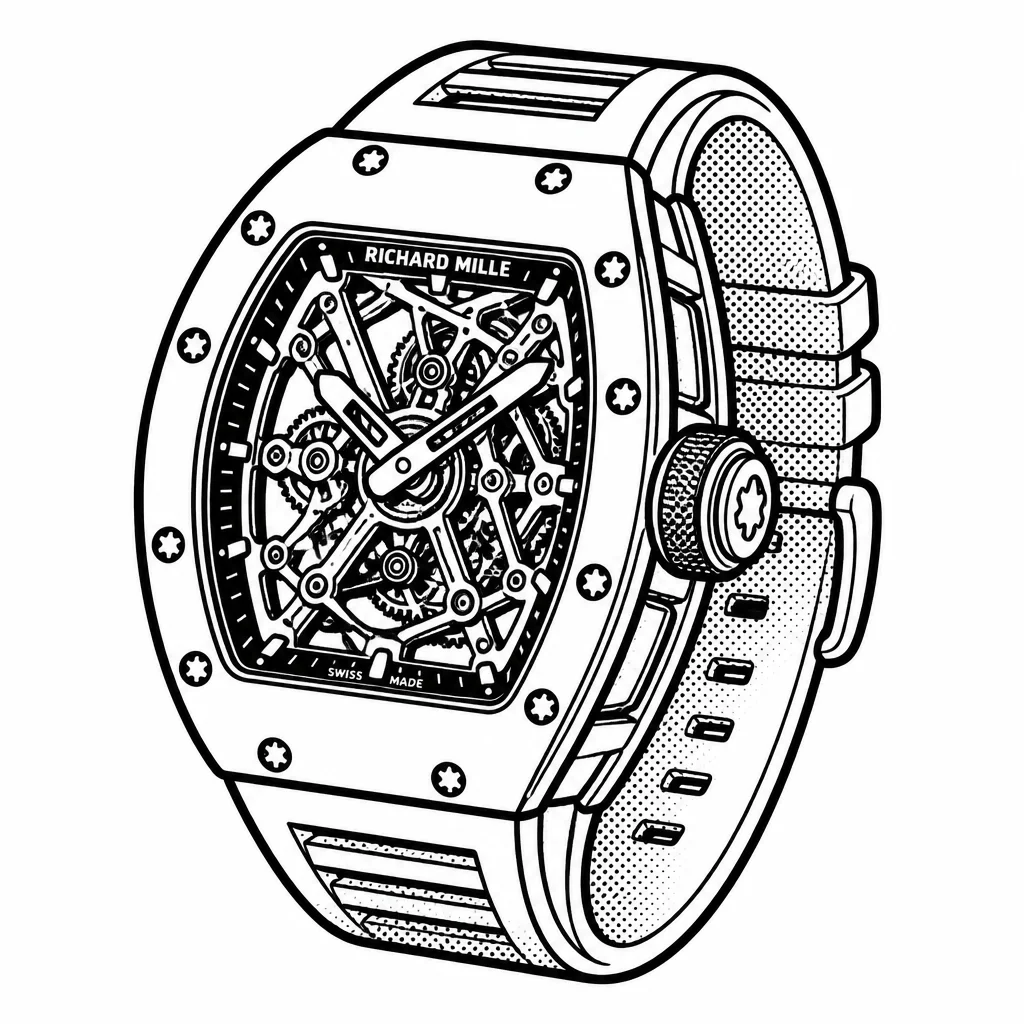
The company sits in Switzerland, the historic home of fine watchmaking, but it is a young brand — founded in 2001 by Dominique Guenat and Richard Mille, who had spent years in the watch business before starting his own house. The pitch from day one was extreme: watches built like race cars, priced from the low six figures up into the millions, made in small numbers. It worked. Richard Mille became one of the few modern watch brands to break into the top tier alongside old houses like Audemars Piguet (private) and Patek Philippe (private), and it did so without a century of history behind it. The business model is simple and brutally profitable. Richard Mille produces a limited number of watches each year and sells them through a small network of authorized dealers and its own boutiques in wealthy cities. Because supply is deliberately kept below demand, many models sell out and trade above retail on the secondary market — which keeps the brand hot and makes owners feel smart. The company also leans hard on sports marketing: it sponsors Formula 1 teams and drivers, tennis stars like Rafael Nadal, and Olympic athletes, putting its watches on wrists in front of exactly the customers it wants. Most of those partnerships are with individuals and teams rather than listed companies, so the brand-building runs through private deals and race sponsorships rather than public corporate partners.
The group is privately held and does not publish detailed financials, but it is consistently described as one of the most profitable watchmakers in Switzerland, with revenue in the billions of Swiss francs and margins that rival the best in luxury. That cash funds new boutique openings, research into exotic materials, and expansion in Asia and the Middle East, where demand for high-end watches has grown fastest. The vulnerability is the same as the strength: a business built on scarcity and status depends on staying desirable. If wealthy buyers ever fall out of love with the brand, or if a recession hits luxury spending hard, there is no cheaper mass-market product to fall back on.
Saved answer · last researched 15 Nov 2026
BIG PICTURE
Richard Mille sells about 5,900 watches a year yet holds 3.2% of the Swiss watch market
- 3.2% Richard Mille's share of the Swiss watch market
- 96.8% The other 96.8% of the Swiss watch market
Richard Mille built a top-six Swiss watchmaker on tiny output: roughly 5,900 watches a year brought in 1.54 billion Swiss francs. Rivals above it sell many times more watches for similar money. Audemars Piguet moved 51,000 pieces for 2.38 billion francs, Patek Philippe 72,000 for 2.30 billion. The brand earns its place by charging enormous prices per watch, not by making many. Source: Morgan Stanley and LuxeConsult watch market report, data from 2024
Timeline
Two Friends Plan a Watch Brand
In 1999, Richard Mille walked away from his job as general manager at Mauboussin after a fight over how the business should be run. He took his ideas to a friend, Dominique Guenat, who owned a watchmaker called Montres Valgine. Together they drew up plans for a new brand, backed by Guenat's company and the watchmaker Audemars Piguet, with one goal: break the old rules of high-end watch design.
The First Richard Mille Watch
The brand's first watch, the RM 001 Tourbillon, came out in 2001, and only 17 were made. People noticed two things right away: the wild price of about $135,000 and the unusual materials, like titanium, along with a 72-hour power reserve. The price sat above Patek Philippe, and when people asked why, Mille said he wasn't competing with Patek Philippe or anyone else.
Richard Mille Starts Making Its Own Cases
For years, a supplier called Donzé-Baume made the brand's watch cases. When Richemont bought that supplier, Richard Mille had a problem: it no longer controlled a key part of its own product. So the company started machining its own cases and some components, with ProArt helping as a subcontractor.
Saying No to Kering
In 2013, the French luxury group Kering, then known as PPR, offered to buy just over half of Richard Mille. The deal would have valued the company at hundreds of millions of Swiss francs. Mille said no. He wanted the brand to stay independent, and that choice shaped everything that came after.
Leaving Geneva, Opening New York
The brand pulled out of the big Geneva watch fair, the Salon international de la haute horlogerie, after the 2018 edition. Instead of relying on that stage, it went its own way. That same year, in October, it opened its sixth and largest United States store in New York.
Closing the Moscow Boutique
In 2022, Richard Mille temporarily shut its boutique in Moscow, as luxury brands pulled back from Russia after the invasion of Ukraine.
A Business Passed to the Next Generation
By 2024, most of the roughly 5,900 watches the brand made each year came from its own Les Breuleux manufacture, with Vaucher and Audemars Piguet's Le Locle site making the rest. The company is not for sale. It has passed to the next generation of both founding families, with Alexandre Mille as Commercial Director and Maxime Guenat as Manufacture General Director.
A Billion-Franc Watch Brand
By 2025, Richard Mille's global revenue reached an estimated 1.75 billion Swiss francs, up from about 1.54 billion the year before. It stayed the world's sixth-largest watch brand, with a small slice of the market and only about 5,950 watches sold. The average retail price climbed to nearly 294,000 francs. That restraint was the point: by making few watches and holding prices steady, the brand built a moat of scarcity, with only about 70,000 watches made in its first 20 years.