Understand any stock in simple English
PIMCO Corporate & Income Opportunity Fund
A closed-end fund that pools investor money and invests it in bonds and other fixed income securities to pay monthly income while also aiming for capital appreciation.
This is a closed-end fund — a pooled investment vehicle that raises money once from investors and then trades on the New York Stock Exchange like a stock. An investor buys shares, and the fund's managers use that money to build and run a portfolio of bonds and other fixed income securities. That's the basic arrangement: you own a slice of a professionally managed bond portfolio, and you can buy or sell your slice any trading day.
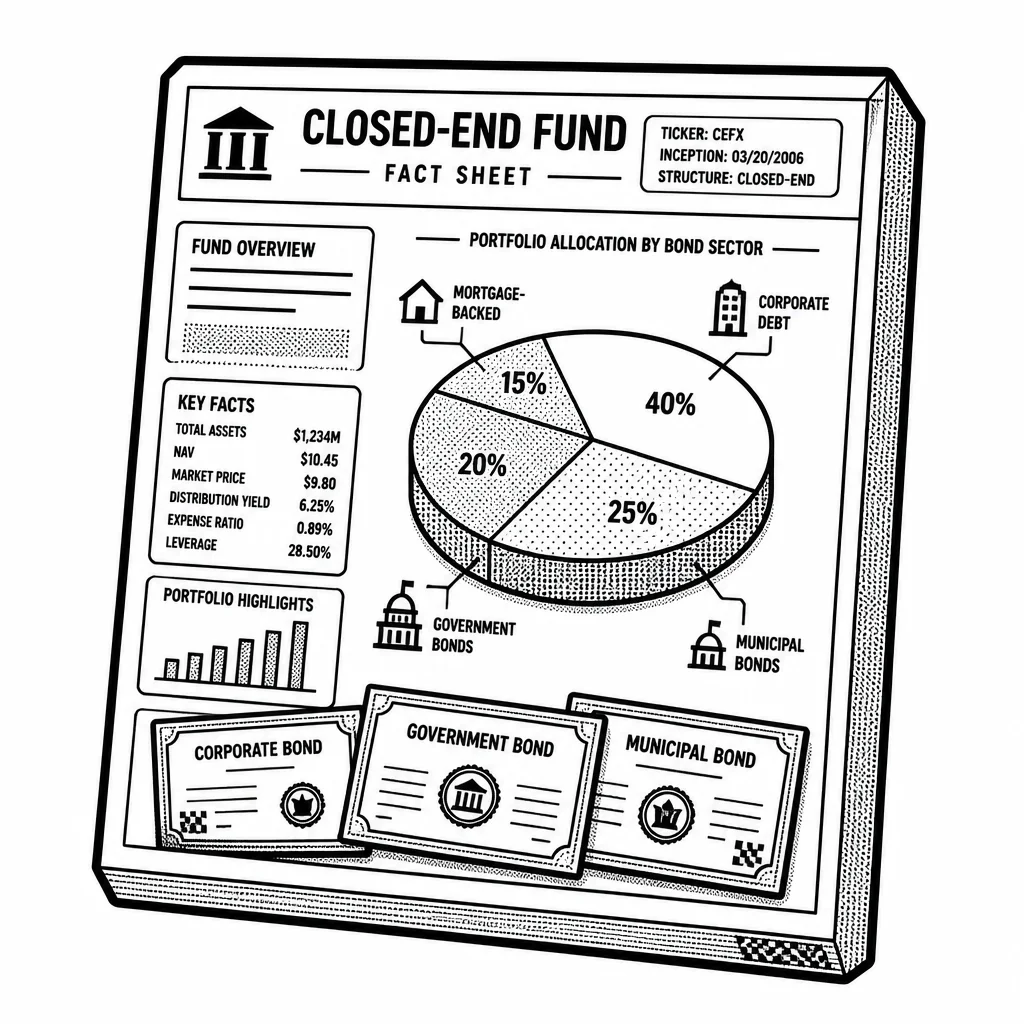
The portfolio spans global fixed income sectors, which is a fancy way of saying it holds debt from many different corners of the world and many different kinds of borrowers. It can own corporate bonds, mortgage-backed securities, government debt, and other credit instruments. The fund's stated goal is maximum total return, meaning it wants to deliver both current income — the interest and distributions that flow from the bonds — and capital appreciation, which is the chance that the bonds rise in value or the fund earns more than it pays out. The money comes from the fund's own investments. Bond interest and other income are collected and distributed to shareholders, typically monthly, and the fund can supplement those payouts through its trading and credit strategies. Investors choose it because it offers a way to own a diversified, actively managed bond portfolio without buying individual securities, and it can use leverage — borrowing — to try to amplify returns, which also amplifies risk. It is managed by PIMCO, one of the largest fixed income managers in the world.
Closed-end funds have a quirk worth knowing. Unlike open-end mutual funds, the share count is fixed, so the price on the exchange can drift above or below the actual value of the underlying bonds. That premium or discount is a real part of what an investor experiences. Management is paid a fee for running the fund, which comes out of the assets. The fund's performance, then, depends on the bond market, on the managers' credit calls, and on the cost of the leverage they use — a steady income engine when credit markets are calm, and a bumpier ride when they are not.
Saved answer · last researched 17 Nov 2026
Timeline
PIMCO Launches a Bond Fund
In 2002, PIMCO and its parent Allianz started a closed-end fund that lent money to companies through bonds. It focused on middle-quality corporate debt — the kind rated just above and just below investment grade — with middle-length maturities. The idea was simple: collect interest from a wide spread of companies and pass most of it to shareholders. For years, that quiet formula was the whole story.
The Fund Reaches for Riskier Loans
Then, in 2026, the fund changed its mission. It widened its strategy to make and buy many more kinds of loans, including loans to subprime borrowers and to companies abroad. Soon after, it was allowed to invest without limit in bonds that had already gone bad. In plain terms, the fund chose to chase higher yields by taking on much higher risk.
The 80% Rule Gets Loosened
The board also loosened the fund's main rule. It had to keep most of its money in corporate debt, but now it could count a broader mix of income-producing investments — even from non-corporate issuers — toward that target. That quietly opened the door beyond the corporate bonds the fund was built on.
A Yield That Earnings Couldn't Cover
The riskier path soon showed its cost. The fund was downgraded to a hold as interest rate risk rose and its earnings fell short. It was paying out a huge yield it could not fully earn, which raised the odds of a distribution cut and a shrinking net asset value. The fund even traded below the value of its own holdings — a rare discount that told investors the worries were real.