Understand any stock in simple English
PIMCO Dynamic Income Fund
A closed-end fund that invests in global debt and other income-producing securities to pay investors regular income.
PIMCO Dynamic Income Fund is a closed-end fund, which is a pooled investment that trades on the New York Stock Exchange like a stock. Investors buy shares to get regular monthly income, not to own a piece of a business. The fund raises money once in an initial offering, then uses that capital to buy a wide mix of bonds and other income-producing securities from around the world. Because it is "closed-end," the number of shares stays mostly fixed — you buy them from other investors on the exchange, not from the fund itself.
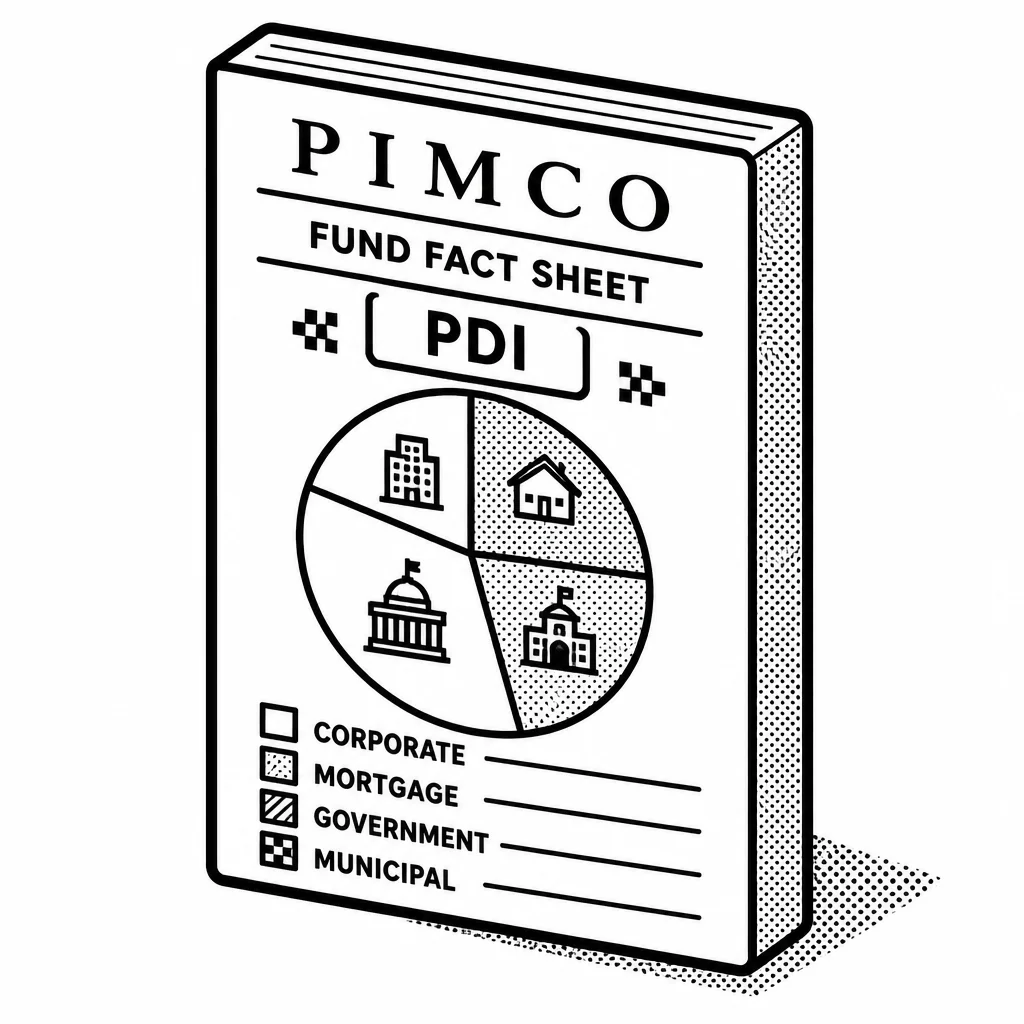
What the fund actually holds is the interesting part. It hunts for yield in places plain vanilla bond funds often skip: corporate bonds, mortgage-backed securities, emerging-market debt, and other credit instruments. The manager, PIMCO, is one of the largest fixed-income investors in the world, so the fund leans on that bond-picking muscle. The fund also uses leverage — borrowed money — to amplify returns, which is a key reason it can pay a big distribution but also a key reason its share price can swing hard. Here is how the money works for an investor. You own shares; the fund collects interest and other income from its bonds; it pays you a monthly distribution. The catch is that a fat distribution is not the same as a fat total return. If the fund's investments fall in value, or if it pays out more than it earns, part of your "income" can effectively be your own capital coming back to you. That is why the fund's price on the exchange can drift away from the value of its underlying holdings — sometimes trading at a premium, sometimes at a discount. Investors who buy at a discount get more assets per dollar; those who buy at a premium pay extra. The fund is a tool for income-focused investors who want professional bond management and monthly cash flow, and who can stomach the risks that come with leverage and credit exposure. It is not a savings account. Interest-rate moves, credit defaults, and leverage all hit the fund's value, and its distributions can change. PIMCO earns a management fee for running it, and that fee comes out of fund assets — a detail worth checking, because fees quietly eat into returns over time.
The bigger picture: PIMCO Dynamic Income Fund sits inside a family of PIMCO closed-end funds that have been popular with retirees and yield-seekers. Its appeal is simple — a team of professional bond traders hunting for income around the world, packaged into a monthly paycheck. Its vulnerability is equally simple — when credit markets get rocky or rates jump, a leveraged bond fund feels it fast.
Saved answer · last researched 17 Nov 2026