Understand any stock in simple English
Enter a ticker to learn what the company does and how it makes money.
Caris Life Sciences, Inc.
Caris Life Sciences runs lab tests on cancer tumors to help doctors pick the right treatment for each patient.
Caris Life Sciences is a cancer testing company. When someone is diagnosed with cancer, doctors often need to know what is actually driving the tumor — which genes are mutated, which proteins are switched on, what the tissue looks like under a microscope. Caris takes a sample of the tumor and runs it through its labs, then hands the doctor a report that tries to answer one question: what is the best treatment for this specific patient?
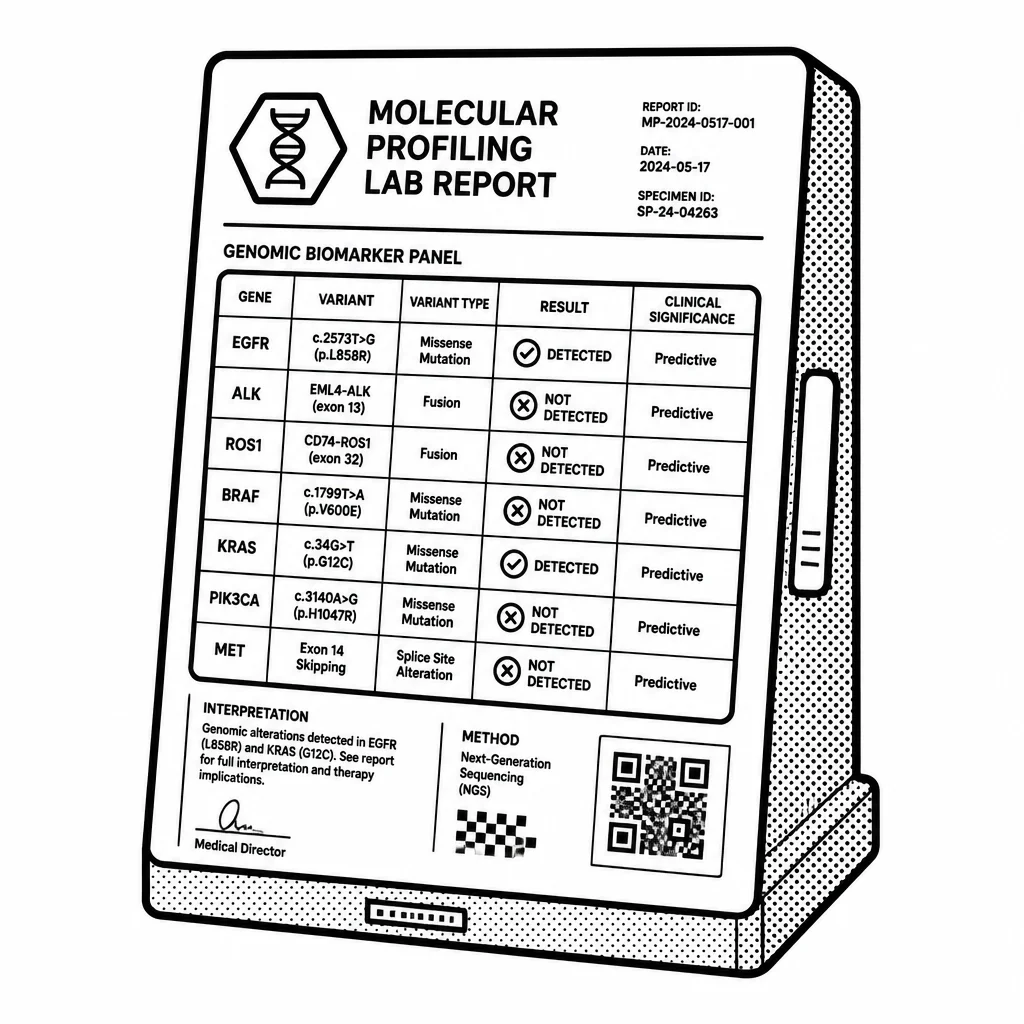
The core product is molecular profiling. Instead of testing for one or two genes, Caris tests a tumor across a very broad panel — DNA, RNA, and proteins all at once — and then uses artificial intelligence to interpret the results and match them to possible therapies. It also offers blood-based testing, which can detect cancer signals from a simple blood draw and monitor how a patient responds to treatment over time. Doctors order these tests, and the company bills insurers or patients for them. That broad, AI-heavy approach is the selling point. A community oncologist may not have the time or expertise to read a raw genetic report, so Caris sells the interpretation as much as the test itself — actionable answers, not just data. The business is also a data business in disguise: every test adds to a growing library of tumor profiles that the company uses to sharpen its models and to work with drugmakers on research and clinical trials. Its main rivals in comprehensive tumor profiling include Foundation Medicine (owned by Roche) and Tempus AI, a fellow Nasdaq-listed diagnostics company. Cancer testing is expensive to build and heavily regulated, and reimbursement from insurers is a constant fight, which makes scale and a large evidence base the real moat.
Caris is newly public, so its stock history is short and it is still investing heavily in growth rather than throwing off cash. The bet is straightforward: as cancer treatment fragments into more targeted drugs, matching the right drug to the right patient becomes more valuable, and whoever holds the biggest library of tumor data and the smartest software to read it wins.
Saved answer · last researched 13 Nov 2026
BIG PICTURE
Caris's blood test for early cancer caught just 60% of stage I and II cases
- 60% Stage I/II cancers detected
- 40% Stage I/II cancers missed
In an early study of 3,014 people, Caris Detect found 60% of stage I and II cancers, meaning four in ten slipped past. The blood test, sold with Everlywell, is a big bet on catching cancer sooner. Today the company earns most of its money from tissue and blood tests that guide treatment after a diagnosis, not from screening. Source: TIKR.com, data from 2026
Timeline
Halbert Buys Molecular Profiling Institute
In 2008, David Dean Halbert bought an early-stage company called Molecular Profiling Institute to build a blood test that could catch disease early. He had a simple but big belief: when something goes wrong in the body, it starts misbehaving at the molecular level, and technology could find it, diagnose it, and maybe even treat it. He expanded that small firm and gave it a new name, Caris Life Sciences.
Caris Becomes a Cancer Company
Caris was formally founded that same year as a next-generation AI TechBio company focused on precision medicine in cancer, matching treatments to the specific molecular makeup of a patient's tumor.
Caris Builds a Cancer Center Network
In 2015 Caris set up the Caris Precision Oncology Alliance, a growing group of leading cancer centers and research groups. The idea was to stay plugged into the smartest minds in cancer care; by 2025 the network had 96 members, including 45 top-tier NCI-designated cancer centers.
Caris Acquires Pharmatech
In 2019 Caris bought Pharmatech and merged its molecular analysis with Pharmatech's just-in-time testing system. That let drug companies find and enroll the right precision-oncology patients for trials far faster, and the new Caris Pharmatech unit ran on a network of 420 research sites.
Caris Raises $830 Million
In 2021 Caris raised $830 million in growth capital led by Sixth Street, one of the largest raises ever in precision medicine. The round valued the company at $7.8 billion.
Caris Assure and FDA Approval
In early 2024 Caris broadly launched Caris Assure, a blood-based molecular test that helps doctors pick the right therapy. Later that year the FDA approved MI Cancer Seek as a companion diagnostic, a test that tells doctors whether a specific drug will work for a specific patient.
Caris Goes Public
In June 2025 Caris listed on Nasdaq and raised about $494 million. Shares were priced at $21, opened at $27, and gave the company a market value of $7.4 billion; founder David Dean Halbert still owned nearly 44% of it, worth about $3.3 billion on paper.
The Stock Crashes
The stock kept climbing after the IPO, hitting an all-time closing high of $39.30 by August 2025. Then it fell hard, dropping to a 52-week low near $14, a loss of more than 60% for anyone who bought in the $30s.
Revenue Nearly Doubles
Despite the stock's wild ride, the business itself exploded: 2025 revenue hit $812 million, up 97% from the year before, with molecular profiling sales up 120%. Gross margin jumped to 66% from 43%, the net loss shrank to $68 million, and the company finally turned positive on adjusted EBITDA and free cash flow, a shift from a cash-hungry growth story to near-breakeven profitability.
Caris ChromoSeq Study Begins
In 2026 the first patients enrolled in a study of Caris ChromoSeq, a whole-genome sequencing test for myeloid malignancies, a group of blood cancers. The study's goal is to show that one genome-wide test can replace a patchwork of separate tests, which is the heart of Caris' strategy to make whole genome sequencing a routine first choice.