Understand any stock in simple English
COSMOS Pharmaceutical Corporation
Cosmos Pharmaceutical runs a chain of discount drugstores in Japan that sell medicines, cosmetics, everyday household goods, and food to ordinary shoppers.
Cosmos Pharmaceutical is a Japanese drugstore chain — the kind of store where you can pick up a prescription, a bottle of shampoo, snacks, and lightbulbs in the same trip. It runs a large network of stores across Japan, mostly in suburban areas where land is cheaper and shoppers come by car. It sells medicines, cosmetics, daily necessities, and food, and its whole pitch to customers is low prices: it works hard to keep costs down and pass the savings on, which is why it has grown into one of the country's biggest drugstore operators.
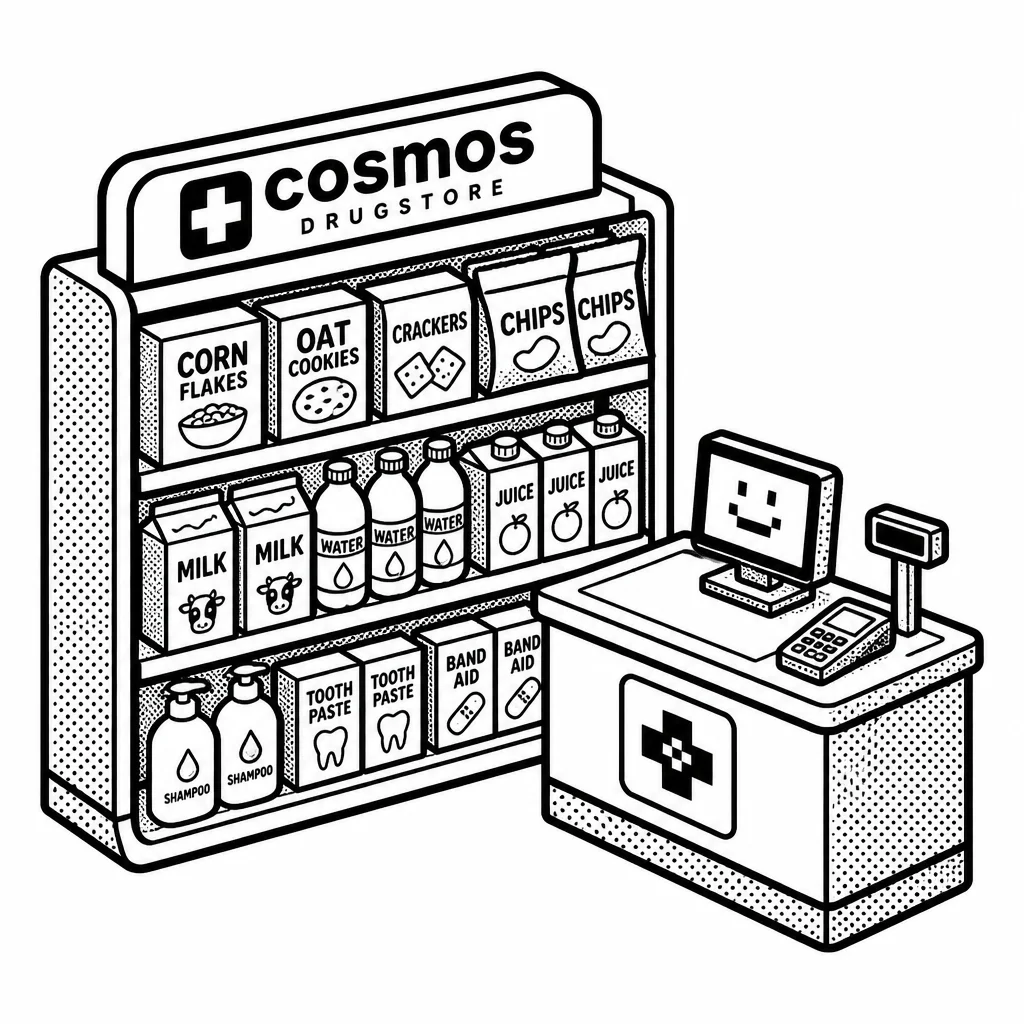
The core of the business is volume. Cosmos buys in huge bulk directly from manufacturers, keeps stores relatively bare-bones, and stacks products high on shelves so a small crew can handle a big store. That lean, discount-first approach is the reason people choose it over a fancier pharmacy or a nearby convenience store — they get the same products for less. The customers are everyday households doing regular shopping, not hospitals or institutions. The Japanese drugstore market is crowded and cutthroat. Cosmos competes with big rivals like Welcia, Tsuruha, and MatsukiyoCocokara, all fighting for the same shoppers, plus discount chains that sell similar household goods. Drugstores in Japan have also expanded well beyond medicine into food and daily goods, so the company is really competing with supermarkets and convenience stores too.
Cosmos has grown steadily by opening new stores, and that expansion is the main thing it spends its cash on, along with keeping prices low. The simple story is a company that makes a thin profit on each item but moves enormous quantities through a growing store base — a scale game where efficient buying and lean operations matter more than fancy branding.
Saved answer · last researched 17 Nov 2026
BIG PICTURE
Cosmos keeps only about 3 yen of every 100 yen of drugstore sales as profit
- 2.9% Turns into net profit
- 97.1% Costs, wages and other expenses
Cosmos runs a discount chain, and its thin net margin shows what that means. Out of every 100 yen shoppers hand over for medicine, food and household goods, about 3 yen remain as profit after everything is paid for. The rest goes to buying stock, paying staff and keeping 1,130 stores open. Low prices and tight costs are the whole business. Source: Simply Wall St, data from 2026
Timeline
A Small Pharmacy in Miyazaki
The story starts in a small city in Miyazaki Prefecture, where the company opened as a local pharmacy called Uno Kaidento Pharmacy. It was a modest beginning, the kind of neighborhood shop that fills prescriptions and sells everyday goods.
Cosmos Pharmaceutical Is Born
Ten years later, the founders set up a proper company, Cosmos Pharmaceutical, to sell medicines, cosmetics and household goods. Its first real store was tiny, just 66 square meters, which is about the size of a small apartment. And yet this cramped little shop, in Okayama, was the seed of everything that followed.
The First Real Drugstore
The small shops gave way to a much bigger idea: the Ukinojo store, the company's first full-scale drugstore at 600 square meters, roughly nine times the size of that first store. This was the moment it stopped thinking of itself as one shop and started building a chain.
Going Public on the Mothers Market
By the early 2000s, the chain had grown enough to list its shares on the Tokyo Stock Exchange's Mothers market, a stepping stone for younger, faster-growing companies. Going public gave it money to expand and a public scorecard for how well it was doing.
Stepping Outside Kyushu
In the same year, it opened the Ouchi store in Yamaguchi, its first store beyond its home region of Kyushu. That may sound like a small step, but it was the company testing whether its way of selling could work far from home.
Moving Up to the Big Board
Two years later, the company graduated to the First Section of the Tokyo Stock Exchange, the main stage for established public companies. It was now playing in the big leagues.
Third in the Industry
The steady expansion paid off: for the fiscal year ended in May, sales passed 600 billion yen, and the company overtook Matsumotokiyoshi Holdings to become the third-largest drugstore chain in Japan. The tiny Okayama shop was now a national force.
A Trillion Yen in Sales
The growth kept compounding. In its results announced in July, sales topped 1 trillion yen for the first time, and the store count passed 1,600. From a 66-square-meter start, the company had become a giant.
A Surprising New Department
Then came a twist: the company announced organizational changes that created a Legal Affairs Department and, unexpectedly, a Hotel Department. The drugstore chain was signaling that it meant to run hotels alongside its stores. How a discount drugstore ended up in the hotel business is a story all its own.