Understand any stock in simple English
Enter a ticker to learn what the company does and how it makes money.
Xiaohongshu Technology Co., Ltd.
Xiaohongshu runs a social media app where people share lifestyle tips, product reviews, and recommendations, and it makes money mostly from advertising and e-commerce.
Xiaohongshu is a Chinese social media app that works like a cross between Instagram and a shopping guide. Users post photos and short videos about beauty products, travel spots, restaurants, fashion, and workouts, and the app is built around honest recommendations from real people rather than polished ads. Its Chinese name translates roughly to "Little Red Book," and the red theme runs through the whole brand. People open it to answer a simple question: "What should I buy, where should I go, and is this thing actually any good?"
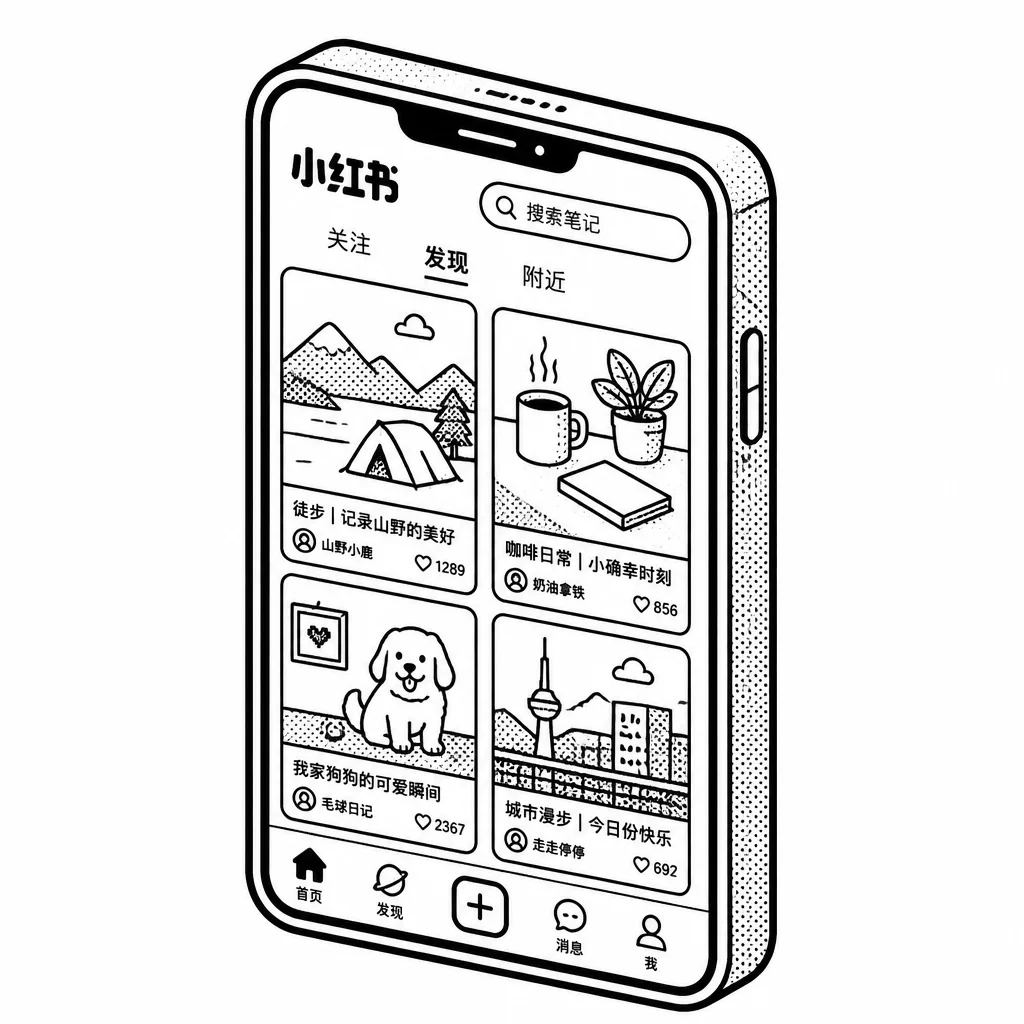
The business earns money in two main ways. First, brands pay for advertising, because the app's users are famously in a buying mood—they come to research purchases, so ads and sponsored posts fit naturally into what they're already doing. Second, Xiaohongshu runs its own e-commerce, letting users buy products directly through the app, and it takes a cut of those sales. The core idea is that trust is the product: when a stranger with no obvious motive says a face cream works, that lands differently than a banner ad. That trust is also the company's biggest strength and its biggest headache. The platform's recommendations carry weight, which makes it valuable to brands—but it also means fake reviews, paid promotion disguised as honest opinion, and exaggerated product claims are a constant problem. Chinese regulators have repeatedly pressed the company on content moderation and on cleaning up misleading marketing. In 2021, the app drew attention and some scrutiny for posts that seemed to encourage risky cosmetic procedures and unhealthy body standards, pushing the company to tighten its rules.
Xiaohongshu is private, backed by investors including Alibaba and Tencent, and its user base skews young and female, though it has broadened over time. It competes with short-video giants like Douyin-owner ByteDance and with Kuaishou in the attention game, while also bumping up against big e-commerce players like Alibaba and JD.com when people actually buy. The company has flirted with going public but has stayed private so far. Its pitch is simple: it's the place where people decide what to buy next, and that makes it one of the more closely watched consumer-internet businesses in China.
Saved answer · last researched 10 Nov 2026
BIG PICTURE
Xiaohongshu's own shops convert just 0.7% to 1.2% of visitors into orders
- 1.2% Shoppers who buy on Xiaohongshu
- 98.8% Shoppers who browse but buy elsewhere
Xiaohongshu is where many Chinese shoppers go to decide what to buy, yet only 0.7% to 1.2% of visits inside its own shops end in an order, the weakest among major e-commerce platforms. Advertising brought in 76% of its 2025 revenue, so the company earns most of its money from brands paying to be seen, while the actual purchase often happens on Taobao or Douyin. Source: 36Kr, citing Ebrun Dynamics, data from 2025
Timeline
Seven Shopping Guides
Charlwin Mao and Miranda Qu started Xiaohongshu in a Shanghai apartment in 2013. Chinese shoppers kept bumping into scattered, unreliable information about buying things overseas, so the pair wrote seven PDF guides to help them. When the 'Xiaohongshu Shopping Notes' app launched at the end of that year, those guides turned into a community where people shared their own shopping experiences — and a culture of 'zhongcao', planting the seed of a purchase in someone's mind, took root.
Fulishe Closes the Loop
A year later, the company launched 'Fulishe', its own online store, mainly selling cross-border beauty products, so that a user who discovered something in the community could actually buy it. It worked: first-year sales passed 300 million yuan, and a bonded warehouse in Zhengzhou followed as the company built up its cross-border supply chain.
The Amusement Park Theory
By around 2016, that self-run store business had hit a wall as cross-border competition turned brutal. Qu drew a different picture: users come to browse and play, not just to buy. The community is the moat, and shopping is only one ride in the amusement park. So from 2017 the company pulled resources back from running its own store and focused on the community — a retreat that later paid off in a big way.
Mark My Life
Xiaohongshu changed its slogan to 'Mark My Life', dropping its single identity as an overseas shopping community. Partnerships with hit variety shows brought in young users, and content spread from beauty into food, home, travel, parenting and fitness. Users passed 150 million in 2018 and 300 million in 2019.
Alibaba Leads a $300 Million Round
That same year, Alibaba led a $300 million funding round, with GSR Ventures, Tencent Investment and GGV Capital joining in. The round valued the company at more than $3 billion and paid for talent, machine learning infrastructure and user growth.
Buyer E-commerce
Rather than building a bigger self-run store or copying Taobao and Douyin's shelf-and-low-price logic, Xiaohongshu found its own path: 'buyer e-commerce'. Livestreams by buyers like Dong Jie and Zhang Xiaohui took off, because the link between community and commerce came naturally — users trust the content, buy from that trust, and share again. Young users also got used to treating the app as a lifestyle search engine: search first, then discover, then order.
Xiaohongshu Turns a Profit
All of that finally added up to a profit in 2023, after a loss the year before — a net profit of $500 million on turnover of $3.7 billion. Monthly active users reached 312 million, up about a fifth year-on-year, making it China's fastest-growing large social platform and restoring investor confidence.
The Self-Operated Stores Shut Down
In early 2024, the company shut down its self-operated e-commerce platforms 'Xiaoluzhou' and the Welfare Club, closing the book on a decade of trying to run its own stores.
A Leadership Reshuffle
In April 2026 came a sweeping reshuffle at the top. Founder and CEO Mao Wenchao moved to focus on long-term strategy, while COO Ding Ling was promoted to president, overseeing community, e-commerce, monetization and technology. New units went up too — a dedicated AI division, an overseas business arm and an innovation lab — pointing the company toward AI, expansion abroad and a wider product range.
The World Cup Push
In May 2026, Xiaohongshu picked up mainland China streaming rights to the FIFA World Cup through sublicensing, a bid to reach more male users as its core female audience runs out of room to grow. It worked fast: in the tournament's first week, World Cup topics drew over 7 billion views, and men made up nearly 36% of active users, up almost 7 points from the end of 2022. The push came as the company prepared for a Hong Kong IPO, with core user growth slowing and the fight for advertising and e-commerce spending getting fiercer.