Understand any stock in simple English
Enter a ticker to learn what the company does and how it makes money.
The Constant Company, LLC
Vultr rents out cloud computing power—servers, GPUs, and storage—to businesses and developers who need to run software on the internet.
Vultr is a cloud computing company. It sells the raw digital machinery that people rent instead of owning: virtual servers that run around the clock, graphics chips (GPUs) for training and running AI models, bare metal servers for workloads that need a whole machine to themselves, and storage to keep the data. Customers are mostly developers and businesses who would rather swipe a card and get a server in seconds than buy hardware, wire it up, and maintain a data center themselves.
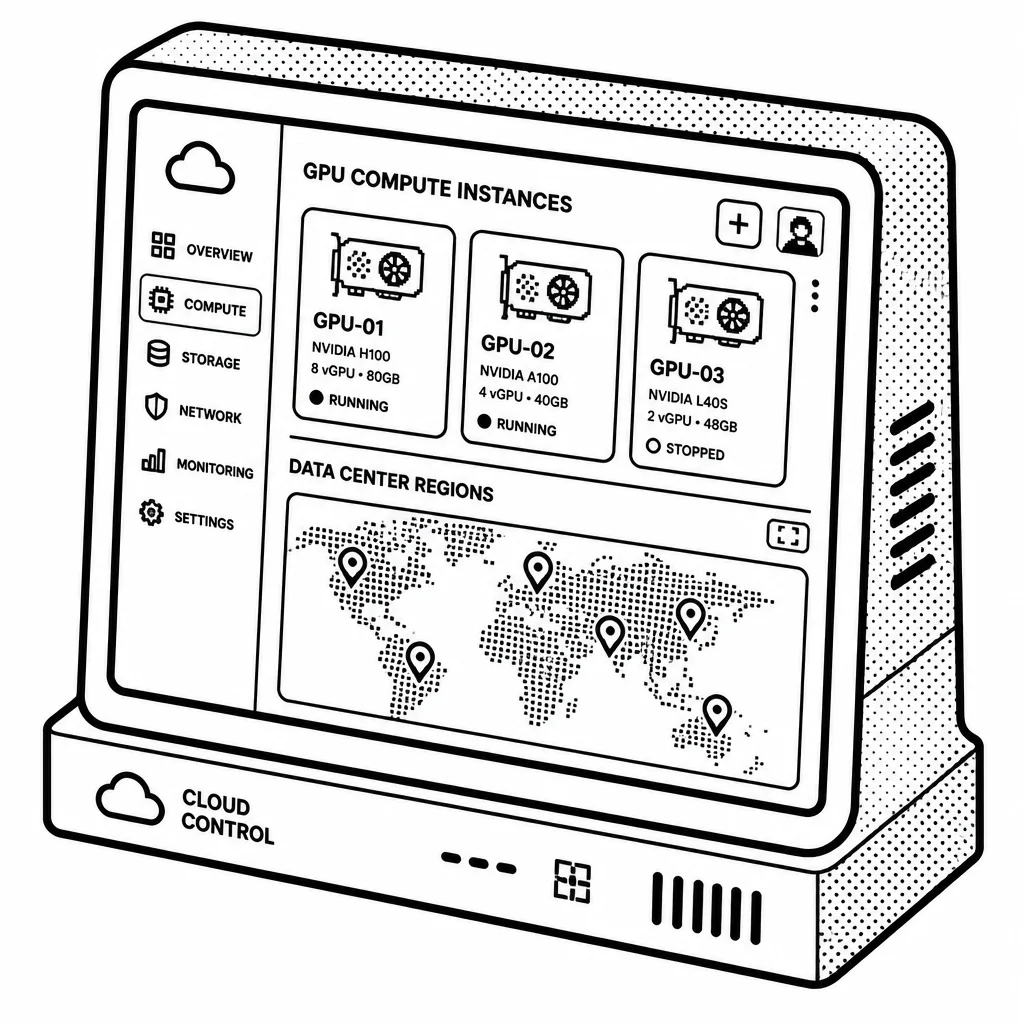
The idea behind the business is simple. Renting computer power is like renting an apartment instead of buying a house—you pay for what you use and someone else handles the plumbing. Vultr's pitch to customers is speed and simplicity: spin up a server in a couple of minutes, pay by the hour, and pick from dozens of locations around the world so the machine sits close to the users it serves. That worldwide footprint matters for things like websites, games, and apps where a fraction of a second of delay is felt by real people. Its most interesting bet lately is AI. Training and running AI models takes enormous amounts of GPU power, and Vultr has been building out GPU capacity and partnering with chipmakers to serve companies that don't want to lock themselves into the biggest cloud providers. That puts it in a crowded field—it competes with Amazon Web Services, Microsoft Azure, and Alphabet's Google Cloud, plus specialists like DigitalOcean—so its edge is being the cheaper, simpler, less locked-in option rather than the everything-to-everyone giant.
Vultr is privately held, owned by its founders and investors rather than traded on a stock exchange, which means it doesn't report quarterly earnings the way public cloud rivals do. The company was founded in 2014 and has grown as a quieter alternative in a market dominated by tech giants, and its fortunes now ride heavily on whether the AI boom keeps driving demand for rented GPU power. The risk is familiar: the big clouds can cut prices and bundle services, and GPU capacity is expensive to build and can go stale fast as chips improve.
Saved answer · last researched 10 Nov 2026
Timeline
A Hosting Business Called Constant
Constant started in 2001 as a hosting business, and for most of its life it ran on its own money. No big investors, no fancy funding rounds. Just a business quietly paying its own way, which is rarer than it sounds.
Constant Becomes Vultr
In 2014, the company rebranded and jumped into the cloud market as Vultr, founded by David Aninowsky. Cloud computing was crowded and expensive to enter, but Vultr had something the flashy startups didn't: years of running servers without burning through investor cash.
A New CEO Takes the Wheel
J.J. Kardwell became CEO in 2020, also leading Vultr Holdings. A new leader at the top often signals a company getting ready to grow up, and that's exactly what was coming.
GPUs Before the AI Crowd
Vultr started investing in GPUs in 2021, years before the generative AI boom of 2023 made them the hottest hardware on earth. That early timing gave the company a front-row seat to how AI workloads were changing, a view most competitors got much later.
Joining the Cloud Native Community
That same year, Vultr became a Silver Member of the CNCF, the group behind much of the open-source software that modern cloud runs on. It was the start of a five-year relationship with the cloud native world.
The First Outside Money
After more than two decades funding itself, Vultr took its first big outside check: $333 million, led by LuminArx and AMD Ventures, valuing the company at $3.5 billion. The money was earmarked to build more infrastructure and push deeper into AI cloud services. For a company that had never needed investors, this was a huge shift.
A Giant AMD Supercluster in India
Vultr announced a 20 MW AMD supercluster in Chennai, India, one of the largest AMD Instinct deployments in the world, alongside its flagship site in Ohio. It was aimed at AI labs, startups, enterprises and researchers who want AI computing kept under their own country's rules.
Platinum Membership and an Open Source Alliance
Vultr upgraded to CNCF Platinum membership and launched the Vultr Open Source Alliance, tying its cloud native roots to open AI tooling. The message was clear: the hosting business from 2001 had become a sovereign AI infrastructure player sitting right where cloud native and AI meet.