Understand any stock in simple English
Enter a ticker to learn what the company does and how it makes money.
SpeQtral Pte. Ltd.
SpeQtral builds satellite and fibre-based quantum key distribution systems that let governments and businesses share encryption keys that are physically impossible to copy.
SpeQtral is a Singapore-based quantum communications company. It sells systems that use the weird rules of quantum physics to create and share secret encryption keys between two places — and it does this both over fibre-optic cables on the ground and via satellites in space. Its customers are mainly governments and large enterprises that need to protect sensitive data from the day when powerful quantum computers could crack today's encryption.
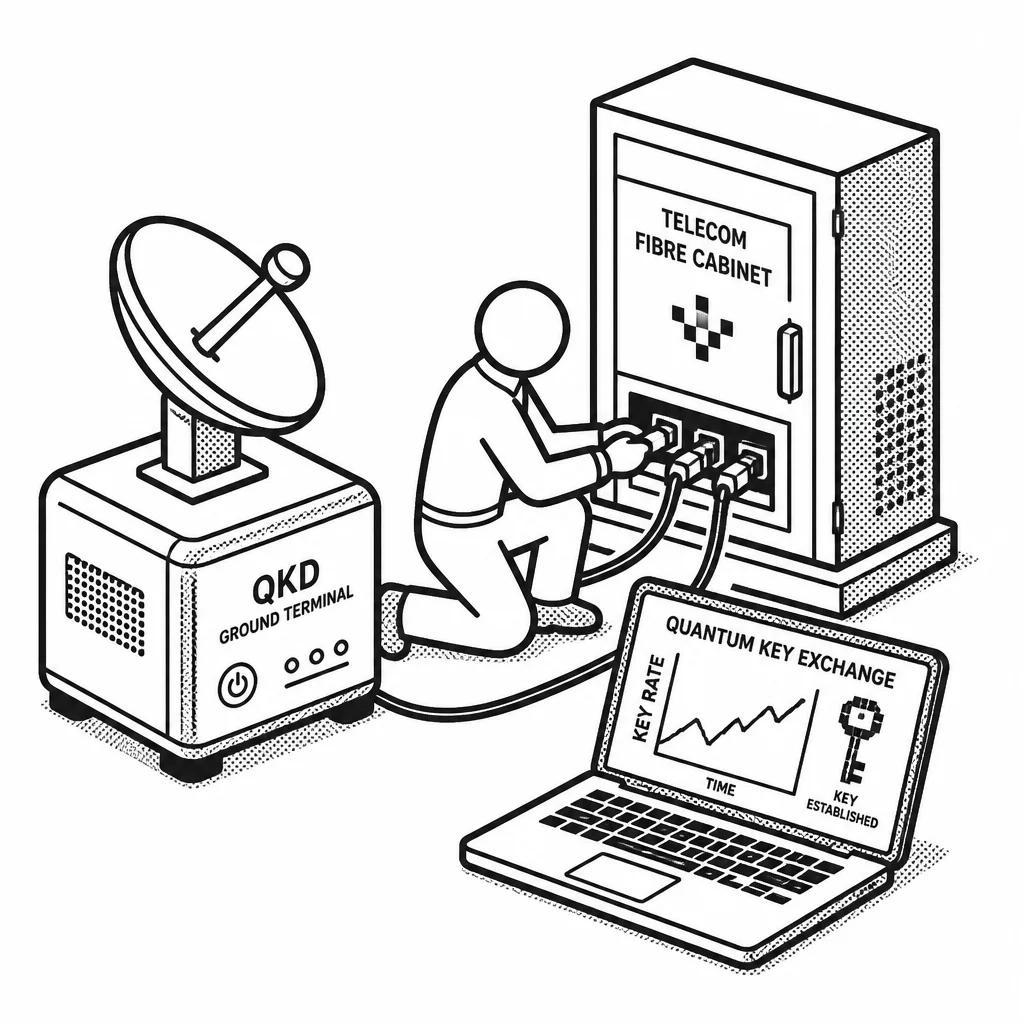
Here's the basic problem it solves. Today's encryption relies on math that is very hard for ordinary computers to break, but a future quantum computer could break it. Quantum key distribution, or QKD, sidesteps that: it sends single particles of light down a fibre or through free space, and physics guarantees that anyone eavesdropping gets caught. If someone tries to peek, the key is corrupted and both sides know to throw it away. SpeQtral's job is to make that work reliably — building the compact optical terminals that go on satellites, the ground stations that talk to them, and the fibre-based systems for shorter links. The company grew out of Singapore's research ecosystem and was formerly called S15 Space Systems. It has attracted backing from investors including Singapore's defence and engineering groups, and it works with partners in Europe and Asia on satellite QKD missions. The commercial reality is that this is still an early market: QKD hardware is expensive, standards and regulations are still forming, and the big question is whether enough governments and banks will pay for physics-grade security before quantum computers actually threaten anything. SpeQtral is essentially making a bet that they will, and that being early with working satellite and fibre products puts it in position to win those contracts.
The business model is selling hardware and systems — satellite payloads, ground stations, and fibre QKD units — plus the integration and support that goes with them, rather than a subscription. Its edge comes from being one of a small handful of companies worldwide that can do satellite-based QKD, a field where the technology is genuinely hard and government customers care about trust and provenance. The risk is equally clear: it is a small private company in a capital-intensive, slow-moving market, competing against better-funded players and betting on a threat that hasn't fully arrived yet.
Saved answer · last researched 11 Nov 2026
Timeline
S15 Space Systems Starts in 2017
The whole thing began with a small satellite called SpooQy-1, which showed that quantum entanglement could work in orbit. When people started asking to buy quantum key distribution satellites, the team behind it realized they had a real business on their hands. So in late 2017 they set up S15 Space Systems, named after the university block Science Site 15, to turn the lab's miniaturized quantum experiments into something that could fly in space. The founders came from the same university quantum lab: Chune Yang Lum, who had a physics background and had worked on satellite telecom, reconnected with Professor Alexander Ling around 2015, and together with Rob Bedington they built the spin-off.
Funding Turns S15 Into SpeQtral
After securing funding, the team moved out of borrowed space into its own offices and labs and became what is now SpeQtral. Until then it had run as S15 Space Systems, working closely with the university on contracted research and satellite operations.
SpeQtre Launches on SpaceX
In November 2025 the company's first satellite, SpeQtre, launched on a SpaceX rideshare mission and settled into a sun-synchronous orbit. Built with the UK's RAL Space, it carries SpeQtral's space-qualified source of entangled photon pairs, the hardware that makes space-to-ground quantum communication possible. It was the company's first real satellite mission on the road to selling commercial quantum key distribution services.
The Harder Road to Quantum Security
Outside China's Micius satellite, which had shown quantum key distribution back in 2017, the world had only seen partial demonstrations. SpeQtral expected to be among the first to follow. Its approach uses entanglement-based QKD, which is harder to pull off than the weak coherent pulses many systems rely on, but more secure.
SpeQtral Takes Control of SpeQtre
In August 2026 SpeQtral took operational control of SpeQtre from RAL Space and began the experimentation phase. Teams started calibrating the delicate optical links that precision quantum communication demands, and got the onboard entangled photon source ready to run. The work gave the company hands-on experience and technical data for the space-to-ground systems it planned to sell, including the BBM92 protocol.
SKY Perfect JSAT Invests
In January 2026, Japan's SKY Perfect JSAT invested in SpeQtral and signed a strategic alliance, aiming to commercialize quantum-cryptography satellite communications by the 2030s. With that backing, the commercial satellite SpeQtral-1 is now planned to launch in fiscal 2027, following the SpeQtre demonstrator.
Toshiba and HPE Quantum-Safe Demo
SpeQtral led the integration of a deployment-ready quantum-safe solution with Toshiba Asia Pacific and HPE, combining Toshiba's quantum network platform with HPE's firewall for secure VPNs. The setup mixed QKD with post-quantum cryptography to protect critical infrastructure and government networks from harvest-now-decrypt-later risks, meaning data stolen today and cracked later. It was shown at GovWare 2026, putting SpeQtral squarely in commercial quantum-safe deployments.