Understand any stock in simple English
Enter a ticker to learn what the company does and how it makes money.
ID Quantique SA
ID Quantique makes hardware and systems that use the weird rules of quantum physics to generate truly random numbers and to protect data from future quantum computers.
ID Quantique is a Swiss hardware company that builds the specialized equipment needed to keep secrets safe in a world where quantum computers are getting stronger. Its customers are governments, banks, telecom operators, and research labs — organizations that cannot afford to have their encrypted data cracked. The company sells three main things: quantum key distribution systems that let two parties share a secret encryption key and know instantly if someone has tried to eavesdrop, quantum random number generators that produce truly unpredictable numbers for encryption, and photon counters that detect single particles of light for labs and researchers.
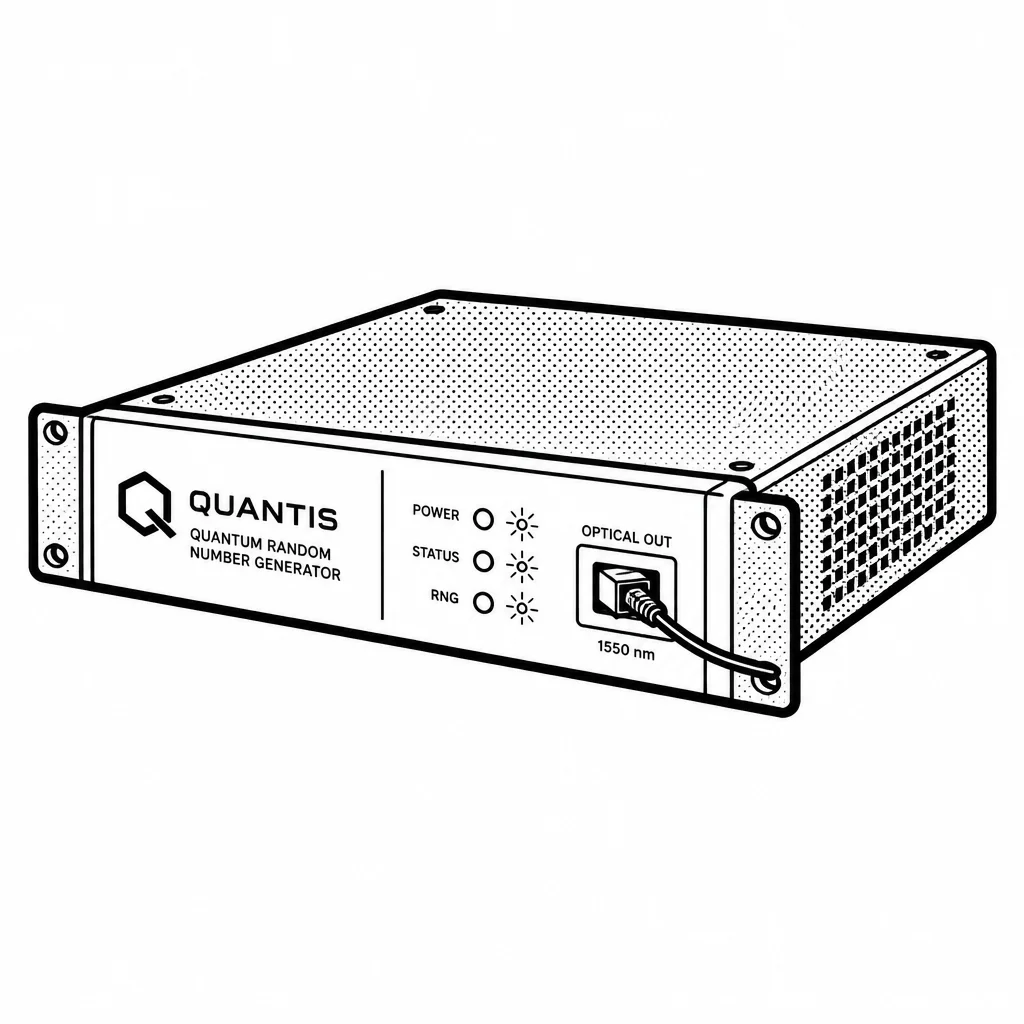
The core problem it solves is that most "random" numbers in computers are not actually random — they come from math formulas that a clever attacker might predict. A quantum random number generator uses a physical quantum process, like a photon hitting a semi-transparent mirror, to produce numbers that are genuinely impossible to predict. That matters because almost all encryption depends on random keys. If your random numbers are weak, your encryption is weak no matter how fancy the algorithm. Quantum key distribution is the more ambitious product. Normal encryption hides data behind math that a future quantum computer could break. QKD instead sends the key itself as fragile photons over a fiber-optic cable. If an eavesdropper touches the photons, the laws of physics change them, and the two sides can see the tampering and throw the key away. ID Quantique sells these systems to telecom networks and governments building "quantum-safe" infrastructure. It has also pushed into post-quantum cryptography software, which is a different defense — math designed to resist quantum attacks — because many customers want both approaches.
The company is private, founded in 2001 as a spin-off from the University of Geneva, and it sits at the small, specialized end of a market that is still early. Its rivals include big telecom equipment makers and a growing pack of quantum-security startups, and the honest risk is that quantum key distribution remains a niche technology if post-quantum software proves good enough on its own. But for customers who want physics-based guarantees rather than math-based ones, ID Quantique is one of the few places to buy the gear.
Saved answer · last researched 11 Nov 2026
BIG PICTURE
Five companies control about 70% of the global market for quantum key distribution
- 70% Top five QKD vendors, including ID Quantique
- 30% All other QKD vendors
Quantum key distribution is the hardware that shares encryption keys using particles of light, and it is a tight club: the five biggest vendors together hold about 70% of worldwide sales. ID Quantique is named among them, alongside MagiQ, Quintessence Labs, QuantumCTek and Qasky. Most of its money comes from selling into that small group of serious players rather than a crowded field. Source: Gelonghui, data from 2026
Timeline
Four Scientists Start a Quantum Company
In 2001, four scientists from the University of Geneva started a company around a belief most people found strange: that quantum physics, the odd rules that govern tiny particles, would someday matter to computers and information. Their idea was quantum key distribution, a way to send secret keys using single particles of light, so that any eavesdropper would be caught by the laws of physics themselves. At the time, plenty of people thought the whole thing was crazy. The founders did not.
From Lab to Market
A few years in, the company did something almost no one had done: it turned its quantum key system into a product you could actually buy, moving from a university spin-off to a real vendor of quantum cryptography. It was among the first in the world to sell such a system, though not quite the first.
Guarding a Government Election
Then came a moment that proved the skeptics wrong. In 2007, a government used quantum cryptography for the first time ever, protecting the Geneva state elections in Switzerland. It stayed in use for years, showing that this lab idea could hold up in real government operations.
Records and Chips
The company kept pushing on several fronts at once. With the University of Geneva, it set a world record for the longest quantum key exchange, sending a key across 307 kilometers. Its random number generator, called Quantis, became the first of its kind to pass Germany's strict randomness validation. And with Battelle, it helped start a working group pushing for security that could survive the coming of quantum computers.
SK Telecom Takes Control
For years the founders had run the show. That changed in 2018, when Korea's SK Telecom, which already held a small slice, poured in about $65 million and raised its stake to a majority. Deutsche Telekom also invested that year, so two big telecom players now had a seat at the table.
Quantum Goes Mass Market
Soon the company's tiny random number chip landed inside Samsung's Galaxy A Quantum, the first mass-market use of quantum technology, and then inside another 5G phone. In Korea, the company and SK Broadband began helping build one of the largest quantum communication networks in the world. Quantum security had gone from the lab to people's pockets.
Twenty Years In
By its twentieth anniversary, the company that skeptics once called crazy had become a global name in quantum technologies, with more than a hundred employees and offices and labs in Korea and the US. It also earned quality certifications, building on praise from ArianeGroup for its work on the Ariane 6 rocket project.
IonQ Buys a Controlling Stake
Then, in early 2025, the quantum computing company IonQ struck a deal to buy a controlling stake from SK Telecom, in an all-stock deal worth roughly $116 million. The purchase handed IonQ around 300 quantum-networking patents and closed that spring, with IonQ's ownership climbing to about 91% by summer. ID Quantique was no longer independent; it became a subsidiary inside IonQ's quantum-networking plans.
A Big Network and New Certifications
The new parent did not slow it down. In 2026, the subsidiary delivered one of Europe's largest working quantum key distribution networks, inside Romania's national infrastructure, and launched a new multiplex product with IonQ to make quantum security deployable at scale in city networks. It also earned an environmental certification, making IonQ the first pure-play quantum company to hold three key ISO certifications at once.