Understand any stock in simple English
Enter a ticker to learn what the company does and how it makes money.
Quantum Xchange Inc.
Quantum Xchange sells encryption and key-management software that helps governments and companies protect data against future quantum-computer attacks.
Quantum Xchange is a cybersecurity company that sells software for keeping secrets safe from a threat most people can't see yet: quantum computers. Ordinary encryption, the scrambling that protects bank transfers, medical records, and government messages, relies on math problems that today's computers can't solve. A powerful enough quantum computer eventually could. Quantum Xchange's job is to help organizations move to "quantum-safe" encryption before that day arrives, and to manage the scramble of cryptographic keys that makes encryption work.
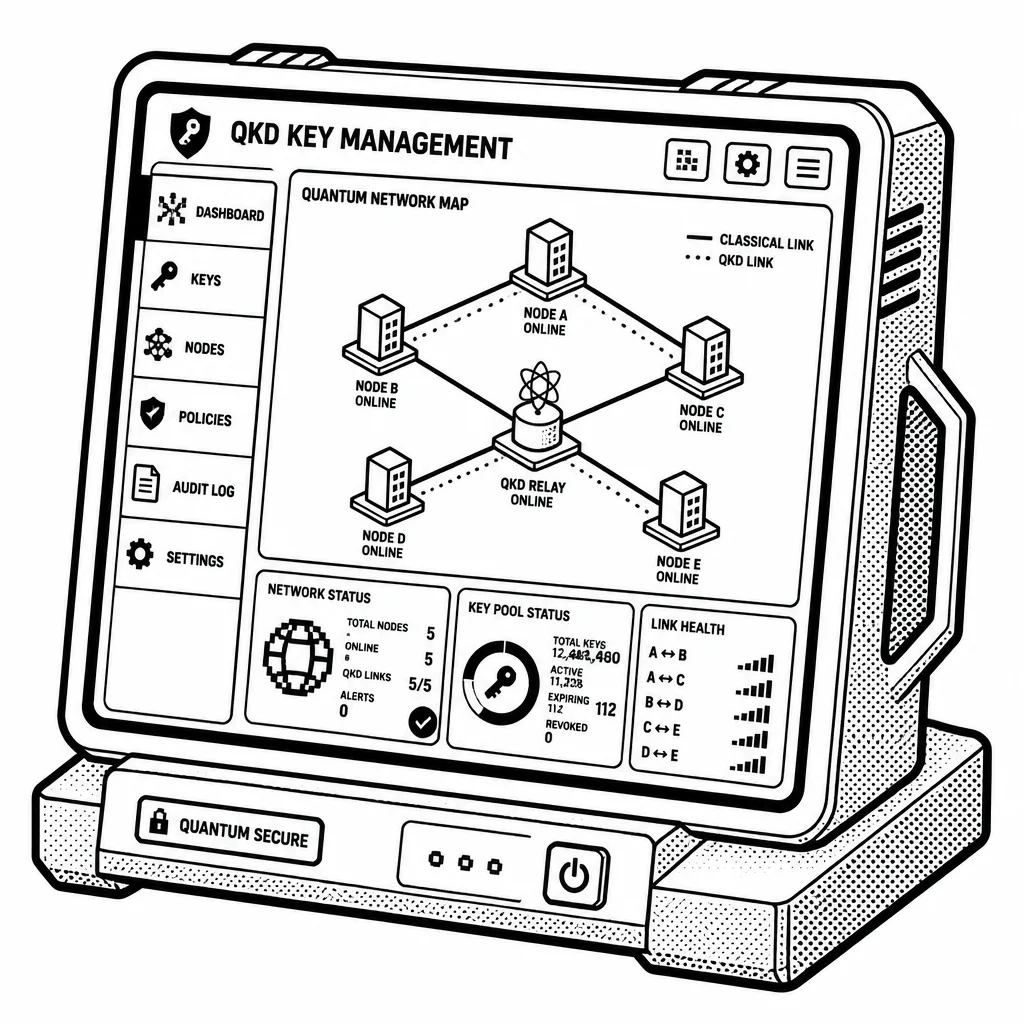
Its core products do two related things. One is key management: a platform, built around what the company calls its TrustPoint technology, that generates, distributes, and rotates the digital keys used to lock and unlock data across an organization. The other is quantum-safe encryption itself, using newer algorithms designed to resist quantum attacks. The company also offers a way to test and monitor an organization's exposure, so security teams can see which connections and systems still rely on old, vulnerable cryptography. Customers are mostly enterprises and government agencies, the kind of buyers with sensitive data, compliance rules, and long-lived secrets that need to stay protected for years. The pitch to those buyers is simple: this is a hard, technical migration, and most IT teams don't want to build it from scratch. Quantum Xchange positions itself as the plumbing layer that sits between an organization's existing systems and the new quantum-safe standards, rather than forcing a rip-and-replace. It competes in a crowded field of cryptography and key-management vendors, and the timing of the whole market depends on how fast quantum computing advances and how fast regulators push agencies and critical industries to upgrade.
The obvious risk is that the quantum threat stays theoretical longer than expected, and customers keep deferring the spend. The counterargument is that "harvest now, decrypt later" attacks mean data stolen today could be cracked years from now, which gives organizations a reason to start migrating early. Quantum Xchange is a private company, so it doesn't report public financials, and its story is really a bet that quantum-safe security becomes standard infrastructure rather than a niche project.
Saved answer · last researched 11 Nov 2026
Timeline
Quantum Xchange Is Founded
Quantum Xchange started with a big worry: one day, powerful quantum computers could crack the encryption that protects ordinary internet traffic, and no one had a simple way to defend against it. Founder Hal Chapel set out to sell quantum-safe encryption to companies and government agencies. The company built the first quantum fiber-optic network in the U.S., running along the Northeast corridor from Washington to Boston, and its first quantum key distribution network linked Wall Street financial markets with back-office operations in New Jersey.
Phio TX Changes the Direction
Building a quantum network was one thing; getting customers to use it was another. So the company launched Phio Trusted Xchange, a key distribution system designed to be flexible about how it protects data. Its clever trick was making traditional encryption keys quantum-safe, while also supporting newer post-quantum methods. That product expansion reshaped the company's strategy, placing it in both the quantum key distribution market and the newer post-quantum cryptography market.
New CEO and Series A Cash
To fund the wider strategy, Quantum Xchange raised a first close of about 13.5 million dollars in Series A money, valuing the company near 59 million dollars after the investment. Alongside the cash came new leadership: Eddy Zervigon took over as CEO, replacing John Prisco, with a new CFO and CTO joining too. Founding CEO Hal Chapel said the change came at a pivotal time as the product line and strategic direction expanded.
A Federal Agency Deploys Phio TX
The strategy paid off in a very concrete way: a U.S. federal agency rolled out Phio TX-EM across 15 production sites without having to rip out and replace major hardware. The deployment added post-quantum protection to networks that were already in place. That mattered because it proved Phio TX could work at scale inside government networks, a key market for the company.
Quantum Xchange Wins Fortress Award
That government proof point helped earn Quantum Xchange the 2026 Fortress Cybersecurity Award in the Quantum Security category. The award recognized federal adoption, expanded global partnerships and deployment of Phio TX for post-quantum readiness. Behind it sat a stack of security validations for Phio TX, covering FIPS 140-3, FIPS 203 and NIST entropy source standards.
Partner Program Grows Fast
To reach more government buyers, Quantum Xchange leaned on partners rather than doing everything itself. Its Partner Program grew strategic partnerships more than fourfold in under 16 months, adding resellers and integrators. The partner channel became a key growth engine as government demand for post-quantum migration surged, and CEO Eddy Zervigon said partners are on the front lines of government cybersecurity deployments, operationalizing quantum-safe security.
Advisors Join for Commercial Scale
As post-quantum readiness became a board-level priority, the company brought in experienced help to turn its technology into a real commercial business. Kfir Godrich, former Chief Innovation Officer of BlackRock, joined the advisory board, and longtime Cisco executive Chris White expanded his role to help accelerate commercial strategy, go-to-market execution and partnerships. The additions signaled a push to translate strong technology into commercial scale.