Understand any stock in simple English
Enter a ticker to learn what the company does and how it makes money.
Postman, Inc.
Postman makes software that helps developers build, test, and manage APIs — the connectors that let different pieces of software talk to each other.
Postman is a software company that makes the tools developers use to build and test APIs. An API is basically a messenger that lets one piece of software ask another for something — a weather app asking a server for today's forecast, or a shopping site asking a payment system to charge a card. Postman gives developers a friendly place to send those requests by hand, see exactly what comes back, and save the ones that work. What started as a side project became one of the most widely used developer tools in the world, with tens of millions of registered users.
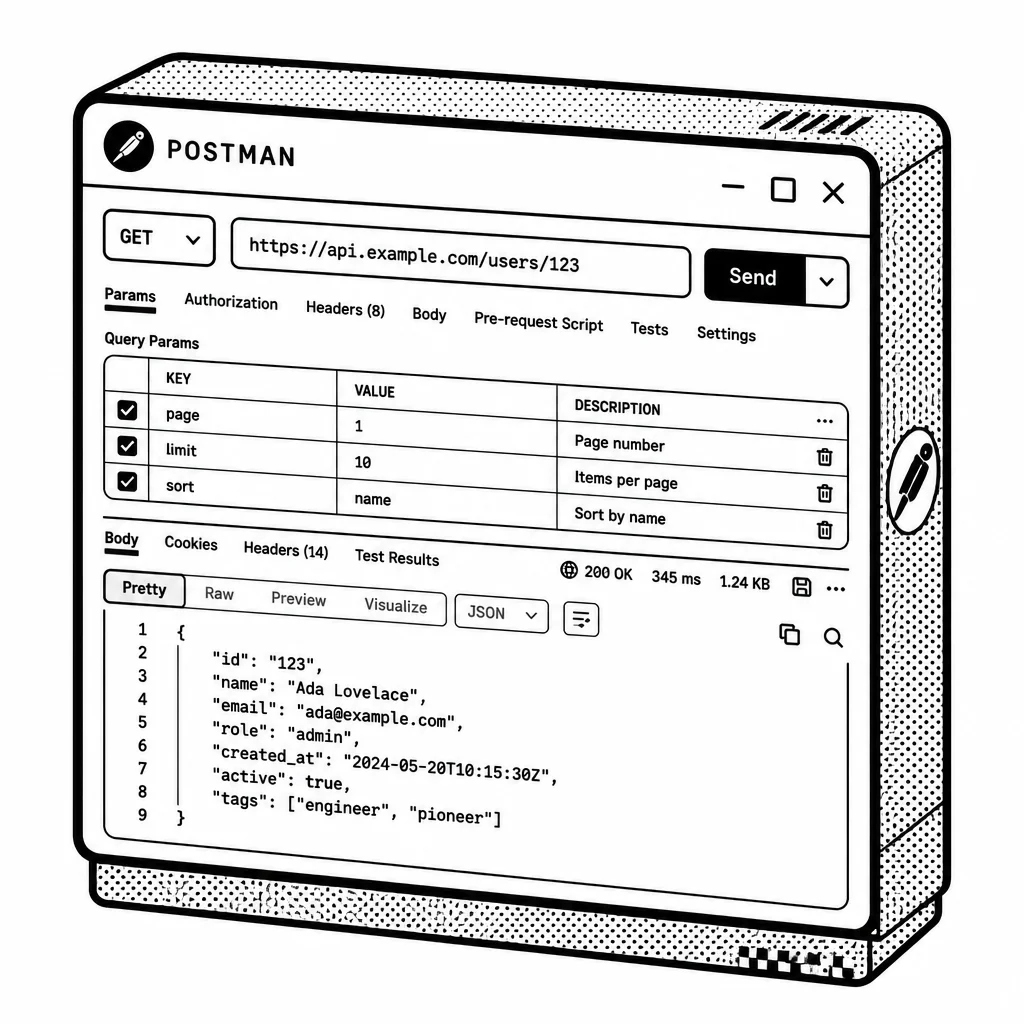
The company's product has grown well beyond a single testing window. Postman now lets teams organize their APIs into shared collections, write automated tests that run every time code changes, and generate documentation so other developers can actually figure out how to use them. It also sells tools for mocking up fake API responses before the real thing exists, and for monitoring live APIs to catch outages. At the center of it all is the Postman API Platform, a shared workspace where an entire engineering team keeps its API work in one place instead of scattered across scripts and sticky notes. Postman makes money mainly by selling paid plans to teams and companies. The free version is generous on purpose: individuals and small groups use it, spread it around their workplace, and eventually the company's IT and security people want admin controls, single sign-on, private workspaces, and governance features — and that's when the paid plans kick in. That bottom-up, land-and-expand motion is the engine. Developers adopt the tool because it's pleasant to use, and the upgrade happens when a big organization decides it needs to manage API work seriously. Competitors include Swagger-style tools and broader API management platforms, but Postman's grip comes from habit: once a team's API collections live in Postman, switching costs are real.
Postman is private, backed by venture capital, and was last valued at $5.6 billion in a 2021 funding round. It has raised hundreds of millions of dollars and has been on the road toward an eventual public listing, though it hasn't gone public. The business rode the API boom of the 2010s and early 2020s and now faces the harder question every developer-tools company faces: keeping paying enterprise customers happy as competition tightens and AI tools start writing and testing code on their own. Its bet is that as software everywhere gets more connected, the humble API — and the workspace where people manage it — only becomes more important.
Saved answer · last researched 10 Nov 2026
BIG PICTURE
Only 24% of developers are building APIs for AI agents to use, Postman's own survey finds
- 24% Developers designing APIs for AI agents
- 76% Developers not yet designing APIs for AI agents
Postman sells the workspace where developers build and test the APIs that software uses to talk to other software. Its 2025 survey of more than 5,700 developers found 89% already use generative AI day to day, yet just 24% design their APIs for AI agents to call. That gap is where Postman is pushing new tools, and where its paid upgrades could come from. Source: Postman 2025 State of the API Report, data from 2025
Timeline
A Side Project Called Postman
Abhinav Asthana was a software engineer at Yahoo in Bangalore, and testing APIs was a pain. So he built a small free tool to make it easier, named it Postman as a play on the API request POST, and put it in the Chrome Web Store.
Three Founders Build a Company
Half a million people were using the free tool, and investors came knocking. Asthana teamed up with Ankit Sobti and Abhijit Kane to turn Postman into a real business, and the three still run it today.
Headquarters Move to San Francisco
To be closer to the customers and investors that mattered, Postman moved its corporate headquarters from Bangalore to San Francisco.
Postman Becomes a Unicorn
A huge funding round valued the company at $5.6 billion, putting it in the rare club of startups worth more than a billion dollars.
Postman Acquires Akita
Postman bought Akita, a company that helps teams watch how their APIs behave in the wild, adding API observability to its toolkit.
Postman Acquires Orbit
Next came Orbit, a tool for building and managing developer communities, as Postman worked to own more of how developers connect with each other.
Valuation Cut in Secondary Deals
The good times cooled. As software company valuations fell across the market, Postman shares traded in private deals at a steep discount to its peak, and some early investors cashed out part of their stakes. The company had been the most valued software startup of Indian origin, and now it was learning what a down market feels like.
Postman Acquires liblab
Postman bought liblab, a platform that automatically generates and maintains SDKs—the little code kits developers use to call an API—to push toward one unified platform for the whole API lifecycle.
An AI-Native Platform Rebuild
Postman rebuilt its platform for the age of AI agents, with workspaces connected to Git, an API Catalog, and an intelligence layer woven throughout. The architecture is Git-native, so developers can work on the same branch as their editor.
Fabric Gateway Ships
Postman launched Fabric Gateway, a control plane that sits between AI agents and the APIs, tools, and models they use. CEO Abhinav Asthana framed it as infrastructure to govern what agents can discover, access, and do—a bet that the governance layer, not the runtime, is the moat of the agent economy.