Understand any stock in simple English
Enter a ticker to learn what the company does and how it makes money.
eleQtron GmbH
eleQtron builds trapped-ion quantum computers and processors for industry, research, and institutions.
eleQtron is a German quantum computing company that builds trapped-ion quantum computers and processors. Its customers are not ordinary consumers. They are companies, research labs, universities and public institutions that want to run experiments and solve problems using quantum machines. In simple terms, eleQtron sells the hardware and the surrounding technology that let these organizations start working with quantum computing instead of just reading about it.
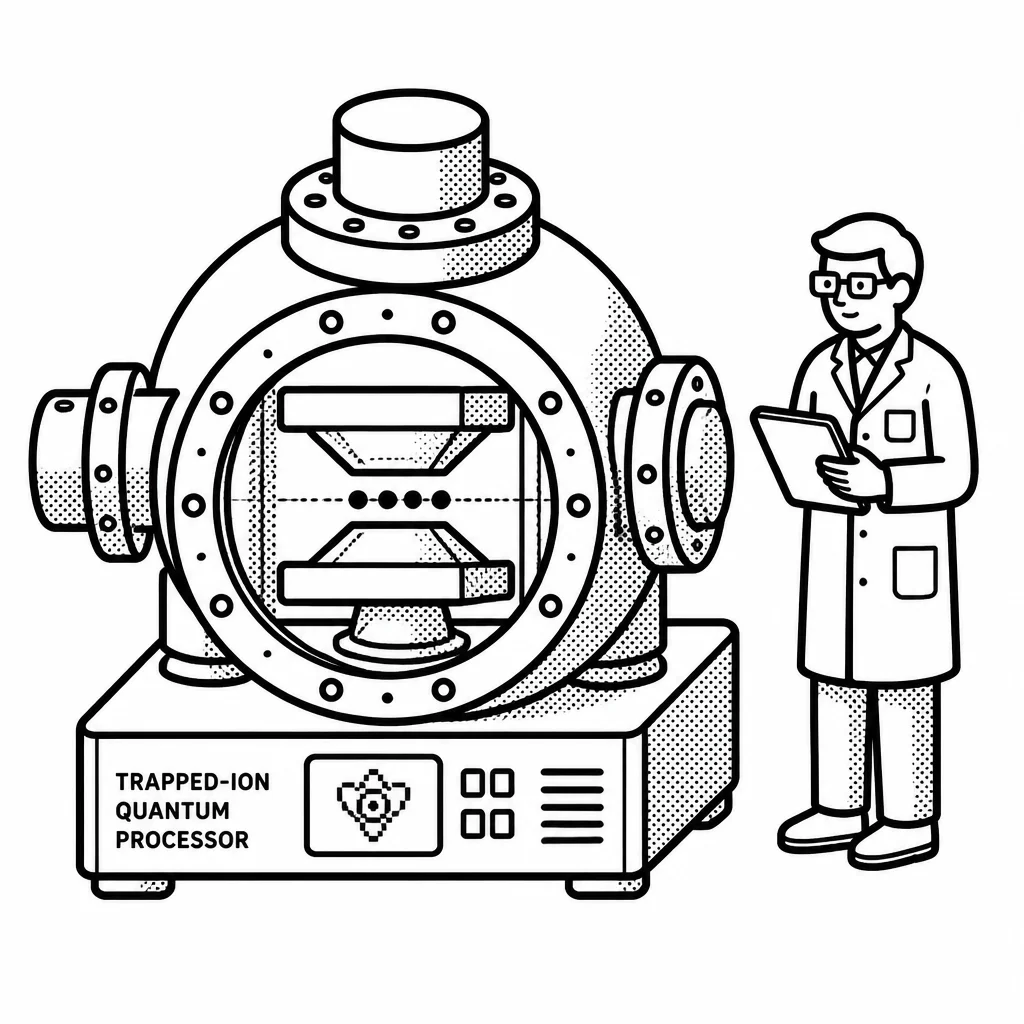
The core idea behind trapped-ion technology is worth understanding. A quantum computer needs physical objects that can hold delicate quantum states, and ions (charged atoms) are one popular choice. eleQtron's specialty is holding those ions in place with electric fields, then using lasers and microwave signals to control them and make them compute. The hard part is keeping the ions stable and precise enough for the results to be trustworthy. That engineering, more than the physics theory, is where a company like eleQtron earns its keep. eleQtron is a relatively small private company, so it does not yet have the giant revenue machine of a big tech firm. Its money comes from selling quantum processors and systems, from research and development partnerships, and from publicly funded projects, which matter a lot in Europe's quantum sector. Germany and the wider European Union have been pushing hard to build homegrown quantum capability, and that support is a big reason a company like this can grow. Customers choose eleQtron because trapped-ion machines are known for high-fidelity operations, and because buying from a European supplier can matter for security and sovereignty reasons.
The competition is serious. Big players like IBM and Google are pouring money into quantum computing, and a crowd of startups is chasing the same prize. The honest truth is that useful, error-corrected quantum computers are still years away, so eleQtron is essentially selling into a market that is mostly research today and hopes to become commercial tomorrow. The bet is that the trapped-ion approach, done well, becomes one of the winning designs. For now, eleQtron's job is to keep improving its machines, win research customers, and stay funded long enough for the commercial payoff to arrive.
Saved answer · last researched 11 Nov 2026
BIG PICTURE
eleQtron's microwaves steer quantum bits with 98.94% average two-qubit gate accuracy
- 98.9% Average two-qubit gate fidelity in MAGICAL's first year
- 1.1% Share of two-qubit gate operations that fall short of perfect
Quantum computers are only as useful as their accuracy. In the first year of its EU-backed MAGICAL project, eleQtron's microwave-controlled ion traps hit 98.94% average fidelity on two-qubit gates, the paired operations that do much of the real work. That matters because eleQtron sells these machines and their computing time to research centers and industry, where errors compound fast. Source: EIC Accelerator winners report (CORDIS project data), data from 2026
Timeline
A University Lab Spins Out
In 2020, three people from the University of Siegen — a professor of quantum optics, a doctor, and an entrepreneur — turned a lab project into a company. The trick up their sleeve was called MAGIC, a way to control trapped-ion qubits precisely and, crucially, in a way that could scale up. Their goal was bold: become Germany's first commercial quantum computer manufacturer.
Public Money Kicks Things Off
Big hardware is expensive, so in 2022 the young company raised over 15 million euros, mostly through a government-funded project tied to its MAGIC technology. That money gave it the early fuel to actually build its ion-trap machines.
Two Contracts With DLR
The following year, eleQtron and two partners, NXP and ParityQC, won two contracts to supply quantum computers to DLR, Germany's space and aerospace agency. The total volume was around 82 million euros — real proof that people would pay for these machines.
From Lab Bench to Factory Floor
In 2025, eleQtron teamed up with institutes of Research Fab Microelectronics Germany to figure out how to mass-produce its quantum chips, moving MAGIC out of lab-scale setups and toward industry-grade manufacturing. By its fifth anniversary, the company had gone from concept to real deliveries, including deployments at DLR and Forschungszentrum Jülich worth over 50 million euros.
A Record Series A
In 2026, eleQtron closed a 57 million euro Series A — one of the largest ever for a quantum computing company worldwide — led by Schwarz Digits. With an order backlog above 54 million euros, it stood among the few quantum players with real commercial traction, and the money was earmarked for scaling production, expanding cloud access, and pushing the MAGIC platform forward.