Understand any stock in simple English
Enter a ticker to learn what the company does and how it makes money.
Oxford Ionics Ltd
Oxford Ionics builds trapped-ion quantum computers that use electronics instead of lasers to control qubits, selling them to businesses and research institutions.
Oxford Ionics is a quantum computing company. It builds machines that use trapped ions—individual atoms held in place by electromagnetic fields—as the basic units of computation, and it sells those machines to businesses and research institutions that want to run quantum experiments and eventually solve problems ordinary computers cannot.
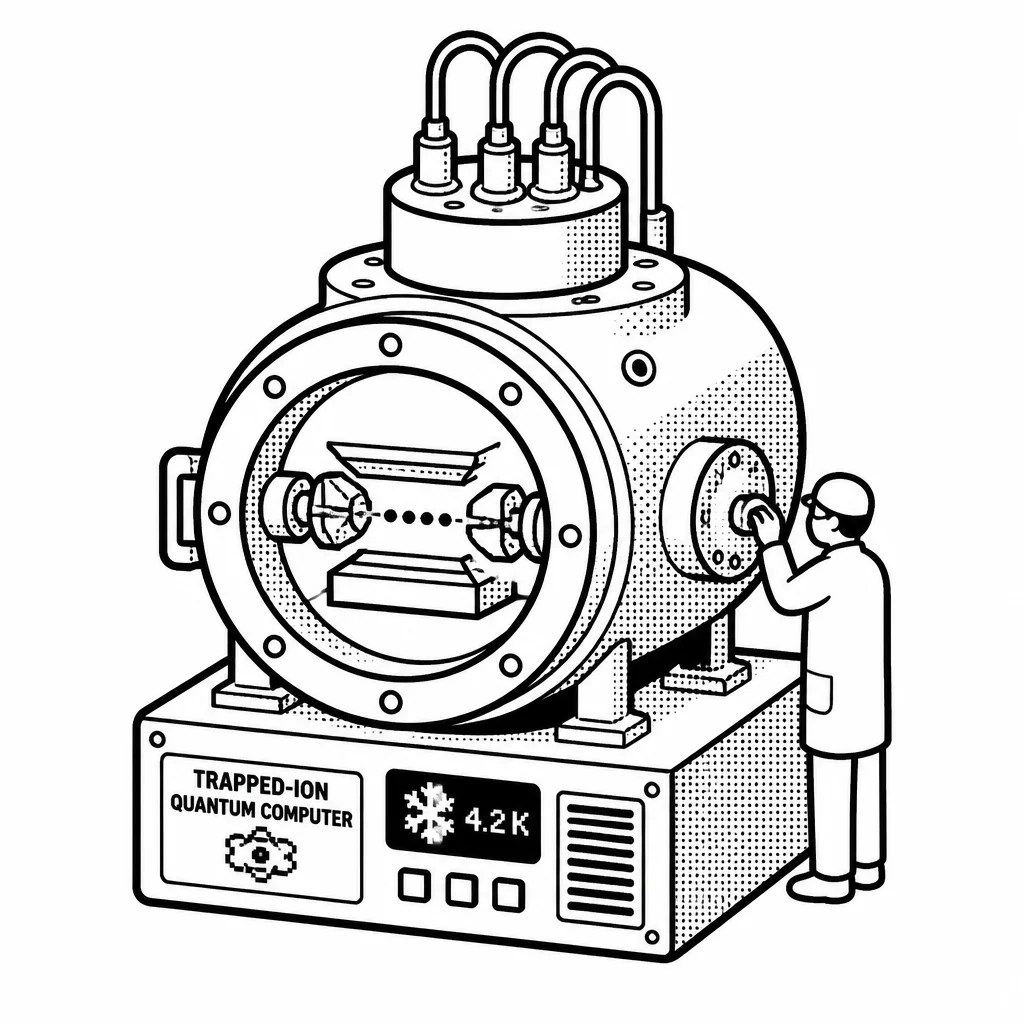
The hard part of quantum computing is control. Most trapped-ion machines today steer their ions with carefully tuned lasers, which are bulky, expensive, and error-prone. Oxford Ionics' bet is to replace those lasers with standard silicon chips that control the ions electronically. The company says this approach makes its machines faster, more reliable, and easier to mass-produce—closer to the way the chip industry already works than to a physics lab. That is the pitch that won it attention and customers. The company was spun out of Oxford University in 2019 by Chris Ballance and Tom Harty, who built the technology during their doctoral research. It has raised significant venture funding and struck partnerships with chip manufacturers and government-backed quantum programs in the UK, betting that electronic control is the path to machines big enough to be genuinely useful rather than just impressive in a lab.
Quantum computing is still a young, unproven business. No one has yet built a quantum computer that reliably beats a classical one at something commercially valuable, and Oxford Ionics competes with much larger players like IBM and Google, as well as other trapped-ion specialists. Its customers are mostly research institutions and early enterprise pilots, so revenue is small and the real payoff, if it comes, is years away. The company's future hinges on whether electronic control really does scale better than lasers—and on whether quantum computing becomes a market before the funding runs out.
Saved answer · last researched 11 Nov 2026
Timeline
Two Physicists Rethink Quantum Computing
Two Oxford physicists, Chris Ballance and Tom Harty, started the company in 2019 to rethink how quantum computers get built. They saw that trapped-ion qubits worked well, but the lasers needed to control them were a bulky mess that could never scale. Their idea was simple to say and hard to do: swap the lasers for ordinary silicon chip technology. Instead of fighting the hardware, they would control quantum bits with electronics, the same stuff inside the phone in your pocket.
Seed Money to Build the Idea
A year later, the company raised a seed round of about $3.3 million, with Oxford Science Enterprises among the early backers. That money paid for the first real work on its trapped-ion technology, turning a clever idea into something you could actually build.
Series A Brings Total Funding Past $40M
In 2023 the company closed a Series A round, pushing total funding past $40 million. Now it could grow the team and scale up operations, which is what you need when your plan is to build machines, not just prototypes.
Breaking Records Without Lasers
Then came the proof. In 2024 the company showed it could control trapped ions with electronics alone and hit 99.97% two-qubit fidelity, a measure of how often the machine gets the answer right. It held world records in single-gate fidelity, two-qubit gate fidelity, and state preparation and measurement. And it did not sit on the lab bench: full-stack quantum computers went out the door to the UK's NQCC and Germany's Cyberagentur.
A Roadmap and Real Sales
In 2025 the company unveiled a roadmap toward fault-tolerant quantum computing with devices of a million or more qubits, and said its systems were available to order. It also reported over $20 million in sales for 2024. The pitch was no longer theoretical: customers were buying.
IonQ Buys Oxford Ionics for $1.075 Billion
That same year, US-listed IonQ agreed to buy Oxford Ionics for $1.075 billion, the highest-value acquisition ever of a University of Oxford quantum computing spinout. The deal cleared UK regulators and formally completed in September 2025. Oxford Ionics kept operating in the UK while its technology was folded into IonQ's global roadmap.
The Argument That Won
Nearly a year later, Chris Ballance held a president's title at IonQ and stayed chief executive of Oxford Ionics. The Oxford lab culture and team survived the takeover, with plans to grow the Oxford workforce. In the end, the acquisition bought an argument as much as a team: that electronic control is the scalable path to large qubit counts.