Understand any stock in simple English
Enter a ticker to learn what the company does and how it makes money.
Canva Pty Ltd
Canva makes free and paid design software that anyone can use to create posters, presentations, social media posts, and more.
Canva is a design software company that lets people who have never opened a professional design program make things that look good. You open a website or app, pick a template — a birthday card, a pitch deck, an Instagram post, a resume — drag in some photos and text, and out comes something polished. The whole point is to strip away the expensive software and steep learning curve that used to sit between a normal person and a decent-looking poster.
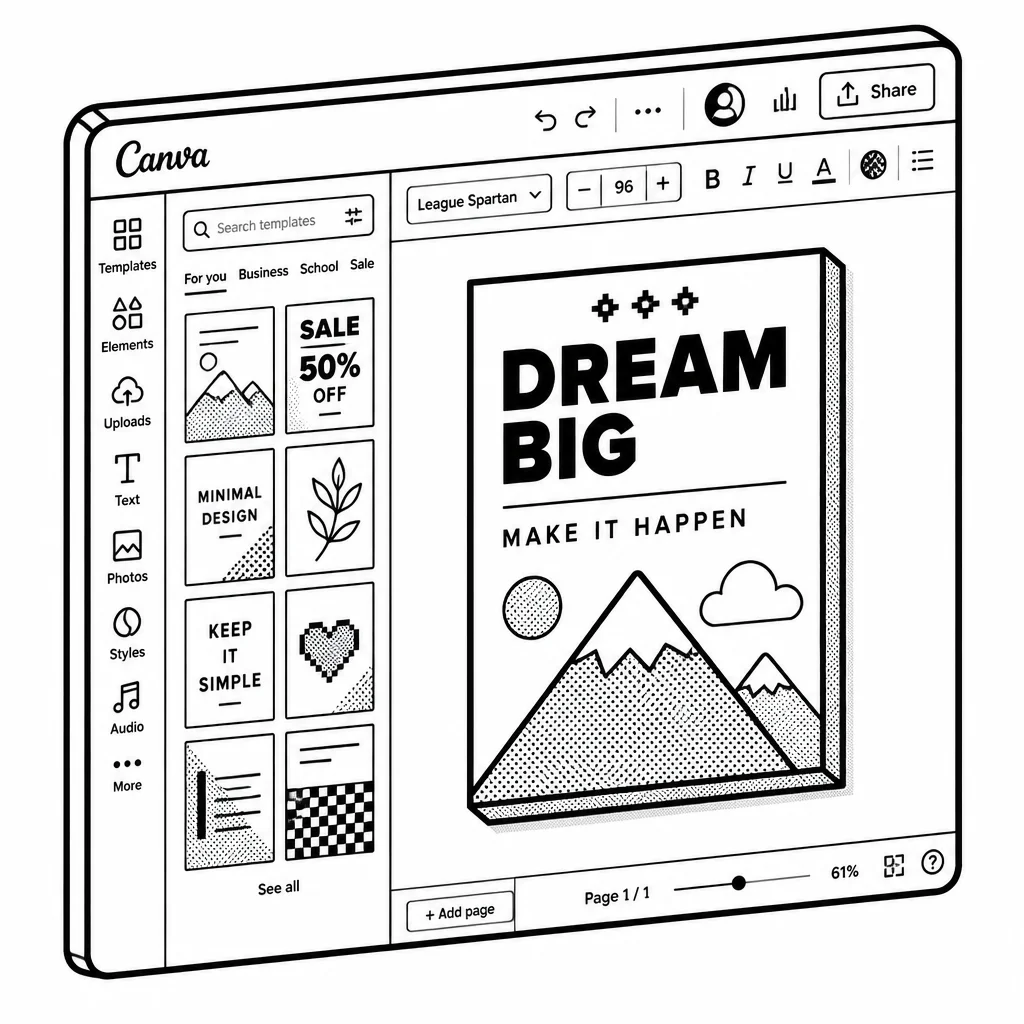
The business runs on a simple split. Most people use Canva for free, and that is deliberate: free users are the marketing engine, since they bring it to their workplace, their classroom, and their friends. The money comes from subscriptions — Canva Pro for individuals and Canva for Teams for organizations — which unlock extra templates, brand controls, a bigger media library, and collaboration tools. It also has a free tier for schools and nonprofits. Canva was founded in 2013 in Sydney by Melanie Perkins, Cliff Obrecht, and Cameron Adams, and it is still headquartered there, which makes it an unusual Australian success story in a market dominated by American software giants. Its competitors are a strange mix. On one side sit the professional tools like Adobe, whose Photoshop and Illustrator are far more powerful but far harder to learn. On the other side are simpler point tools and, increasingly, AI image and text generators. Canva's bet is that most people don't want power — they want speed and a result that doesn't look embarrassing. That has worked: the company has said it passed $2 billion in annualized revenue and has hundreds of millions of users, making it one of the most valuable private software companies in the world.
The interesting wrinkle is how it treats its money and ownership. Canva has raised outside capital but has deliberately stayed private, and it has used its cash and shares to buy smaller companies that add capabilities — including design tools, image editing, and AI features — rather than building everything itself. It has also made a point of giving equity away: the founders pledged to give most of their wealth to charity, and the company has set up a program to share ownership with employees. Whether the AI wave helps or hurts a template-driven design tool is the big open question, and it is the one that will decide whether Canva stays a giant or becomes a footnote.
Saved answer · last researched 4 Nov 2026
BIG PICTURE
95% of Fortune 500 companies use Canva, which makes money from paid team subscriptions
- 95% Fortune 500 companies using Canva
- 5% Fortune 500 companies not using Canva
Canva is often seen as a friendly tool for students and small businesses. Yet 95% of Fortune 500 companies use its products, according to the company. Those large customers pay for group subscriptions, and Canva has been profitable since 2016. Its recurring revenue passed $4 billion in 2025, up from $1.4 billion in 2022. Source: Les Numériques, data from 2026
Timeline
Fusion Books Starts in a Living Room
Melanie Perkins was teaching students how to use design software, and she kept watching them struggle. Tools like Photoshop were 'crazy hard' to learn. So she and Cliff Obrecht built Fusion Books, a simple online tool for making school yearbooks, working out of her mother's living room in Perth. It was a small business, but it proved a big idea: design could be simple and shared, and that became the seed for Canva.
Canva Opens to the Public
Perkins and Obrecht moved to Sydney and brought in Cameron Adams, a former Google designer, as a third co-founder. Together they raised money and set out to make design easy for everyone, not just trained professionals. Canva opened to the public as a template-based drag-and-drop tool. Pick a template, drop in your words and pictures, and you had a design.
Canva Becomes a Unicorn
A big investment led by Sequoia Capital valued Canva at a billion Australian dollars. That made it a unicorn, the tech word for a private startup worth over a billion. It was only the second Australian startup to get there, after Atlassian, and it put Canva firmly on the map.
Canva Buys Pixabay and Pexels
Canva bought two free stock photo sites, Pixabay and Pexels, so users could pull their photos straight into designs. It was a small deal with a big effect: the content library grew, and Canva started looking less like a simple tool and more like a whole design ecosystem.
Canva Hits a $40 Billion Valuation
Canva raised a huge round of money, and its valuation peaked at around 40 billion US dollars. Suddenly this Perth living-room idea was one of the most valuable private software companies in the world.
The Valuation Comes Down
Then the tech mood turned. Investors got cautious about fast-growing startups, and Canva's valuation was marked down from its peak to about 26 billion dollars. The important part: this was a change in how investors felt, not a collapse in users or revenue. The business kept growing underneath.
Canva Buys Serif and Leonardo AI
Canva bought Serif, the UK maker of the Affinity design tools, for about 380 million dollars, moving onto the turf of professional design software like Adobe. It also bought Leonardo AI, an AI image generator. The message was clear: Canva was no longer just the easy tool for beginners. It wanted to be a full creative and AI platform.
Canva Reaches $42 Billion
An employee share sale valued Canva at 42 billion dollars, above its old peak. By the end of the year it had more than 265 million monthly users and about 4 billion dollars in yearly recurring revenue. Canva had become a leading global design platform and one of the most watched IPO prospects around.
AI Costs Hit Growth
Then came the twist. Canva cut its expected revenue growth from 30% to 20%, blaming the surprisingly high cost of running its AI features. It slowed new AI products while it rebuilt the underlying systems, and after that rebuild the cost per AI task fell by nearly 90%. Investors marked the valuation down sharply, and the expected IPO slipped toward 2027.
Canva Cuts 22% of Its Workforce
A few months later, Canva announced a restructure affecting 1,271 roles, about 22% of its people, through layoffs and relocations. CEO Melanie Perkins called it the hardest moment in the company's 13-year history and said Canva needed to 'refound' itself around smaller teams. The cuts came after the first growth slowdown in a decade, with pressure from AI rivals and AI costs, as the company reshaped itself for its next chapter.