Understand any stock in simple English
Enter a ticker to learn what the company does and how it makes money.
Figma, Inc.
Figma sells cloud-based software that teams use to design and build digital products together in real time.
Figma makes the software that a lot of the digital world is designed in. If you have used an app, a website, or a game that felt polished, there's a decent chance a designer built that screen inside Figma first. The core product is a design tool that runs in a web browser, so people can work on the same file at the same time, like a shared Google Doc, except for screens, buttons, and layouts instead of text. That live collaboration is the whole trick: before Figma, designers mostly passed files back and forth, and the modern alternative, Adobe, was built around desktop files rather than the browser.
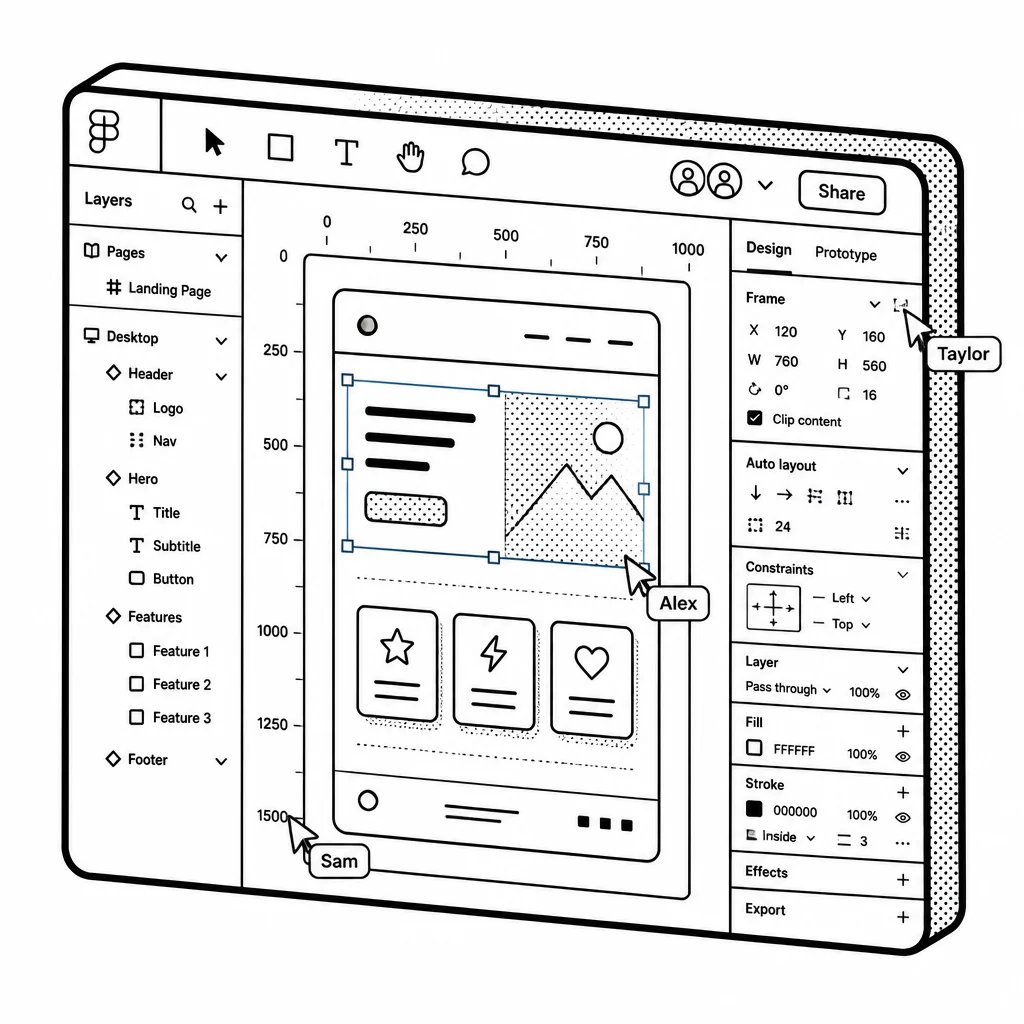
The company earns money by selling subscriptions. Designers and product teams pay monthly per person, and the real money comes from big companies with hundreds or thousands of seats, where design, engineering, and product management all need to look at and comment on the same work. Figma keeps adding tools around that core: a whiteboard for early brainstorming, a tool for building interactive prototypes, and, more recently, its own software for making slides and websites. It also sells FigJam and Dev Mode, which helps engineers turn a finished design into actual code. The business is closely watched because of its strange history. Adobe agreed to buy Figma for $20 billion in 2022, but regulators in the US, UK, and Europe pushed back, and the deal collapsed in late 2023. Adobe paid Figma a $1 billion termination fee, which was a very nice consolation prize. Then in 2025 Figma went public on the New York Stock Exchange in one of the year's biggest tech listings, and the stock popped hard on day one. Its headquarters are in San Francisco.
Figma's strength is habit and network effects: once a big company's design team is inside Figma, switching means retraining everyone and moving old files, which is painful. Its risk is competition from deep-pocketed rivals and the constant threat that AI tools will let anyone generate a decent interface with a prompt, shrinking how much design work people need a dedicated tool for. So far, though, Figma has bet that AI makes designers faster rather than unnecessary, and it is stuffing AI features directly into its products.
Saved answer · last researched 14 Nov 2026
BIG PICTURE
Figma survey finds 83% of product builders now work on AI projects, up from 65% a year earlier
- 83% Product builders working on AI-powered projects
- 17% Product builders not working on AI projects
Figma's 2026 survey of designers, developers and product managers found 83% are now building AI-powered projects, up from 65% a year before. Nearly half say at least half their work involves AI features. That matters because Figma sells the shared canvas where these teams design and test products together, so more AI work means more time spent inside its software. Source: Figma 2026 AI Report, data from 2026
Timeline
Two Students Start Figma
Dylan Field and Evan Wallace wanted to build design software that lived in a browser, so teams could work on the same file at once, the way people already did in Google Docs. Field got a $100,000 Thiel Fellowship, and he dropped out of Brown University to start the company.
Figma Launches Publicly
After years of building, Figma opened to the public. It let teams design together in the same file in real time, with nothing to install and no files passed back and forth. Pros first waved it off as a light toy next to desktop software, but strong features, flexibility and version control won them over.
Adobe Agrees to Buy Figma
Adobe agreed to buy Figma for about $20 billion in cash and stock, calling it the start of a new era of collaborative creativity. The price was a stamp of approval: the design upstart was now the next big thing in design software.
The Adobe Deal Collapses
European regulators blocked the deal, fearing it would kill competition in product design software, and the takeover fell apart. Figma walked away with a $1 billion breakup fee, money it would put into new products and AI.
Figma's Value Gets Cut in Half
With the Adobe deal gone, Figma's internal valuation dropped to around $10 billion, roughly half of what Adobe had offered. The company was still valuable, but the market was now pricing it on its own.
Figma Goes Public
Figma listed on the NYSE under the ticker FIG, priced at $33 a share for a $19.3 billion market value. The stock opened at $85 and closed its first day at $115.50, a 250% jump that pushed the value to nearly $70 billion and made it one of the decade's hottest debuts.
The IPO Rally Unwinds
Just days later, the post-IPO excitement faded and about $11 billion of market value came off the stock. The blockbuster first day, it turned out, was not the new normal.
Anthropic Launches Claude Design
Anthropic released Claude Design, a direct rival to Figma, Adobe and Canva, as AI tools kept getting better fast. Investors worried AI could threaten or even replace design software, and Figma's shares fell nearly 80% from their peak.
Figma Releases Its Agent
Figma fought back by making its agent widely available in early October, and customers used it so much that credit consumption more than doubled by the end of the month. It pitched itself as the center of gravity for design and code, with its MCP server and first-party model, and raised its full-year revenue outlook.