Understand any stock in simple English
Enter a ticker to learn what the company does and how it makes money.
Siemens Healthineers AG
Siemens Healthineers makes the machines, software, and tests that hospitals and clinics use to diagnose and treat patients.
Siemens Healthineers is one of the world's biggest makers of medical equipment. If you've ever had an MRI, a CT scan, or a blood test at a hospital, there's a decent chance a machine or a chemical from this company was involved. It sells imaging scanners, laboratory testing gear, and cancer-treatment devices to hospitals and clinics in pretty much every country.
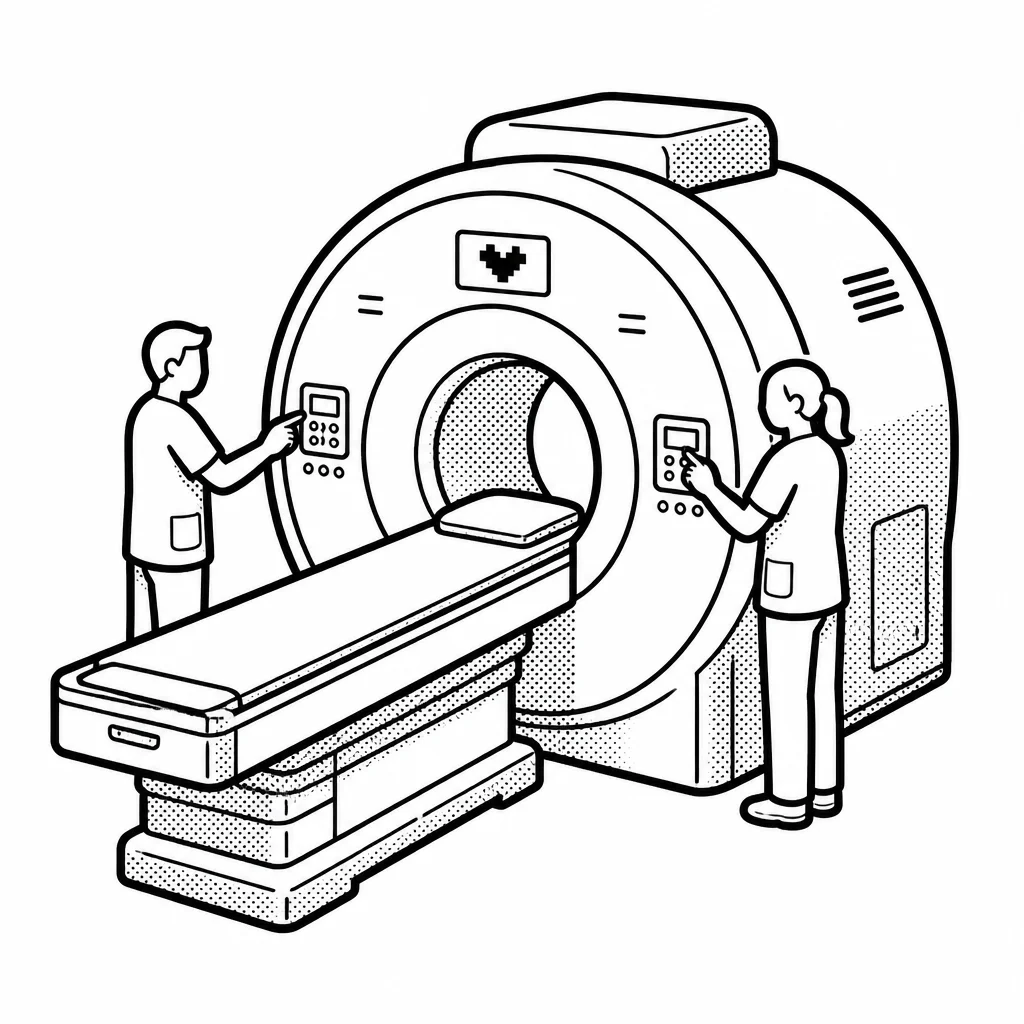
The business breaks into a few main parts. Imaging is the biggest: MRI, CT, and X-ray machines, plus the software that runs them. Diagnostics covers the lab side — the machines and chemical tests that analyze blood and other samples. And there's a smaller but important unit for image-guided therapy, which helps doctors treat things like heart problems and tumors with live images guiding their hands. It also owns Varian, a major maker of radiation machines for cancer treatment, which it bought in 2021 for about $16 billion — a big bet that cancer care would be a growth engine. Hospitals don't just buy a scanner and walk away. They pay for service contracts, software updates, and the reagents that keep lab machines running, which makes revenue steadier than one-off equipment sales. The catch is that this is an expensive, competitive business. Rivals like GE HealthCare and Philips fight for the same hospital budgets, and governments squeezing healthcare spending can slow orders. Siemens Healthineers also depends heavily on China, where slower hospital spending and local competition have hurt sales recently.
The company is a separately listed spin-off of the German conglomerate Siemens, though Siemens still owns a stake. It pays a dividend and has been working through problems in its diagnostics unit, where margins lag the imaging business. The simple version: it sells the expensive tools of modern medicine, then keeps earning money keeping them running — a good business as long as hospitals keep buying and patients keep needing scans.
Saved answer · last researched 12 Nov 2026
Timeline
Two Men and a Telegraph
In Berlin, Werner von Siemens and Johann Georg Halske started a small telegraph-building shop around Siemens' clever pointer telegraph, a device that spelled out messages by pointing at letters. The company soon made an improved induction device, and its Slide Inductor for electrotherapy became the first medical product it built and sold successfully for decades. That early medical thread would, in time, become the whole point of the business.
First X-Ray Tubes
Just one year after Wilhelm Conrad Röntgen discovered the X-ray, Siemens was already making X-ray tubes industrially for medical diagnosis. That quick jump put the company into medical imaging, the core business it still leads today.
Medical Firms Merge
X-ray pioneer Friedrich Dessauer's Veifa-Werke and the firm Reiniger, Gebbert & Schall joined forces with Siemens' medical operations to form Siemens-Reiniger-Werke. The combined business grew into a major maker of electromechanical medical technology inside the Siemens group.
Into Siemens AG
Siemens-Reiniger-Werke was folded into the newly founded Siemens AG, and the medical division was renamed. A few years later it was reorganized as a corporate division for medical technology within Siemens.
Siemens Medical Solutions
The medical division took the name Siemens Medical Solutions, and later became Siemens Healthcare, one of the main sectors of Siemens AG.
The Healthineers Name
Siemens rebranded its healthcare division as Siemens Healthineers, with CEO Bernd Montag introducing the name. The launch came with a celebratory dance routine that got a lot of ridicule, and Montag later admitted it was a mistake.
Healthineers Goes Public
Siemens Healthineers listed on the Frankfurt Stock Exchange, selling a small slice of the company to public investors while Siemens kept a majority stake. It was Germany's largest listing in decades.
A Painful Profit Warning
The share price plunged after the company guided to a profit decline for the coming year, hit by tariffs running to hundreds of millions of euros. Weak fourth-quarter results added to investor frustration over repeated negative surprises.
A Standalone Healthineers
Siemens Healthineers announced it will rename itself simply Healthineers as Siemens spins it off, cutting its stake from about two-thirds to a bit over a third. The Diagnostics segment will be carved out as a standalone company by mid-2028, and the company is exiting general ultrasound imaging to focus on Imaging and Precision Therapy. The aim is to sharpen the company as a fully standalone healthcare leader concentrated on its high-margin imaging and cancer-therapy core.