Understand any stock in simple English
Enter a ticker to learn what the company does and how it makes money.
GE HealthCare Technologies Inc.
GE HealthCare makes the big medical machines and imaging tools that hospitals use to see inside the body and care for patients.
GE HealthCare is one of the world's largest makers of medical imaging machines. If you've ever had an X-ray, a CT scan, an MRI, or an ultrasound, there's a good chance the machine came from this company. It sells these scanners, along with patient-monitoring equipment and the contrast dyes that make images easier to read, to hospitals and health networks around the world.
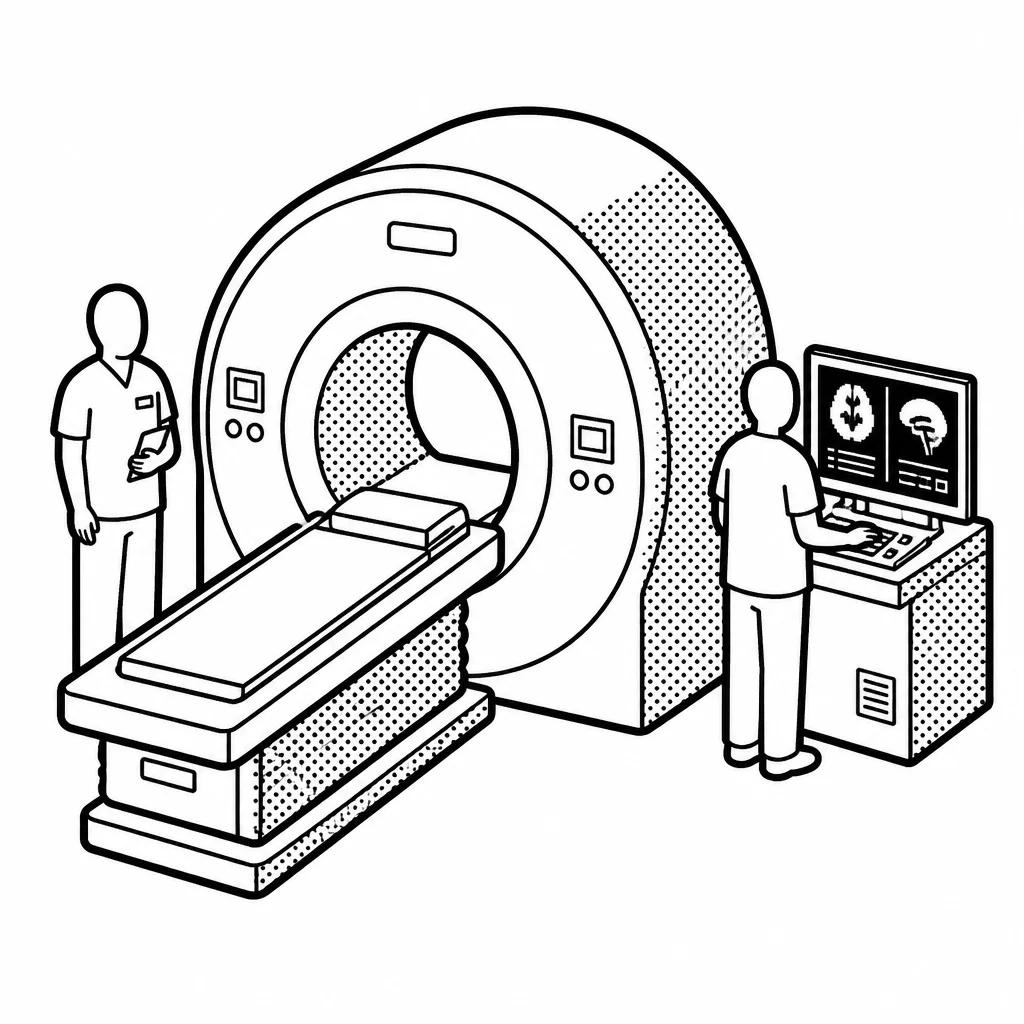
The business splits into a few main parts. The biggest is imaging, where it sells the scanners and the software that runs them, plus a service business that keeps those machines humming for years after the sale. There's also an ultrasound division, a patient care unit that makes monitors and anesthesia equipment, and a pharmaceutical diagnostics arm that sells the injectable dyes used in scans. Hospitals pay for the hardware, the ongoing service contracts, and the consumables — and they keep coming back because these machines are expensive, deeply embedded in daily workflows, and often paired with long-term service deals. What makes this a good business is the recurring revenue. A scanner is a big one-time sale, but the service contract and the consumables that follow can last a decade or more. That's why the company pushed hard into service and software, and why it spends heavily on research to stay ahead of rivals like Siemens Healthineers, Philips, and Canon. It's a scale game with high barriers to entry — regulators must approve every device, and hospitals don't switch vendors casually.
GE HealthCare became an independent public company in early 2023, spun out of the old General Electric conglomerate after more than a century inside it. GE traces its medical imaging roots back to the 1890s and the earliest X-ray tubes, so this is a very old business wearing a new ticker. Since going solo, management has focused on paying down debt from the separation and investing in faster-growing areas like AI-assisted imaging software, where algorithms help radiologists spot problems and speed up scans. The company also leans on its installed base: once a hospital owns its machines, every upgrade, service call, and software add-on is a chance to earn more.
Saved answer · last researched 12 Nov 2026
BIG PICTURE
GE HealthCare has less than 5% of multi-modal diagnostic data integrated into treatment decisions
- 5% Integrated into decision-making
- 95% Not effectively integrated
Hospitals generate 35% more diagnostic data every year, yet less than 5% of it is effectively woven into treatment decisions. GE HealthCare sells the scanners, contrast agents and software that create much of that data, and its installed base of more than 4 million machines gives it a direct line to sell the missing integration. Source: KoalaGains, data from 2026
Timeline
The First X-Ray Machine
In 1896, GE's Elihu Thomson built electrical equipment for making X-rays and showed that doctors could use it to see bone fractures in three dimensions. This was the very start of GE's medical imaging business, the seed that eventually grew into GE HealthCare.
A Tube That Saw Deeper
A GE researcher named William Coolidge built a better X-ray tube that let doctors see more deeply into the body. The design worked so well that doctors still use the idea today.
The First Body Scanner
In 1978, GE introduced the 7800, the first full-body CT scanner that hospitals could use as a routine tool. It was the first scanner designed by the healthcare business itself.
Sharper Pictures of Soft Tissue
Five years later, GE launched the first high-field MRI scanner, which used a powerful superconducting magnet to capture soft tissue in amazing detail. That cemented GE's lead in advanced medical imaging.
A Command Center for Hospitals
In 2015, GE helped launch the first NASA-style command center inside a hospital, using data, machine learning, and language software to help hospitals run smoother and waste less. It was a sign the company was moving beyond machines into digital tools.
A Smarter Way to See
In 2019, GE won FDA clearance for the first CT image reconstruction technology built on deep learning, a type of AI. The software uses a neural network to produce high-quality images, pushing GE further into AI-powered imaging.
GE Decides to Split in Three
In late 2021, GE announced it would break itself into three public companies: GE Aerospace, GE HealthCare, and GE Vernova. The board believed the healthcare business would be worth more on its own than buried inside a giant conglomerate.
GE HealthCare Goes Solo
At the start of 2023, GE HealthCare completed its spinoff and began trading on Nasdaq, launching with about 51,000 employees in more than 160 countries and serving over a billion patients a year. Going independent, its CEO said, gave it the freedom to invest and innovate in precision care.
Full Ownership in Japan
In 2025, GE HealthCare bought the other half of Nihon Medi-Physics, a Japanese radiopharmaceutical company it already partly owned. Full ownership strengthened its drug-making arm for molecular imaging.
A Rough Quarter
In 2026, GE HealthCare reported quarterly earnings and cut its outlook for the full year, blaming a recall tied to a supplier and falling sales in its patient care unit. The stock dropped about 13% in a single day, and a securities fraud investigation followed.
Fewer Silos, Bigger Units
Later that year, GE HealthCare merged its Imaging and Advanced Visualization Solutions businesses into one large unit worth nearly $15 billion, and set up a new Global Markets region covering everywhere except China. New leaders were put in place to simplify how the company runs and speed up growth.
Buying Sofie Biosciences
That fall, GE HealthCare agreed to pay $945 million in cash for Sofie Biosciences, adding U.S. rights to a tracer used in medical scans and expanding its radiopharmaceutical manufacturing. The deal deepened its high-margin drug diagnostics business.