Understand any stock in simple English
Enter a ticker to learn what the company does and how it makes money.
IMC Rare Earths Ltd
IMC Rare Earths is a mining company that explores and develops rare earth element projects in Brazil to supply industries.
IMC Rare Earths is a mining company with a very specific target: the rare earth elements buried in the ground in Brazil. These are not the "rare" metals like gold that people picture in a jeweler's window. They are a group of seventeen chemical elements with tongue-twisting names like neodymium and dysprosium, and they are the secret ingredients in the modern world. They make the tiny, powerful magnets inside electric car motors, wind turbine generators, and the speakers in your phone. They are also used in the phosphors that make screens glow and in the polishing powders that smooth glass and silicon chips.
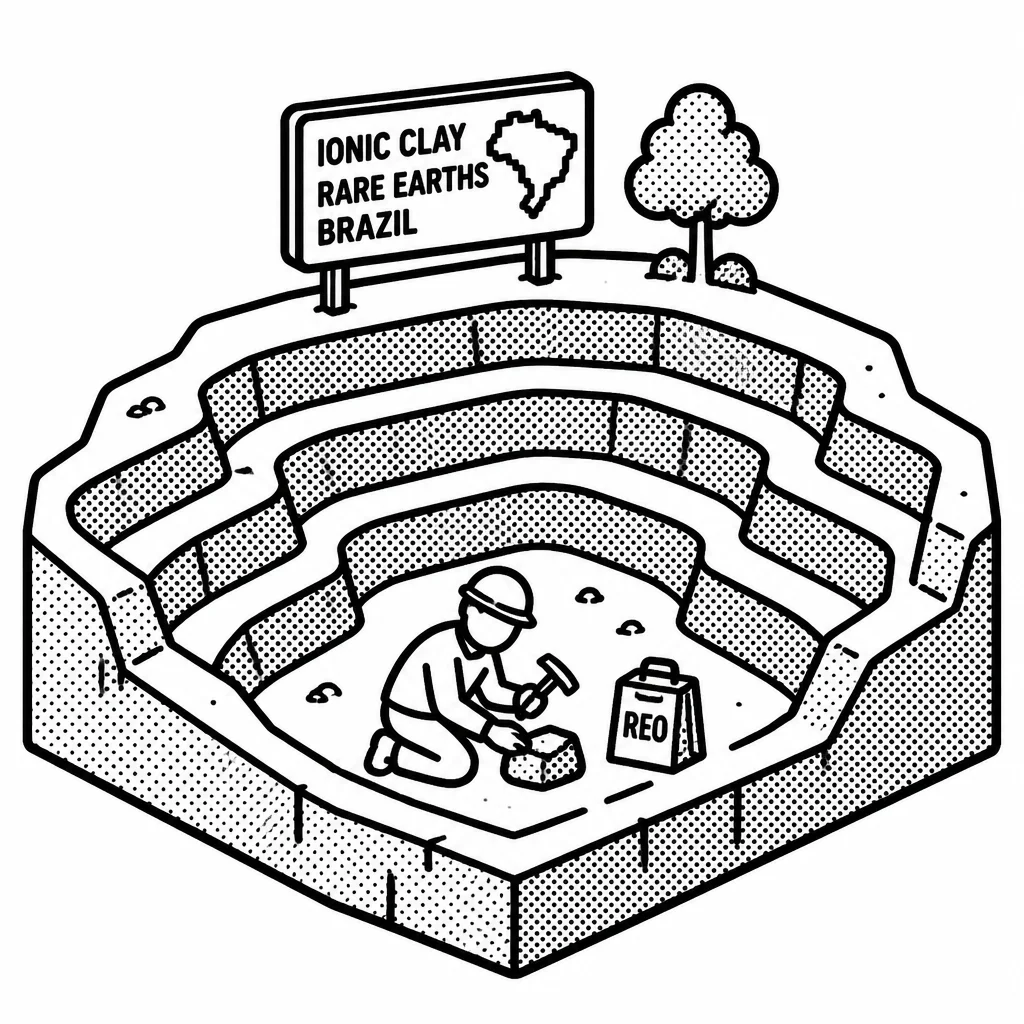
The company's job is to find these elements in Brazil, figure out if they can be dug out and processed at a sensible cost, and eventually sell them to the industrial companies that need them. This is not a business that makes a product today and rings up sales tomorrow. It is in the development stage, which means the work is exploration, drilling, and studying the geology to prove a project is worth building. The customers, when they arrive, will be magnet makers, electronics manufacturers, and the sprawling supply chains behind them. They pay for a reliable, non-Chinese source of these critical materials, because China currently dominates rare earth processing and many Western governments are desperate to break that grip. What makes this an interesting and difficult business is the gap between finding rare earths and actually making money from them. Rare earths are not that rare in the earth's crust; the hard part is separating the seventeen elements from each other, which is chemically messy and expensive. IMC Rare Earths is betting that Brazil's geology gives it a good enough deposit to justify the long, capital-hungry road from exploration to a producing mine. Investors in the stock are effectively buying a lottery ticket on that deposit turning into a real, cash-generating operation.
The company is small and early-stage, which means the risks are real. It has no meaningful revenue yet, and its value depends on exploration results, permitting, financing, and eventually building a mine. Mining projects take years and enormous sums of money, and many never get built. The reward, if it works, is that rare earths are essential to the energy transition, and buyers in the US and Europe are actively hunting for new suppliers outside China.
Saved answer · last researched 15 Nov 2026
BIG PICTURE
China refines over 90% of the world's rare earths, the bottleneck IMC is trying to break
- 90% Global rare earth refining controlled by Chinese producers
- 10% Refining capacity outside China
Chinese producers control more than 90% of the world's rare earth refining capacity, according to the company's own IPO filing. That concentration is the reason a pre-revenue explorer in Bahia can matter: carmakers and defense contractors want magnet rare earths from somewhere other than China. IMC holds a 1.1 billion tonne inferred resource at Itarantim, but it has no mine yet, only drilling results and a plan. Source: IMC Rare Earths SEC F-1 filing, data from 2026
Timeline
A Brazilian Mineral Venture Begins
The story starts in Brazil, where a man named Francesco Scolaro set up a small company to find, develop, and eventually sell minerals. He called it Niobium Brazil, and it was his vehicle for turning Brazilian ground into a real business.
Building the Corporate Nest
Over time, the Brazilian business was passed up into a new parent company, and that parent was passed up again into another one. Nobody outside was buying or selling anything here; it was the owner rearranging his own companies into a tidy group structure, one layer at a time.
A Cayman Holding Company Appears
Next came a new company in the Cayman Islands, IMC Rare Earths Ltd. Through a simple share swap, it became the parent sitting on top of the whole chain, turning a loose collection of companies into one group with a single head.
The Group Reorganization Finishes
One more piece slid into place when a Brazilian entity called Ionic Clays was handed to IMC Brazil for no money at all. With that, the reshuffling was done: IMC in the Cayman Islands now sat above every company in the group.
Filing to Go Public
With the structure in place, the company turned to outside investors. It filed quietly with US regulators and then publicly, aiming to raise up to $20 million by selling shares on the NYSE American under the ticker IMC, at a planned price of $4 to $6 each.
The IPO Prices and the Stock Soars
The offering priced at $5 a share, selling four million shares and raising the $20 million it wanted. Then the stock took off, nearly two and a half times its offer price, as investors got excited about the potential of the company's Itarantim project.
Strong Recovery Numbers at Itarantim
The company then reported something genuinely promising from its lab work: it could pull up to about 95% of the terbium, a valuable rare earth, out of its ore, and it had produced a mixed rare earth carbonate. It brought in ANSTO Minerals to push the process further.
A Good Result, a Falling Stock
Here is the strange part. The news was good, but the stock fell almost 9%. Investors who had ridden the shares up 137% decided it was time to take profits, and the market also remembered an uncomfortable fact: the company still had no revenue and less than a year of cash to keep going.
Digging Deeper at Block D
The company kept pushing. It launched deeper diamond drilling at Block D to test what lies below the reach of its earlier auger drilling, and brought in WSP to run a field program at Block A testing a way to flush the minerals out of the ground rather than dig them up. That cheaper, gentler approach could matter a lot ahead of the big milestones planned for 2027.