Understand any stock in simple English
Enter a ticker to learn what the company does and how it makes money.
VictoryShares International Free Cash Flow ETF
An exchange-traded fund that gives investors a basket of international stocks chosen for generating strong free cash flow.
This is a fund, not a company that makes or sells anything. It is an exchange-traded fund, or ETF, which is a basket of stocks you can buy and sell on a stock exchange like a single share. This particular basket holds shares of companies outside the United States — international businesses — and it picks them using one specific filter: free cash flow.
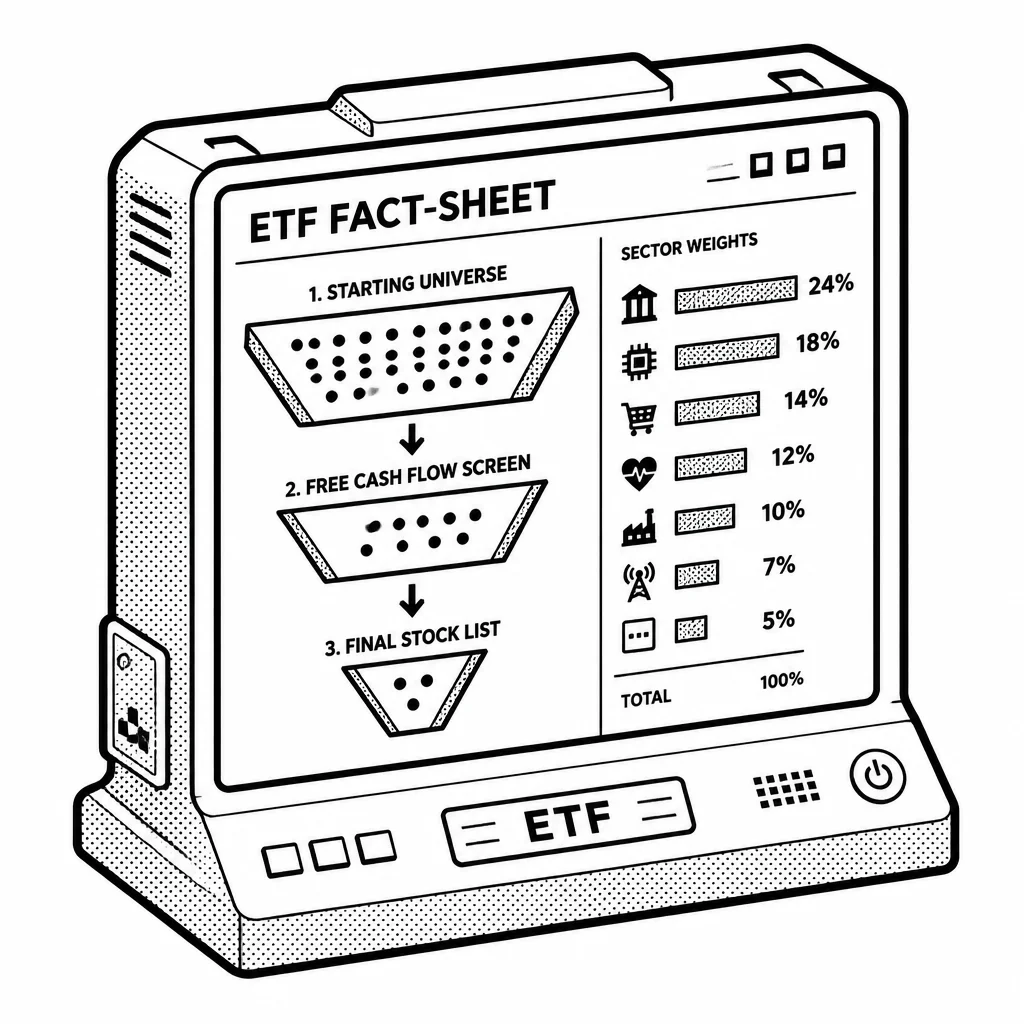
Free cash flow is the money a business has left over after paying its everyday bills and funding the equipment and factories it needs to keep running. It is the cash that can actually be returned to owners, spent on buying back shares, or used to pay down debt. A company that throws off lots of it is usually a sturdy business. So the fund's strategy is simple: find international companies that produce plenty of this leftover cash, and hold them in a single package. The idea is that cash-rich firms tend to be more resilient and less dependent on borrowed money. An investor buys it for instant, low-effort diversification. Instead of picking individual foreign stocks — and dealing with all the extra work that entails — you get a ready-made slice of many international cash generators at once. It trades on the NASDAQ under the symbol IFLO, and it is run by Victory Capital Management, the asset manager behind the VictoryShares brand. The fund charges an annual fee, taken as a small percentage of your money each year to cover the cost of running and rebalancing the basket.
It is a niche product rather than a household name, and that carries real trade-offs. International stocks can swing in value with currency moves and overseas economic cycles, and a fund focused narrowly on one factor — free cash flow — will sometimes trail a broad market index when investors are chasing faster-growing names instead. The basket is also rebalanced periodically to keep its holdings aligned with the cash-flow screen, which means the lineup of companies changes over time. It is a tool for someone who wants a systematic, cash-focused way to own foreign businesses, not a guarantee of returns.
Saved answer · last researched 14 Nov 2026
BIG PICTURE
About 55% of this international fund's money sits in Europe, not Japan or Canada
- 55% Europe
- 45% Japan, Canada and other markets
Europe holds roughly 55% of IFLO's country exposure, with Japan a distant second at nearly 22%. So a fund sold as broad international diversification is really a bet that European companies keep pumping out spare cash. Germany, Britain and the Netherlands do much of the work. If European industry stumbles, the fund feels it. Source: Seeking Alpha, data from 2026
Timeline
Victory Launches Two Cash Flow Funds
The free cash flow idea is simple: free cash flow is the cash a business has left after paying for everything it needs to keep running, and companies that throw off a lot of it are often good businesses. In mid-2025, Victory Capital launched the International Free Cash Flow ETF, which tracks an index that screens profitable companies outside the US, skips banks and real estate, and keeps the top hundred that look cheap against their cash flow and are still growing. Together with its sibling fund, it gave investors a way to build a whole global cash flow portfolio using Victory's existing lineup.
Victory's ETF Lineup Hits 26 Funds
These launches pushed VictoryShares to 26 ETFs, on a platform that had grown past $14 billion in assets. The firm wasn't dabbling anymore; it was betting that cash flow investing could be its thing.
Energy and Software Take Over
A quarterly rebalance in 2026 reshuffled the fund. Out went names like Shell and a batch of global tech and electronics companies, and in came Canadian energy producers like Suncor and Canadian Natural Resources, plus software giant SAP. The index doesn't pick winners by hand: it lets cash flow screens re-sort the list as bargains move around.
A Fast 30 Percent Start
The young fund then rallied about 30 percent in a short stretch, powered by a surge in the gold and energy names sitting at the top of its holdings. It was a great start, but a small fund with no record through a full commodity and rate cycle, and that heavy bet on cyclical sectors left an open question about whether the run could last.