Understand any stock in simple English
Enter a ticker to learn what the company does and how it makes money.
Five9, Inc.
Five9 sells cloud-based software that runs customer service call centers and uses artificial intelligence to help agents handle customer conversations.
Five9 is a software company that runs call centers in the cloud. When you phone a bank, a health insurer, or an online store and a friendly agent picks up, there is a decent chance that person is sitting in front of Five9's software. The company sells the whole kit: the system that routes incoming calls and messages to the right agent, the screen the agent stares at, the tools that queue up chat and email and social media messages, and the reporting that tells managers how their team is performing.
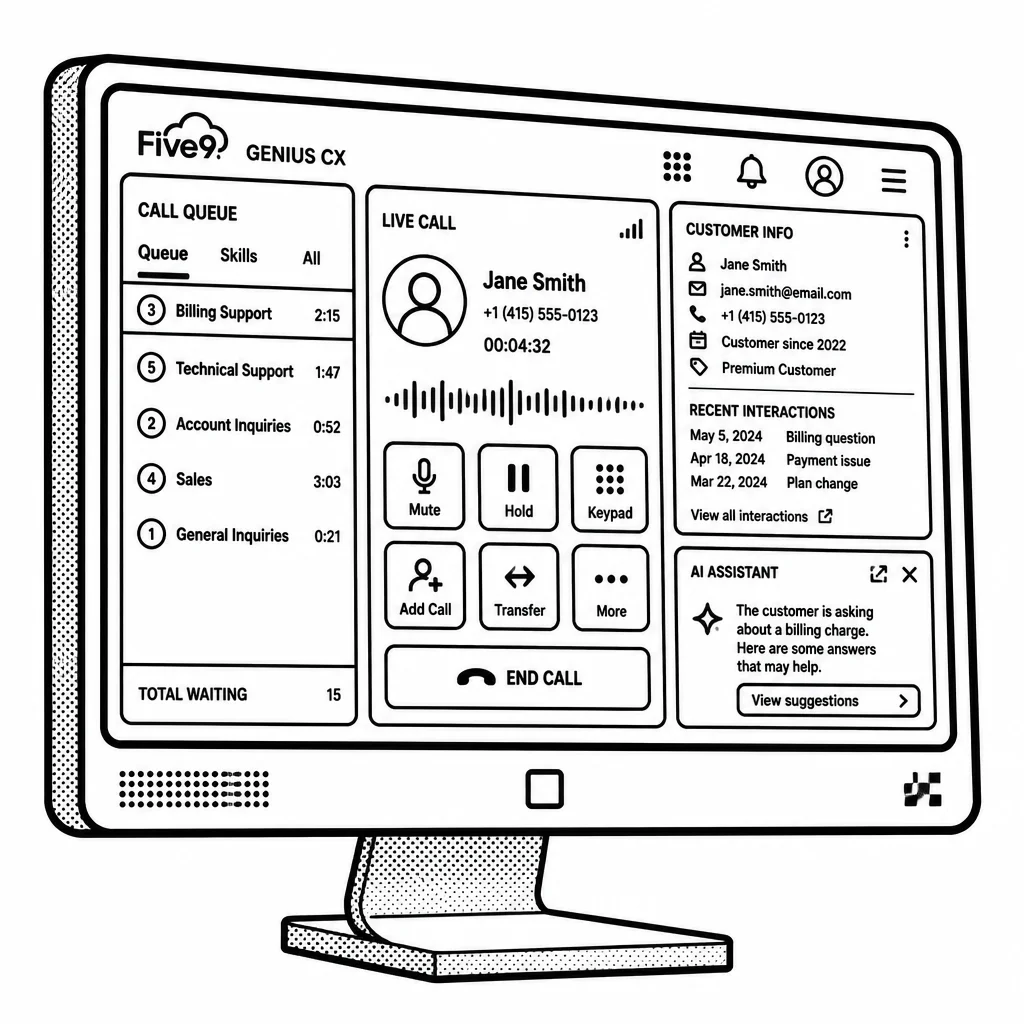
The old way to build a call center was to buy racks of phone equipment and wire it all together in a building. Five9's pitch is that you don't need any of that. Customers log in through a web browser, agents can work from home or anywhere else, and the system scales up when a sale or a storm makes the phones ring off the hook. That flexibility is why businesses choose it over legacy hardware from Cisco and other established vendors, and it is the same reason it competes hard with cloud rivals like Genesys (private) and NICE. The newer and more exciting part of the story is artificial intelligence. Five9 has built AI agents that can answer simple customer questions on their own, plus tools that listen to live calls and whisper suggestions to human agents, summarize conversations automatically, and predict which customers are about to get frustrated. The bet is that AI doesn't replace the call center — it makes every agent faster and lets companies handle more volume without hiring as many people. That story has resonated with investors, even as the company has had to prove it can grow profitably rather than just chase revenue.
Five9 focuses on mid-sized and large organizations rather than tiny businesses, and it has landed customers across healthcare, financial services, retail, and outsourced customer-service providers. The company is based in San Ramon, California, and has been public since 2014. One notable chapter: in 2021, Zoom agreed to buy Five9 for roughly $14.7 billion, a deal that would have married video meetings with call centers. Five9's own shareholders voted it down, and the company stayed independent — a decision that looks different depending on the day, but one that left Five9 to keep building its AI call-center business on its own.
Saved answer · last researched 14 Nov 2026
BIG PICTURE
92% of people say they'd wait under 10 minutes for a human before giving up on a customer service bot
- 92% Consumers who would give an AI agent under 10 minutes before asking for a human
- 8% Consumers who would wait longer or never ask for a human
Five9's own 2026 survey of 3,000 shoppers in the US, UK and Germany found almost everyone has a short fuse with chatbots. Nearly all would hand the conversation to a person in under ten minutes. That sets the bar for Five9's product: it sells software that runs call centers and adds AI to them, so its tools have to hand people off quickly and smoothly rather than trap them in a loop. Source: Five9 2026 Consumer CX Report, data from 2026
Timeline
Four Founders Bet on the Cloud
In 2001, four founders started Five9 to sell phone technology over the internet instead of with physical hardware. The timing was rough, because the market they began in was falling apart after the dot-com bust. But they kept reworking the idea until they landed on something new: a call center that lived entirely in the cloud, a rental service that undercut the big hardware makers like Avaya and Nortel. They didn't invent it perfectly on the first try, but they found a cheaper way for businesses to run customer calls, and that became the company.
Five9 Goes Public
After years of building that cloud call-center business, Five9 sold shares to the public on NASDAQ. It was a major milestone for a company that had started in a shaky market, and it showed the cloud model had real staying power.
Zoom's Takeover Bid Fails
In 2021, Zoom offered to buy Five9 in an all-stock deal worth roughly $14.7 billion. But because the offer was paid in Zoom stock, and that stock kept losing value, Five9's own shareholders voted the deal down. The takeover collapsed, and Five9 stayed independent, free to keep running its own race.
Burkland Returns as CEO
The following year, Mike Burkland came back as chief executive. He had run the company before, but stepped down in 2017 after a cancer diagnosis. His return signaled a push deeper into big-business cloud service and AI-powered customer support.
Guidance Cut Sinks the Stock
Then in 2024, Five9 trimmed its forecast for the year, blaming tight customer budgets and its own sales execution. The stock fell by more than a quarter in a single drop, and a securities class action lawsuit followed. It was a sharp reminder that even a growing company can stumble.
Mathradas Takes Over as CEO
In 2026, the board handed the top job to Amit Mathradas, who had been CEO of Nintex and helped scale Avalara before it was bought by Vista Equity Partners for $8.4 billion. He replaced Burkland, and the board said the change was about speeding up its AI-driven customer experience strategy and winning share in unified platforms.
Five9 Buys Level AI
Soon after, Five9 agreed to buy Level AI for about $325 million in cash. Level AI's tools can be sold on their own to companies that aren't yet on Five9's platform, which opens a new door to customers, and the deal is expected to pull Five9's AI plans forward by around a year.