Understand any stock in simple English
Enter a ticker to learn what the company does and how it makes money.
HANMI Semiconductor Co., Ltd.
HANMI Semiconductor makes the machines that chipmakers use to build and package advanced semiconductors, especially the tools that attach chips to their packages.
HANMI Semiconductor builds the machines that other companies use to make chips. Its specialty is the "back end" of chipmaking — the part after the delicate circuits are printed on a silicon wafer, when the wafer has to be cut apart and each chip has to be attached to a package, wired up, and protected. HANMI sells the tools that do this: saws that slice wafers into individual chips, "bonders" that attach chips to their packages or stack them on top of each other, and vision systems that help machines place tiny parts with extreme precision.
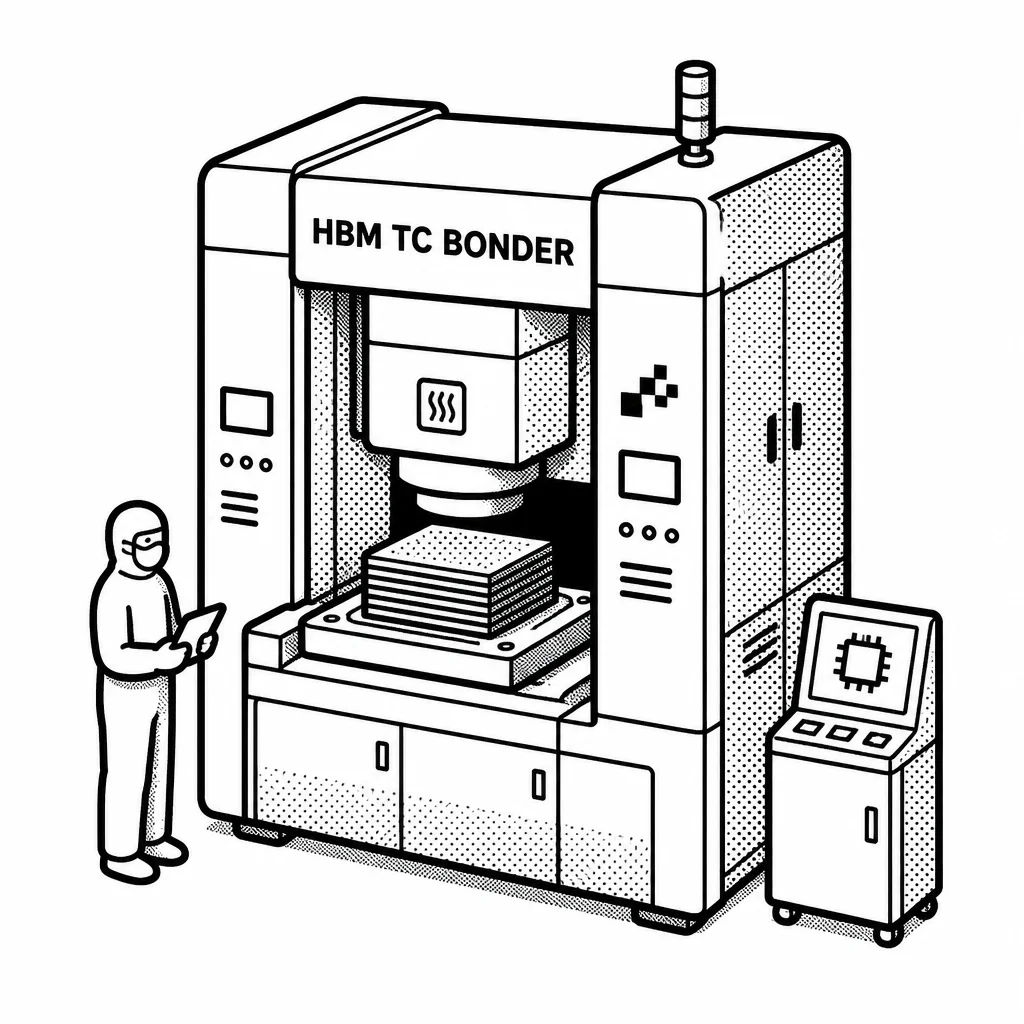
The business is driven by one big trend: chips are getting harder to package. For decades, most chips were simple flat rectangles that got wired into a plastic or ceramic case. Now, the most valuable chips — the ones powering AI data centers — are built by stacking multiple chips or chiplets together in a single package, because that lets designers combine different kinds of silicon without making one giant, expensive chip. That stacking is done by machines called thermo-compression bonders, and HANMI has become a major supplier of them. Its customers are the big chipmakers and chip-packaging companies, mostly in Asia, who buy these tools because precision and speed directly determine how many good chips they can produce. The company is headquartered in South Korea, which puts it close to the world's biggest memory-chip makers. That neighborhood matters: memory makers are heavy users of advanced packaging, and HANMI's bonders have become important equipment for building high-bandwidth memory, the stacked memory used alongside AI processors. HANMI's main competition comes from other semiconductor-equipment suppliers, including Besi and ASMPT, plus various Korean and Japanese toolmakers. What sets HANMI apart is its focus on bonding and packaging rather than the front-end lithography and deposition business, where much larger players dominate.
Semiconductor equipment is a boom-and-bust business. When chipmakers are expanding capacity or racing to build new AI memory, they order lots of tools, and HANMI's sales jump. When they pause, orders dry up. That cyclicality is the main risk investors watch, along with the possibility that a competitor's bonder wins the next generation of designs. The reward is that HANMI sits in a genuinely hard technical niche — placing and bonding chips with micron-level accuracy at high speed — where being early and reliable can lock in customers for years.
Saved answer · last researched 12 Nov 2026