Understand any stock in simple English
Enter a ticker to learn what the company does and how it makes money.
Zoho Corporation Private Limited
Zoho sells affordable business software—email, spreadsheets, customer tracking, accounting—that helps small and mid-sized companies run their operations without paying big enterprise prices.
Zoho is a software company that makes the unglamorous tools a business needs to actually function: a place to track customers, a professional email address, spreadsheets, invoices, and accounting books. Most of its customers are small and mid-sized businesses that could never afford the big enterprise suites, and Zoho's pitch is simple—pay a low monthly fee per employee and get a bundle of useful apps instead of one expensive product.
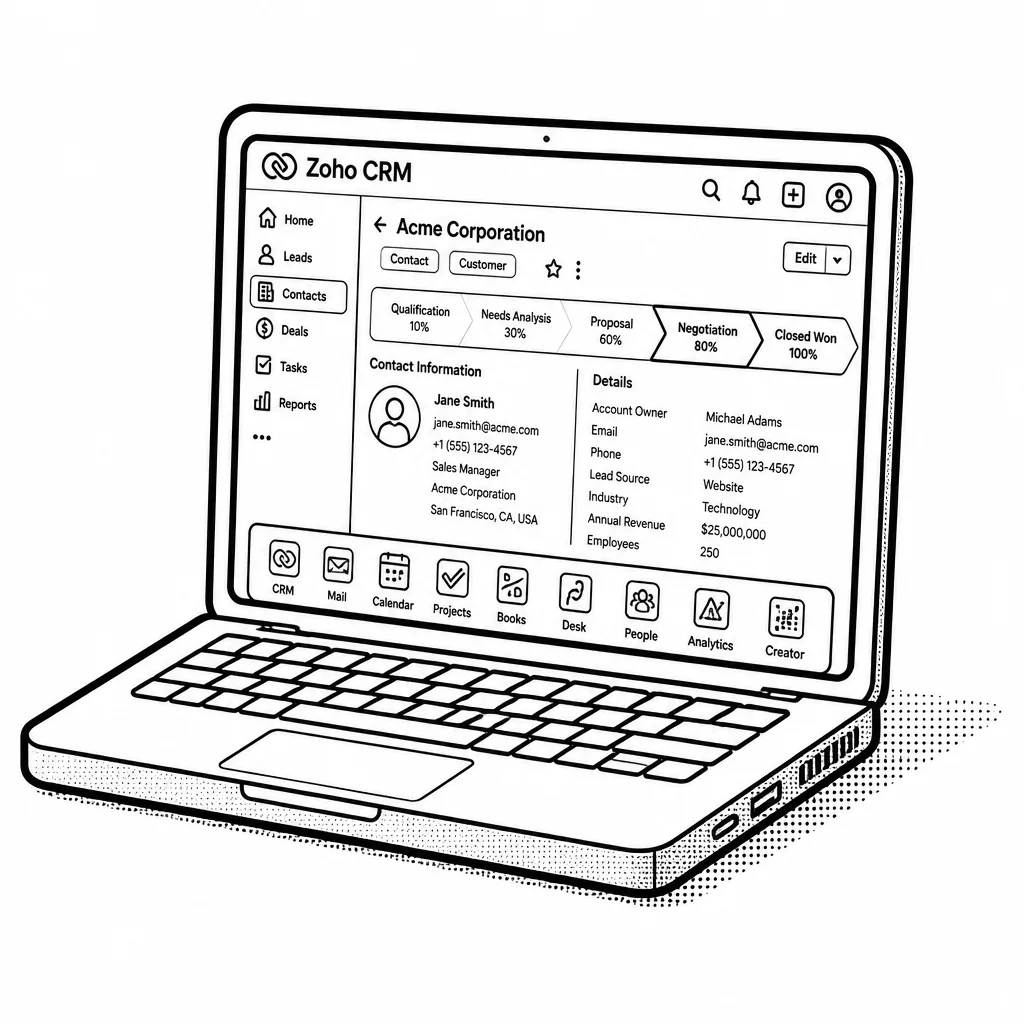
The company runs a huge catalog of more than fifty apps, but the core workhorses are Zoho CRM (the customer-tracking tool that is its best-known product), Zoho Mail and the broader Workplace suite, and Zoho Books, its accounting software. These are sold either individually or as bundles priced per user, which means revenue grows as customers add employees and add more apps. Zoho also makes money from Zoho One, a flat per-employee subscription that unlocks the entire catalog—a clever way to sell more without charging more per app. What makes Zoho unusual is its ownership and cost structure. It is privately held and bootstrapped—no venture capital, no outside investors—controlled by founder Sridhar Vembu and his family. It is headquartered in Chennai, India, but runs much of its engineering from small rural offices in India, deliberately hiring outside big cities to keep costs low and talent loyal. Because it answers to no public shareholders, it can price low, plan in decades, and skip the growth-at-all-costs playbook.
That low-cost, no-investor model is both its strength and its limit. It competes with giants like Microsoft (Dynamics and Microsoft 365), Salesforce in customer tracking, and Google in email and productivity, and it wins on price and breadth rather than on brand or deep enterprise features. Rivals' AI features and integrations have become table stakes, and Zoho has answered with its own AI assistant. The cash the business generates stays inside the company, funding product development and rural hiring rather than dividends or buybacks, which suits a firm built to stay independent and profitable on its own terms.
Saved answer · last researched 10 Nov 2026
BIG PICTURE
Zoho is the employer 10% of surveyed Indian tech workers most want to join
- 10% Indian tech professionals naming Zoho as top choice
- 90% Those choosing other employers
In a survey of Indian tech professionals about where they most want to work, 10% picked Zoho, ahead of Infosys, TCS and HCLTech combined at 3%. Zoho sells budget business software to small companies, so it competes for talent against far larger firms. Being a preferred employer helps it hire engineers without paying Silicon Valley salaries, which keeps its costs and prices low. Source: LinkedIn post by Fabian Warislohner citing AIM, data from 2026
Timeline
Two Brothers Start AdventNet
In 1996, Sridhar Vembu's brothers and Tony Thomas started AdventNet, a network management company. Sales were weak, so Sridhar stepped in to lead sales. The founders put their earnings back into building products instead of paying themselves salaries, and by 1998 the company had crossed a million dollars in revenue.
AdventNet Rejects Venture Capital
A few years later, AdventNet crossed $10 million in revenue and Sridhar became CEO. The company turned down a $10 million venture capital offer that valued it at $140 million, choosing to stay bootstrapped. That decision to grow on its own money would shape everything that followed.
ManageEngine Launches and Founders Exit
In 2002, Zoho launched ManageEngine, an IT management software that became a major revenue driver. Around the same time, disagreements over strategy led Sridhar's brothers and Tony Thomas to exit, leaving Sridhar alone at the top.
Zoho Cloud Division Launches
In 2005, Sridhar launched a cloud software division called Zoho, building an online suite of business applications. By 2008, Zoho had crossed one million users.
Company Renamed Zoho Corporation
In 2009, the company renamed itself Zoho Corporation after its online office suite. The change marked a full shift to cloud-first thinking and the SaaS subscription model, where customers pay regularly to use software over the internet instead of buying it once.
Gofrugal Merges with Zoho
In 2023, ERP software company Gofrugal, founded by Sridhar Vembu's brother Kumar Vembu, merged with Zoho. It was a family reunion of sorts, bringing the brothers' businesses back under one roof.
Davey Becomes Group CEO
In 2025, co-founder Shailesh Kumar Davey succeeded Sridhar Vembu as group CEO, while Vembu became chief scientist to focus on research and development. Vembu pointed to recent major developments in AI as the reason for the role change.
Zoho Marks 30th Anniversary
In 2026, Zoho marked its 30th anniversary by crossing one million paying customers and more than 150 million users. Customer numbers rose 32% year-on-year and revenue grew 20% in 2025, all while the company remained bootstrapped and privately owned.