Understand any stock in simple English
Enter a ticker to learn what the company does and how it makes money.
Zepto Limited (formerly Kiranakart Technologies Private Limited)
Zepto runs a network of small warehouses that deliver groceries and everyday essentials to Indian households in about ten minutes.
Zepto is a quick-commerce company: it sells groceries, snacks, drinks, and household basics through a phone app and rushes them to your door in around ten minutes. The promise sounds absurd until you see how it works. Instead of one big supermarket serving a whole city, Zepto blankets a city with dozens of small "dark stores" — tiny warehouses that are not open to the public and exist only to fulfill online orders. When you tap buy, the nearest store picks and packs your items, and a rider on a motorbike drops them off. The short distance is the whole trick: a ten-minute delivery is only possible because a store sits a few minutes away from the customer.
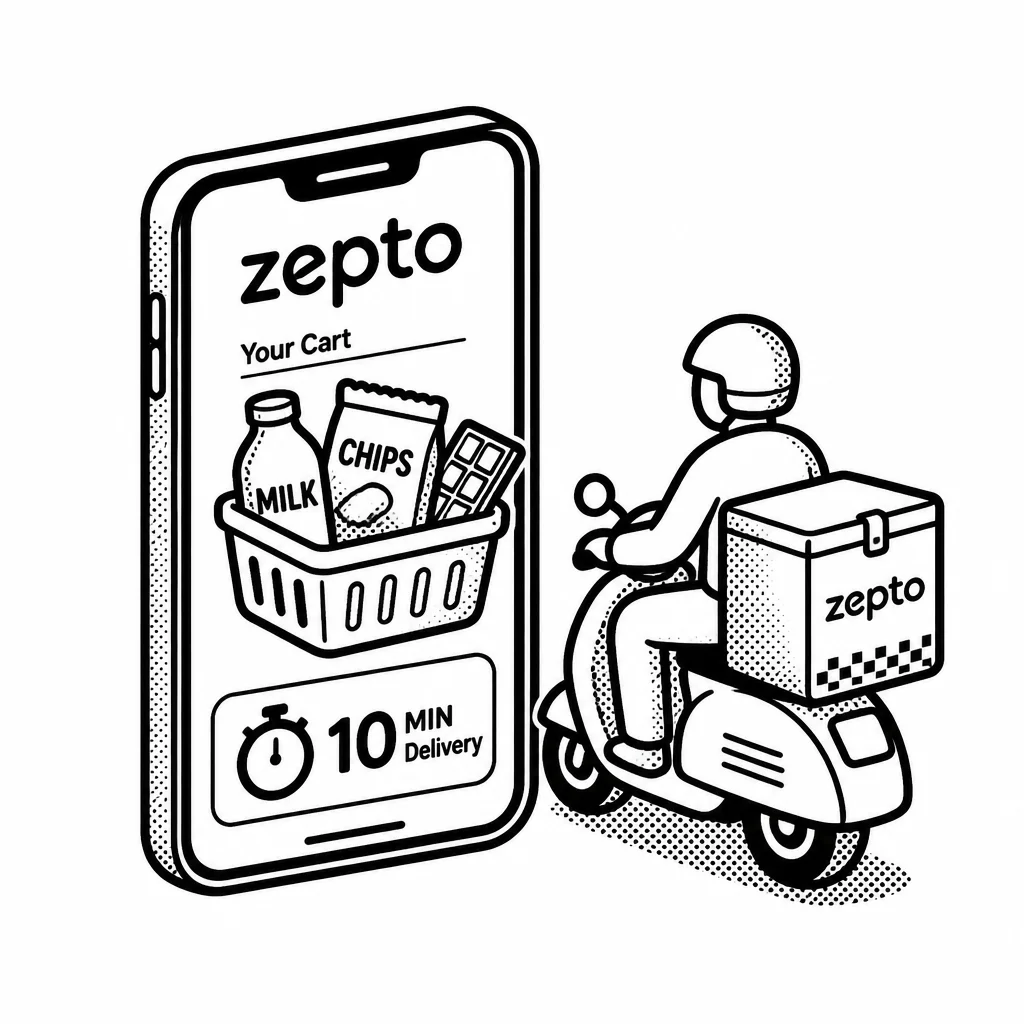
Customers pay for the groceries and a small delivery fee, and many order far more often than they would from a weekly supermarket run — a late-night craving, a forgotten ingredient, a phone charger at midnight. Zepto makes money on the value of the goods plus fees, and it thrives on order density: the more orders each dark store handles, the faster the fixed costs of rent and staff get spread out. That density is also its vulnerability. Quick commerce is a brutal, low-margin race, and Zepto fights deep-pocketed rivals like Swiggy's Instamart and Blinkit, which is owned by Eternal (the company formerly called Zomato). Winning means opening stores faster than anyone else while somehow losing less money per order. The company began in 2021 when two Stanford dropouts, Aadit Palicha and Kaivalya Vohra, started delivering groceries from a Mumbai apartment, and it grew explosively during India's quick-commerce boom. Backed by venture investors, it has poured money into expanding its store network across major cities. In 2025 Zepto took a major step by converting from a private company into a public limited company, renamed Zepto Limited — a strong signal it is preparing to raise money from public markets. It also expanded beyond groceries into categories like electronics and beauty, chasing bigger basket sizes.
The honest picture is a business growing fast on thin or negative profits, funded by investors betting that scale will eventually bring margins. Its edge is speed, brand recognition among urban young Indians, and the sheer convenience habit it has created. Its risk is that the ten-minute promise is easy for rivals to copy and expensive to sustain. Whether Zepto becomes a durable giant or another cash-burning casualty depends on whether it can make each dark store profitable before the funding taps slow — the central question of India's quick-commerce war.
Saved answer · last researched 10 Nov 2026