Understand any stock in simple English
Enter a ticker to learn what the company does and how it makes money.
Waabi Innovations Inc.
Waabi builds self-driving software that lets trucks drive themselves on highways, and it licenses that technology to trucking and logistics companies.
Waabi is a self-driving trucking company. It builds the brains for autonomous trucks — the software and artificial intelligence that let a big rig drive itself down the highway — and it sells or licenses that technology to trucking fleets, logistics operators, and truck makers rather than owning and running a giant fleet itself.
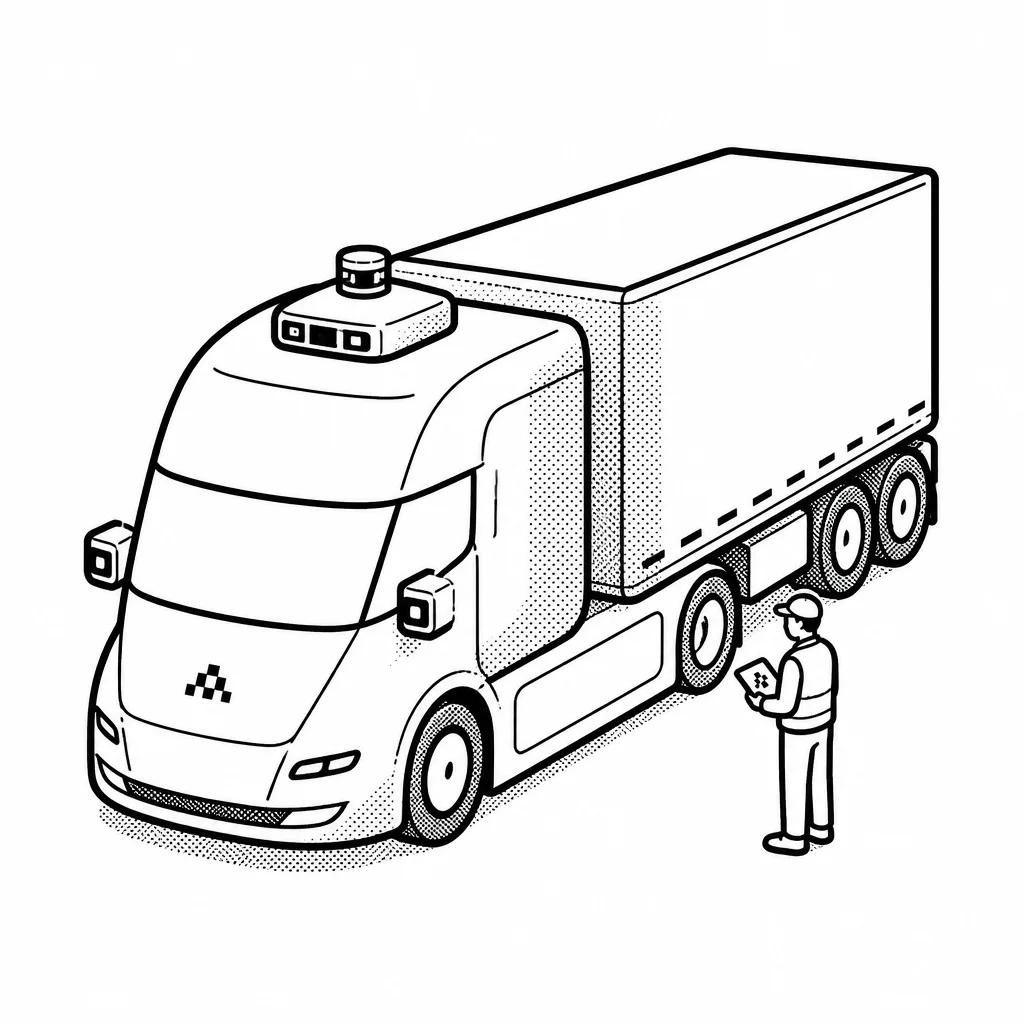
What makes Waabi unusual is how it trains its drivers. Instead of logging millions of real-world miles with safety drivers babysitting the wheel, Waabi runs most of its learning inside a detailed simulated world it calls Waabi World. The software practices countless highway situations in a computer — bad weather, weird traffic, surprise obstacles — and the simulator tests the AI automatically. This is closer to how a video-game engine works than to a traditional road test, and it's much cheaper and faster than burning diesel on real highways. Waabi pairs this with a small fleet of real trucks to keep it honest, and its big partnership is with NVIDIA, whose chips and simulation tools power the training. The company was founded in Toronto in 2021 by Raquel Urtasun, a well-known AI researcher who previously led Uber's self-driving research lab. The bet is that trucking has a painful, expensive problem: there aren't enough drivers, and long-haul routes are tiring and dangerous. A truck that can handle the boring highway stretch — with a human taking over for the tricky last mile in cities — could keep freight moving around the clock. Waabi's pitch to customers is that its software learns faster and cheaper than rivals by leaning on simulation, so it can reach commercial deployment sooner. It has raised serious money from venture investors and strategic partners, and in 2024 it announced a partnership with Volvo and its self-driving arm to put Waabi's software into autonomous trucks.
The hard part is that self-driving trucks are still a young, unproven business. Regulation varies by region, safety claims get heavy scrutiny, and competitors like Aurora Innovation are racing to launch commercial driverless trucking. Waabi's own answer to the skeptics is its simulator-first approach and its willingness to work with established truck makers rather than fight them. Whether that turns into real revenue at scale is the open question — the technology is promising, but the money is still mostly ahead of it.
Saved answer · last researched 9 Nov 2026
BIG PICTURE
Waabi's Texas trucking runs saw freight loads grow more than 80% in 2026
- 80% Freight-load growth on Dallas–Houston runs in 2026
- 20% Loads not added in 2026
Since the start of 2026, the number of freight loads Waabi's trucks hauled on its Dallas to Houston routes grew by more than 80%. That is company-reported growth on a small base, and the trucks still carry a safety operator. It shows the business is starting to move real customer freight while it waits for driverless approval from Volvo. Source: MANNARINO Systems & Software, data from 2026
Timeline
Raquel Urtasun Starts Waabi
Raquel Urtasun spent years as the chief scientist of Uber's self-driving unit, and she came away with a contrarian idea: the way everyone was training self-driving software was backward. Most companies logged millions of real-world miles to teach a car to handle rare situations, which is slow and expensive. So in Toronto she founded Waabi around a neural simulator called Waabi World, which generates those situations in software, letting the system learn from far fewer real miles. An $82M Series A that June gave her the money to build the team and prove the idea worked.
Uber Freight Trucking Pact
Waabi aimed its technology at trucks first, and it found a natural partner in Uber Freight, which already matched shippers with carriers. The two signed a 10-year autonomous trucking agreement, and Waabi began hauling cargo on fixed routes between Dallas and Houston with a safety driver on board. The routes were the point: a tight, known stretch of highway is a far easier problem than every road everywhere.
A $200M Round and Volvo Trucks
The plan clearly had believers. Waabi raised an oversubscribed $200M Series B led by Uber and Khosla Ventures, with Nvidia, Volvo and Porsche chipping in. The money was earmarked for a big leap, fully driverless trucks in 2025, plus a Texas terminal and a commercial expansion. Waabi also teamed up with Volvo to build trucks designed from the start for autonomy, rather than bolting sensors onto an ordinary rig.
Driverless Launch Slips
The 2025 target was public, and it did not hold. Waabi had planned to put a fully driverless truck on public highways by the end of the year, but the rollout was pushed back by a few quarters to allow final validation. That is the awkward truth of self-driving: the last stretch of proving the system is safe is the slowest, and a company's promises are only as good as its willingness to wait.
Lior Ron Joins as COO
To get over that final hurdle, Waabi brought in someone who knew the freight business from the inside. Lior Ron, the former CEO of Uber Freight, came aboard as chief operating officer during a commercial push. His job was to prepare the company to scale operations and reach the driver-out milestone with its major partners.
A $1B Round and Robotaxis
Then came the reveal, and it was large. Waabi closed a $750M Series C co-led by Khosla Ventures and G2 Venture Partners, plus roughly $250M in milestone-based Uber funding, about $1B in total, the largest primary fundraise in Canadian tech history. It also marked Waabi's first move beyond trucking, with at least 25,000 Waabi-powered robotaxis to deploy exclusively on Uber's platform. The trucking pioneer was now a robotaxi company too.