Understand any stock in simple English
Enter a ticker to learn what the company does and how it makes money.
Trader Joe's Company
Trader Joe's runs a chain of small, quirky grocery stores that sell a tight selection of mostly private-label food at low prices.
Trader Joe's is a grocery store chain, but it is not trying to be the store for your whole weekly shopping list the way a giant supermarket is. It runs small, crowded, cheerful stores stocked with a deliberately narrow selection of food — maybe a few thousand items instead of the tens of thousands a big supermarket carries. Most of what sits on the shelves wears the Trader Joe's name. The company designs and buys its own products from suppliers, then sells them under its own label, which lets it cut out the middleman and keep prices low.
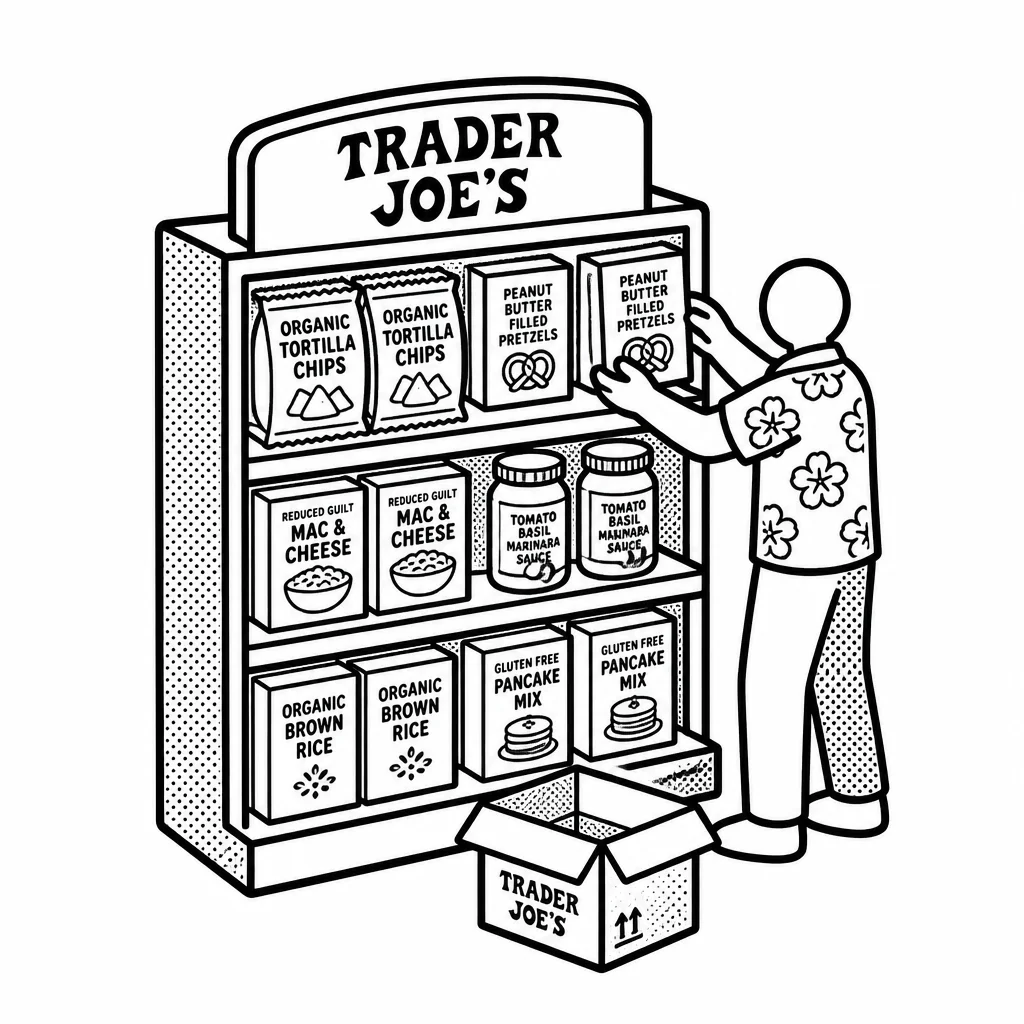
The business model is essentially "sell less stuff, but sell it well." Because the chain stocks so few items, each one has to earn its spot, and buyers hunt for unusual products you won't find at a normal grocer — frozen dumplings, cookie butter, cheap wine, seasonal snacks. Customers come for the treasure-hunt feeling and the friendly, slightly eccentric vibe: staff in Hawaiian shirts, hand-drawn signs, free samples. The chain is privately held, owned by the family of a German billionaire, and it does not franchise or go public, so it can play a long game without Wall Street breathing down its neck. Competitors are everywhere — Walmart, Costco, Kroger, and discount grocers like Aldi all fight for the same food dollars. Trader Joe's edge is that it feels different: a small store you can get through in twenty minutes, with prices that undercut fancy organic chains without the fancy markup. Its weakness is that narrow selection — if you need a specific brand or a huge variety, it isn't the place. The company also keeps expansion slow and careful rather than carpet-bombing the country with new stores.
The chain spends its cash mostly on opening new stores and building out its private-label supply chain, and because it is private, it doesn't pay dividends or buy back shares in any public sense. The real magic is the private label: by owning the product and the store, Trader Joe's keeps more of each dollar and controls quality and price at the same time. It is a quiet, profitable machine that grows steadily without much shouting.
Saved answer · last researched 4 Nov 2026
BIG PICTURE
Trader Joe's sells its own brand on 59% of what's on its shelves
- 59% Trader Joe's private-label products
- 41% Branded and other products
Trader Joe's fills 59% of its shelves with products sold under its own name, far more than Costco's 33% or Sam's Club's 38%. Most of what a shopper drops in the basket is made for Trader Joe's alone, so rivals can't undercut it on the same box. It also means the store keeps more of each dollar and leans on its own shoppers rather than big food brands to draw people in. Source: Fabian Warislohner, LinkedIn (citing industry analysis), data from 2026
Timeline
Joe Coulombe Opens Trader Joe's
Joe Coulombe had run a chain of convenience stores, but 7-Eleven was crushing him on price and scale. So instead of fighting that fight, he aimed at a different shopper: well-educated people who weren't rich but wanted interesting, quality food that regular supermarkets didn't carry. His answer was to buy straight from wholesalers, skip the middleman, and pass the savings along in a small store with a goofy nautical theme, where the staff were 'captains' and 'mates'. That recipe of good food, low prices, and a quirky personality was the seed of everything that followed.
The Albrecht Family Buys the Chain
A dozen years in, Coulombe sold Trader Joe's to the Albrecht family of Germany, the owners of Aldi Nord. For Coulombe it was mostly about managing risk: as the owner, he faced tax and legal exposure he didn't want to carry alone. The remarkable part is what the new owners didn't do: they left the day-to-day running alone, keeping Coulombe as CEO and letting the store keep its identity.
Trader Joe's Moves Into Northern California
After years of growing in Southern California, the chain pushed north within its home state under a new CEO, John Shields. To shoppers it looked like just more stores. In hindsight it was the first step of a much longer march, as the company began moving beyond its home state.
The First Store Outside California
The next stop was Phoenix, Arizona, the chain's first store outside California. This was the real beginning of the national-grocer story: a California chain testing whether its formula worked somewhere else. It did.
The East Coast Push
Soon the company went much further, opening stores in Boston, Washington, D.C., and New York within a few years. It also went online that year, putting its Fearless Flyers and product information on the web. A regional California chain was becoming a national brand.
Dan Bane Takes Over as CEO
When Shields retired, the numbers told the story of the expansion era: the store count had multiplied several times over since 1990, and annual sales had gone from about $132 million to $2 billion. Dan Bane stepped in as CEO to run the much bigger machine.
Two-Buck Chuck Arrives
Then came the bottle that made the chain famous beyond its regulars: Charles Shaw wine at $1.99, nicknamed 'Two-Buck Chuck'. Cheap wine that tasted fine was a perfect fit for the Trader Joe's promise, and it became a core part of the chain's identity; over a billion bottles have sold. The wine made the store a destination for people who had never set foot in one.
Bryan Palbaum Becomes CEO
Dan Bane retired after more than two decades and was succeeded by Bryan Palbaum, previously the company's COO and president, with Jon Basalone named vice-CEO and president. The handoff came as the chain kept steadily expanding across the country.
Trader Joe's Tops the Supermarket Rankings
In 2026 the chain scored 86 on the American Customer Satisfaction Index, taking the top supermarket spot from Publix. It runs more than 600 stores across 40-plus states and keeps opening more. And it does all this while still privately held under Aldi Nord, paying for its own expansion instead of answering to public markets.