Understand any stock in simple English
Enter a ticker to learn what the company does and how it makes money.
Trade Republic Bank GmbH
Trade Republic is a mobile brokerage app that lets people buy stocks, ETFs, and other investments commission-free, and it also pays interest on cash deposits.
Trade Republic is a phone-first bank and stockbroker built for ordinary people who want to invest small amounts without paying big fees. Open the app, pick a stock or an index fund, and buy a slice of it for as little as one euro. Most trades cost a flat one-euro fee, and the app handles the boring parts — settlement, tax reporting, and the paperwork — so buying your first share feels more like ordering a pizza than visiting a bank branch.
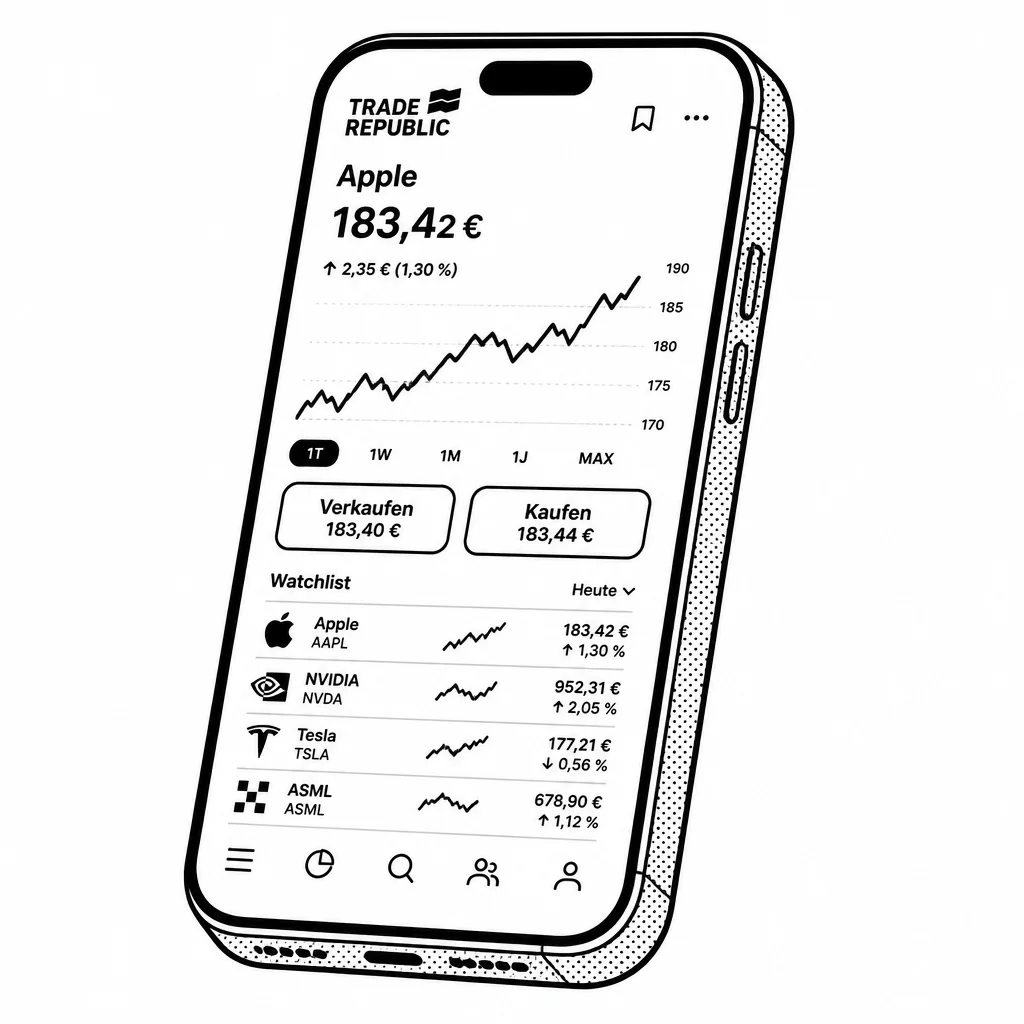
The company makes money in a few quiet ways rather than through trading commissions. The biggest is payment for order flow: it routes customer trades to a partner exchange or market maker, which pays Trade Republic for the business. It also earns interest on the cash customers leave sitting in their accounts, and it takes a small cut from savings plans and some fund products. Customers choose it because it is simple, cheap, and made for phones rather than branch visits. That model has made it one of Europe's fastest-growing retail brokers, with millions of customers across Germany and beyond. Founded in Berlin in 2015 by Christian Hecker, Thomas Pischke, and Marco Cancellieri, the firm grew out of a frustration with how expensive and clunky traditional brokers were. It went on a tear during the 2020–2021 retail trading boom, and it has since pushed into savings plans, crypto, and even a full banking licence — the latter letting it hold deposits and offer interest directly. That licence matters: it turned Trade Republic from an app that merely passed trades along into a genuine bank with its own balance sheet.
The uncomfortable part is that payment for order flow is controversial. Critics argue it is a hidden cost, and regulators have been tightening the rules around it. Trade Republic's response has been to widen its base: cash interest, crypto, and new markets across Europe give it more ways to earn beyond the trading app. The bet is that owning the full relationship with a customer — cash, investments, crypto in one app — is stickier and more valuable than taking a cut on every trade.
Saved answer · last researched 10 Nov 2026
BIG PICTURE
Seven in ten Trade Republic customers are under 35
- 70% Trade Republic customers under 35
- 30% Customers 35 and older
Most brokerages have older clients, but Trade Republic's average customer is in their early thirties. About 70 percent are younger than 35, and half of those are between 18 and 26. Nearly half of all its customers buy their first stock through the app. This explains how the Berlin company makes money from people who are just starting to invest, not from wealthy veterans. Source: DIW Econ analysis of Trade Republic data, reported by Finalarm, data from 2026
Timeline
Three Founders Meet in Munich
Christian Hecker and Thomas Pischke met at a university seminar in Munich and got talking about a simple frustration: banks ran on old computers and clumsy systems, so trading cost customers too much and felt needlessly complicated. Then Pischke met Marco Cancellieri at a hackathon, and Cancellieri started building a broker app prototype the very next day. By fall of that year, the three had decided to build the bank of the future.
Sino AG Takes a Majority Stake
Two years after the founders set out, the German investment firm Sino AG put money in and took a majority stake. That backing gave the young company room to keep building before it had a product on the market.
The App Goes Live
The Trade Republic app launched in January, giving ordinary people a phone-based way to buy stocks and ETFs. Mid-year it added derivatives to the mix, and new investors Creandum and Project A put in growth capital.
GameStop Freezes the Platform
Then came January 2021 and the GameStop short squeeze, when a crowd of small investors piled into a handful of meme stocks. Trade Republic temporarily blocked purchases in several of them, which threw the platform into chaos, and later more than 4,000 complaints landed with the German regulator over those restrictions.
A Full Banking Licence
In December the European Central Bank handed Trade Republic a full banking licence. That let it hold customer deposits directly and move beyond broking into savings and current-account products.
Savings Banks Push Back
With low fees, high savings rates and free ETF plans, Trade Republic had become a genuinely hard competitor for established banks. The savings banks, feeling the pressure, planned to launch a simpler securities trading offer of their own from early 2026.
Germany's Most Valuable Startup
A secondary share sale in December valued Trade Republic at 12.5 billion euros, making it Germany's most valuable startup. Its customer base had doubled to more than 10 million people in 18 months, with 150 billion euros in assets on the platform. No fresh money went to the company itself; it said it was profitable and did not need outside capital.