Understand any stock in simple English
Enter a ticker to learn what the company does and how it makes money.
Synthesia Technology Ltd
Synthesia sells software that turns simple text into realistic videos of AI-generated human presenters speaking on camera.
Synthesia is an AI video company. You type in a script, pick one of its digital avatars or clone a real person, and the software produces a polished video of that presenter speaking your words — no cameras, no actors, no studio. Companies use it for training videos, product explainers, internal announcements, and other corporate content that used to require a film crew and weeks of scheduling.
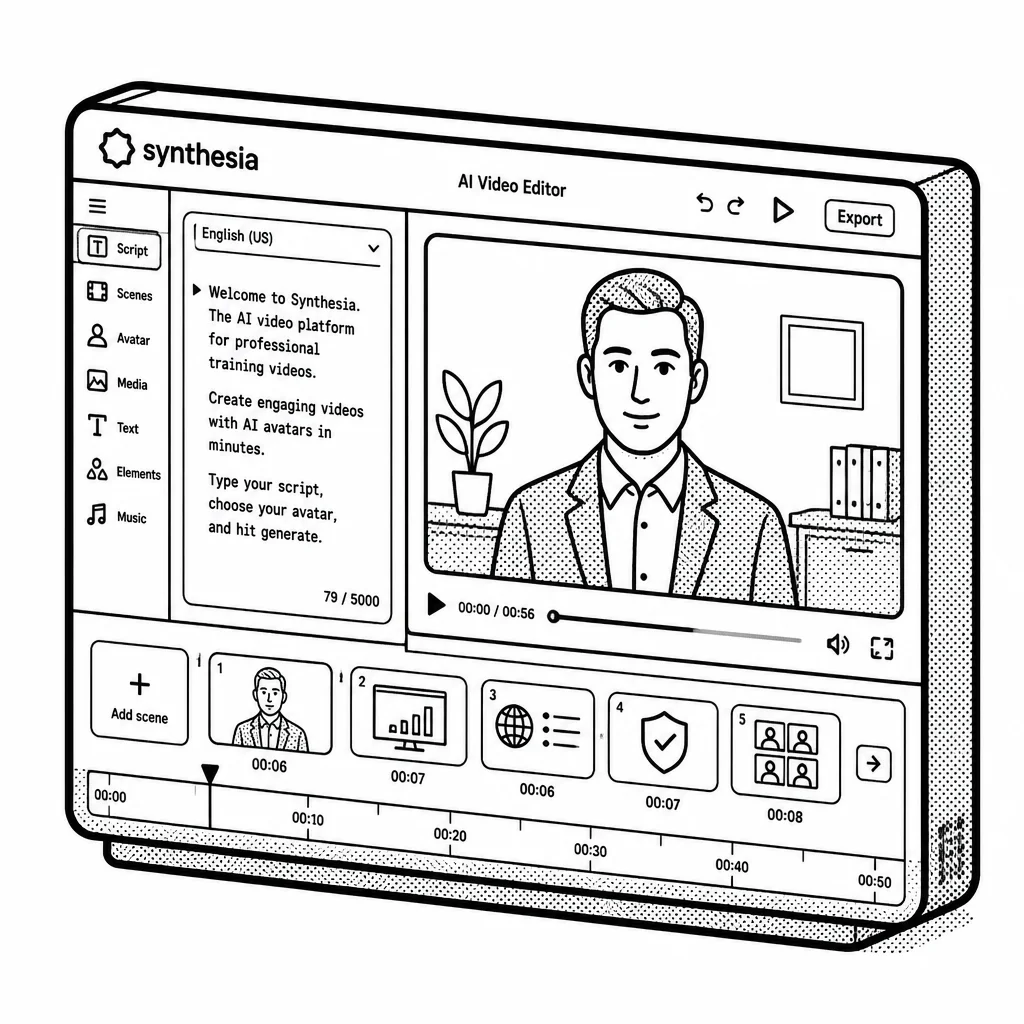
The customers are mostly businesses, not Hollywood. Big employers use it to churn out onboarding and compliance training in dozens of languages, since one avatar can be made to speak a different language and sound native-ish in each. That translation-at-scale pitch is the sales hook: a company that once paid to reshoot a video per country can instead generate all the versions from one script. Synthesia makes money on subscription plans, priced by how many videos you make, alongside custom "personalized" avatars that show a real person's face and voice. The company is based in London, and it has become one of the UK's most valuable AI startups, raising hundreds of millions of dollars at a multi-billion-dollar valuation. Its rivals include other AI video tools like HeyGen and a wave of avatar startups, plus the older, slower option of filming real people. The obvious risks are the same ones hanging over all generative AI: deepfake anxiety, the pressure to prove its avatars aren't being misused, and the chance that giant foundation-model players make this kind of video cheap and ubiquitous.
What makes it interesting as a business is the boring-but-huge market it's chasing: corporate training and communications, where companies spend a fortune on video but hate the cost and delay. If Synthesia can convince them that an AI presenter is good enough, the savings are obvious — and so is its recurring revenue.
Saved answer · last researched 10 Nov 2026
Timeline
Five Founders and One Research Paper
In 2017, Victor Riparbelli read a research paper about AI-generated video and saw something big: what if anyone could make a video without a camera, a studio, or editing skills? He teamed up with Steffen Tjerrild, Lasse Korsgaard, Matthias Niessner, and Professor Lourdes Agapito to build exactly that. Their goal was simple to say and hard to do — put video production in everyone's hands.
The BBC Proof of Concept
A year later, the young company showed up on the BBC with a striking trick: presenter Matthew Amroliwala appeared on screen speaking Spanish, Mandarin, and Hindi — languages he did not actually speak. It was a proof of concept, and it showed a huge audience what the core technology could do.
From Hollywood to Enterprise
For three years the company sold dubbing and translation to film studios and agencies, and the business just would not scale. Then something surprising happened: big companies started asking for help making training and onboarding videos with talking heads. So Synthesia changed direction — away from movie magic and toward everyday corporate video. Less Pixar, more PowerPoint.
A Billion-Dollar Valuation
The new focus paid off. In 2023 the company raised $90 million in a funding round led by Accel, with Nvidia's investment arm joining in, and hit a $1 billion valuation. That made it a unicorn — and one of Europe's most valuable AI startups.
Propaganda and the Trust Problem
Success brought a darker side. A late-2023 report found that governments in Venezuela and China had used Synthesia's tools to make fake TV news videos with AI avatars for propaganda. The company fought back by improving misuse detection and screening new users and content through moderators. It was a hard lesson, but it pushed Synthesia to make trust and compliance part of what it sells.
Hitting $100 Million ARR
By 2025 the business was moving fast. In April it crossed $100 million in annual recurring revenue, and on one single day it added more than a million dollars of new ARR. Earlier that year it had doubled its valuation to $2.1 billion with a $180 million funding round, money meant to fuel expansion into Japan, Australia, Europe, and North America.
Synthesia Says No to Adobe
Then came the offer. Adobe made a strategic investment in April 2025 and followed it with a takeover bid of about $3 billion. Synthesia turned it down, choosing to stay independent — a bold bet on its own future, including the possibility of one day going public.
Google Ventures Leads a $4 Billion Round
Independence looked smarter and smarter. In 2026 the company raised $200 million in a round led by Google Ventures, valuing it at $4 billion, and it also let employees sell some shares in a sale run with NASDAQ. The new money was aimed squarely at enterprise learning and development, powered by AI agents that need less and less human hand-holding.
Synthesia 3.0 and Talking Back
The technology itself kept changing shape. Synthesia 3.0 introduced conversational AI video agents — videos you can actually talk to in real time, not just watch. That marked the shift from one-way video to interactive, personalized experiences, and it became the company's next big growth engine at a $4 billion valuation.