Understand any stock in simple English
Enter a ticker to learn what the company does and how it makes money.
Ripple Labs, Inc.
Ripple sells blockchain software and a digital token called XRP that banks and payment companies use to move money across borders faster.
Ripple is a payments software company built on a cryptocurrency idea. It sells banks and money-transfer businesses a way to send money across borders in seconds instead of days, and it also owns a digital token called XRP that sits at the center of that system.
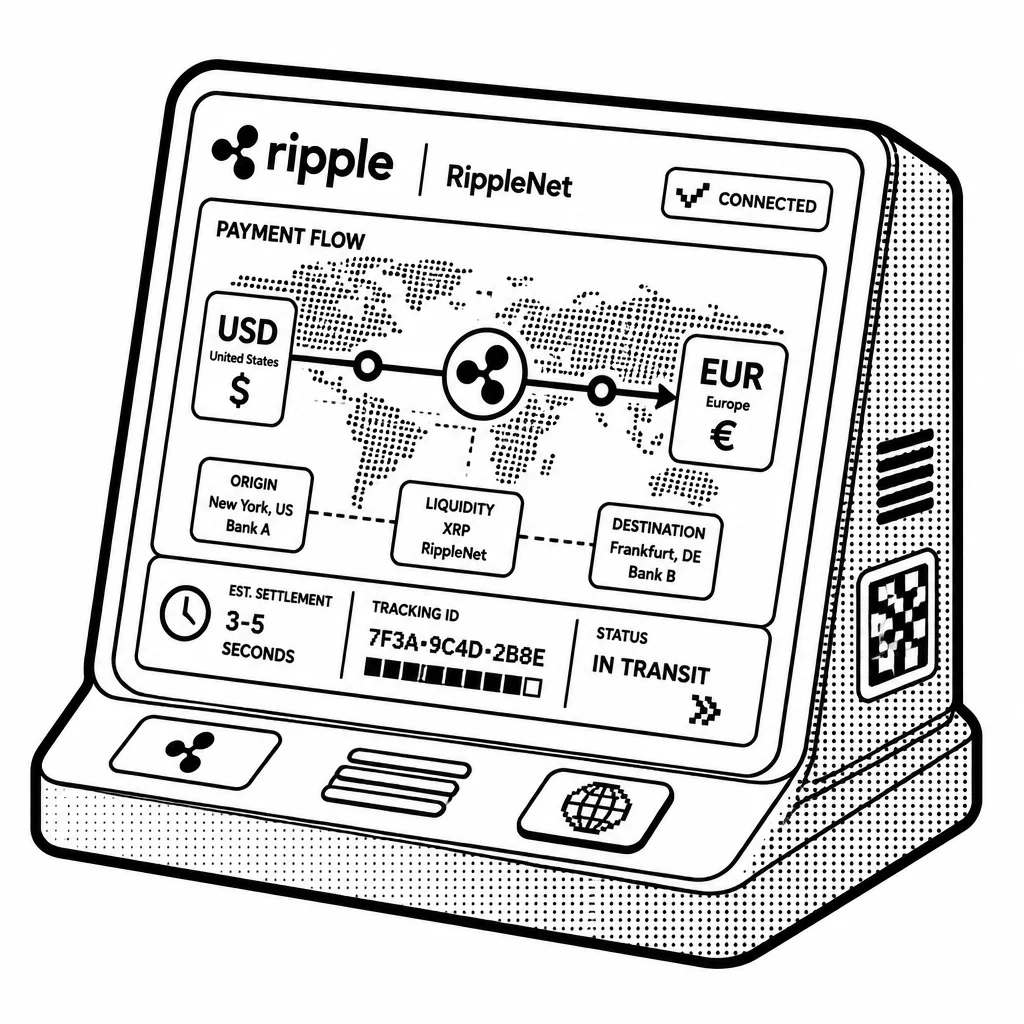
The old way of moving money between countries is slow and expensive. A bank in the US sending dollars to a bank in the Philippines often has to route the cash through a chain of middlemen, and each one takes a cut and adds delay. Ripple's pitch is simple: use XRP as a bridge. One side converts dollars into XRP, the token zips across the internet in seconds, and the other side converts it into pesos. No middlemen sitting on money for days. Banks pay Ripple for the software that runs this plumbing, and Ripple also holds a giant pile of XRP itself, which rises and falls in value and funds much of the company. Here's the messy part. In December 2020, the US Securities and Exchange Commission sued Ripple, claiming XRP was an unregistered security — essentially that the company had sold it like a stock without following the rules. That lawsuit hung over the business for years, scaring off some US partners and hammering the token's price. In 2023, a judge ruled that XRP sold on public exchanges to ordinary buyers was not a security, a big partial win for Ripple, and the case finally wrapped up in 2025 with a $125 million penalty and clarity that let the company move on. That fight mattered enormously: it was really a test of whether crypto tokens count as securities.
Ripple makes money two ways. It sells software subscriptions and licenses to financial institutions for cross-border payments, and it profits from its enormous holdings of XRP, which it sells over time and which gives the company a war chest. It also launched RLUSD, a stablecoin pegged to the dollar, betting that banks will want a regulated digital dollar for settlements. The company is private, valued at roughly $11 billion in a 2022 funding round, and its fortunes are tightly tied to XRP's price — a volatile asset it can't fully control. Competitors include traditional payment networks like Swift-style bank messaging and the cross-border rails run by Visa and Mastercard, though Ripple's real bet is that blockchain can undercut them on speed and cost.
Saved answer · last researched 10 Nov 2026
Timeline
RipplePay Starts as a Bank-Free Network
In 2004, long before Bitcoin existed, Ryan Fugger started RipplePay. His idea was simple but radical: a peer-to-peer trust network where people could move money without banks, beyond the reach of governments. The project was ahead of its time and later grew into the company we now know as Ripple.
McCaleb Takes Over and Launches XRP
In 2012, Jed McCaleb took the project from Fugger and brought in Chris Larsen. Together they launched the XRP Ledger and the XRP token, which let users send money directly to each other. This was the start of the OpenCoin era and the foundation of Ripple's payment network.
OpenCoin Becomes Ripple Labs
The company renamed itself Ripple Labs in 2013, and later simply Ripple. The XRP token had launched that January with a supply of 100 billion coins. The new name stuck as the company grew.
McCaleb Leaves After Strategy Clash
Jed McCaleb left in 2013 after disagreeing with Chris Larsen about strategy. Stefan Thomas stepped in as CTO, while Larsen stayed on as CEO through the company's early growth.
Regulators Fine Ripple Over XRP Sales
US regulators fined Ripple $700,000 for breaking the Bank Secrecy Act by selling XRP without authorization. Ripple had to register with FinCEN, follow anti-money-laundering rules, and submit to outside audits. The fine pushed the company to build a compliance-first approach.
The SEC Sues Ripple
In late 2020, the SEC sued Ripple, claiming its $1.3 billion XRP offering was an unregistered securities sale. The lawsuit threatened Ripple's core business, and exchanges delisted XRP. The case became a defining legal battle for both the company and the crypto industry.
Judge Rules XRP Is Not a Security
In July 2023, a judge ruled that XRP sold on public exchanges was not a security. It was a landmark victory that saved Ripple's core business, and the SEC soon dropped its charges against Larsen and Garlinghouse.
SEC Lawsuit Settles
In 2025, the SEC case finally settled with Ripple paying a $125 million fine. The SEC ended further appeals, lifting a major regulatory cloud. With clarity in hand, Ripple could focus on growth.
Ripple Goes on an Acquisition Spree
Ripple used its newfound clarity to buy its way into new businesses. It acquired Metaco for crypto custody, Rail for stablecoin payments, Hidden Road for prime brokerage, and GTreasury for treasury management. The deals pushed Ripple well beyond payments.
Ripple Raises at a $40 Billion Valuation
Ripple raised $500 million from Fortress and Citadel Securities at a $40 billion valuation. It also ran a $1 billion tender offer for early investors. Despite the regulatory clarity, the company chose to stay private rather than go public.
Ripple Reaches Scale
By 2026, Ripple was on track to exit the year with $900 million in annualized product revenue. It won final approval for a National Trust Bank charter. And it had served over 1,700 institutions, processing over $16 trillion in transactions in 2025.