Understand any stock in simple English
Enter a ticker to learn what the company does and how it makes money.
LiveRamp Holdings, Inc.
LiveRamp helps companies connect their customer data to advertising and marketing tools without sharing the raw personal information itself.
LiveRamp sits in the messy middle of modern advertising. When a company wants to show you an ad or send you a personalized offer, it usually has a jumble of customer information scattered across different systems — email lists here, loyalty programs there, website visits somewhere else. LiveRamp's job is to stitch all that together into a single, usable picture of a customer, then let the company match that picture to ad platforms and marketing tools without ever handing over the raw personal data itself. That last part is the trick: it uses coded stand-ins instead of names and emails, so privacy rules can be respected while targeting still works.
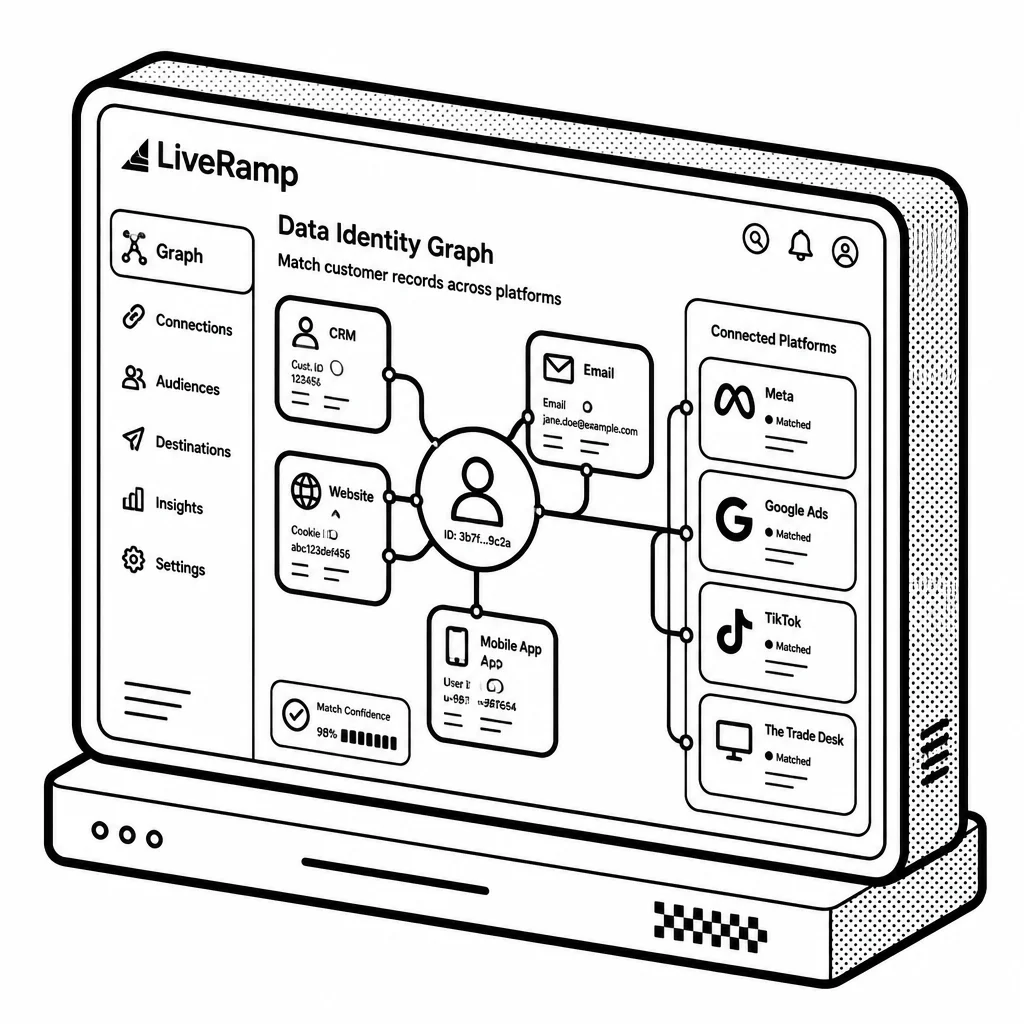
The core product is called data collaboration, and the simplest way to understand it is as a safe middleman. A retailer uploads its customer list; LiveRamp turns it into anonymized "identity" codes and matches those codes to the same people inside platforms like Meta Platforms or Google. The advertiser can then reach the right people, measure whether the ads worked, and avoid wasting money on the wrong audience — all without exposing anyone's email address. Customers pay LiveRamp recurring subscription fees for this plumbing, and it has become deeply embedded in how big brands and publishers run their marketing. That embedded position is both the strength and the risk. LiveRamp is the biggest independent identity-matching company, which matters in a world where Apple's privacy changes and tighter cookie rules keep making it harder to track people. When the easy tracking tools break, the neutral middleman that lets companies still connect their own data becomes more valuable. But the company sells marketing software to businesses, and that market is cyclical: when advertisers get nervous and cut budgets, LiveRamp feels it. It has also faced slower growth as some big platform players build their own matching tools, and its stock has been volatile as investors debate how much of the ad-tech middle layer survives.
Headquartered in San Francisco, LiveRamp began life inside Acxiom, the old data-broker business, and was spun out as its own public company in 2018. It has since shed the legacy data-selling baggage and repositioned itself as a privacy-friendly data collaboration platform. It spends heavily on research and development to keep its identity network growing, and it has used acquisitions to expand into new areas like data clean rooms. The company generates real free cash flow, which it has used to buy back shares and strengthen the balance sheet rather than pay a dividend. The bet is straightforward: as privacy rules tighten and third-party tracking crumbles, the company that quietly connects first-party data safely becomes more indispensable, not less.
Saved answer · last researched 6 Nov 2026
BIG PICTURE
Only 31% of LiveRamp users expect it to stay independent
- 31% LiveRamp users who expect neutrality to hold
- 69% Users who expect changes or aren't sure
LiveRamp's whole pitch is that it sits in the middle, connecting a brand's customer data to ad tools without handing the data over. Publicis, one of the big ad agency groups, agreed in May 2026 to buy the company for $2.2 billion. Among advertisers that use or plan to use LiveRamp, 31% think it can keep that neutral role unchanged. Many are already lining up backups. Source: Advertiser Perceptions July 2026 Omnibus Study, data from 2026
Timeline
A Phonebook Start in Arkansas
Charles Ward started a company in Conway, Arkansas that turned phonebooks into mailing lists and also ran payroll for other businesses. It was unglamorous work, but it solved a real problem: companies wanted names and addresses they could actually use. That humble idea turned out to have a very long life.
CCX Network Goes Public
The company reorganized as CCX Network and sold shares to the public for the first time. Going public gave it money to grow and a public scorecard to live by.
Becoming Acxiom
The company took the name Acxiom, and under that name it became one of the biggest data brokers in the country for decades. Its business was knowing things about people and selling that knowledge to marketers.
A Three-Billion-Dollar Deal Collapses
Acxiom agreed to be bought out for about three billion dollars by Silver Lake Partners and ValueAct Capital. Then the credit markets seized up, the buyers walked away, and the company had to start over with a new chief executive. A deal that big falling apart tends to shake a company's sense of itself.
Scott Howe Takes the Wheel
Acxiom named Scott Howe as chief executive and president. He would end up leading the company through its biggest reinvention, from a data broker into something quite different.
Buying LiveRamp
Acxiom bought LiveRamp, a young company that had spun out of RapLeaf and had a clever trick: it could match a company's own customer data to the wider online world so that data could actually be used for advertising. Acxiom paid three hundred ten million dollars and kept the LiveRamp name, making data connections a core part of its business. That purchase would eventually swallow the parent.
Selling Acxiom, Keeping LiveRamp
Interpublic Group bought Acxiom's Marketing Solutions business for two point three billion dollars, but the deal deliberately left LiveRamp out. After the sale closed, Acxiom renamed itself LiveRamp, changed its ticker, and handed the Acxiom brand to its buyer. What was left was a pure-play data connectivity company. The old data broker had sold its brokerage and bet on the connections business instead.
Adding Consent and TV Data
LiveRamp bought Faktor, a consent management platform, and Data Plus Math, a TV analytics company, for one hundred fifty million dollars. Consent tools mattered because privacy rules were tightening, and TV measurement opened a new market beyond web advertising.
Privacy Manager and Safe Haven
LiveRamp launched its own consent management platform, Privacy Manager, and a privacy-safe data collaboration tool called Safe Haven. It also bought Acuity Data to make Safe Haven smarter for retailers. The company was building products around a simple idea: companies want to share data without giving away the sensitive parts.
Publicis Buys LiveRamp
French advertising giant Publicis agreed to buy LiveRamp for thirty-eight dollars and fifty cents a share, about two and a half billion dollars in cash, calling it the foundation of its AI growth engine. The deal closed after federal antitrust approval with five years of neutrality requirements, and LiveRamp stayed an independent business with Scott Howe still as chief executive. The phonebook mailing-list company had come a very long way, and now it belonged to a global ad firm.