Understand any stock in simple English
Enter a ticker to learn what the company does and how it makes money.
OpenEvidence, Inc.
OpenEvidence is a free medical research tool that uses AI to answer doctors' clinical questions by citing evidence from medical journals.
OpenEvidence is, quite simply, a search engine for doctors. A physician is in an exam room, a patient has an unusual combination of symptoms, and the doctor needs to know what the latest research says about a drug interaction or a treatment option. Instead of digging through journals, the doctor types a question into OpenEvidence and gets an answer in seconds, with every claim tied back to a specific published paper.
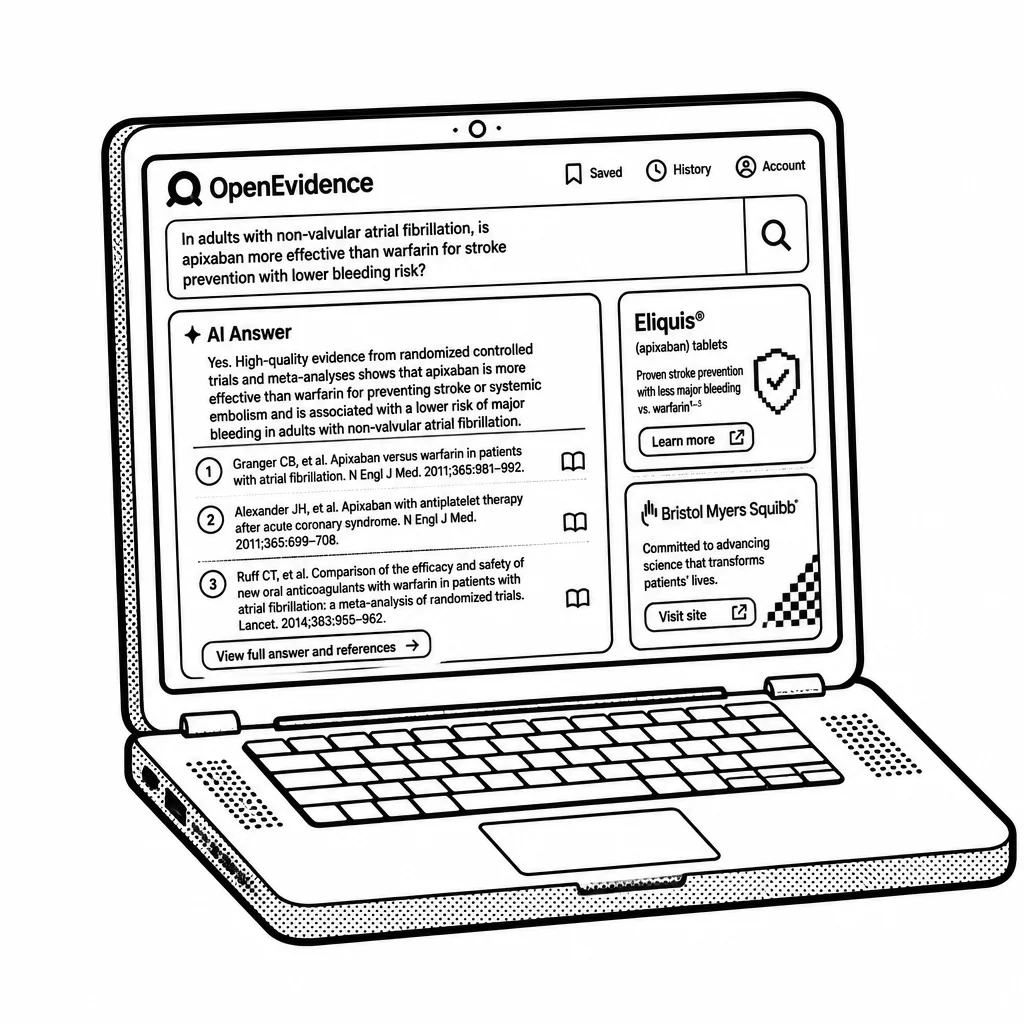
The company's big edge is that its AI is built on a walled garden of medical knowledge. OpenEvidence licenses the actual text of major journals, including the New England Journal of Medicine and JAMA, and its AI is trained only on that vetted material, not the open internet. That matters because a general chatbot can invent a plausible-sounding citation. OpenEvidence's answers are grounded in real articles, so a doctor can click through and check the source. It is free for verified clinicians, and the company makes money by selling advertising from pharmaceutical and medical device companies that want to reach doctors at the exact moment they are researching a condition. That is a clever twist: the ads look more like sponsored clinical information than billboards. The founders, Daniel Nadler and Zachary Zysman, built the company in 2022, and Nadler is the more colorful figure: he previously founded Kensho, a financial-data AI company sold to S&P Global for roughly $550 million. OpenEvidence has grown fast, riding the same AI wave that made ChatGPT famous but aiming at a narrower, higher-stakes audience where being wrong is not an option. By mid-2025, the company said it was used by a large share of U.S. physicians, and it raised venture funding at a reported valuation north of $3 billion.
The obvious question is whether free-for-doctors and paid-by-advertisers is a business that lasts. Competitors include general AI assistants and specialized medical tools, and the journals that supply the content could decide to charge more or build their own products. But OpenEvidence's bet is that trust is the moat: if doctors come to rely on it for quick, sourced answers during patient visits, the advertisers will follow the eyeballs. It is a search-and-advertising business wearing a stethoscope.
Saved answer · last researched 9 Nov 2026
BIG PICTURE
Half of US doctors ask this free AI app their bedside questions
- 45% US doctors using OpenEvidence
- 55% US doctors not using OpenEvidence
A survey of 1,000 doctors found 45% use OpenEvidence, about three times the share using ChatGPT for the same work. That matters because the app is free to any US doctor, and drug companies pay for ads shown during the few seconds it takes to answer. The people paying are advertisers reaching doctors at the moment they decide on treatment. Source: Business Model Analyst, citing Offcall, data from 2026
Timeline
Two Founders Take On Medical Literature
Doctors have a simple problem: medical research piles up faster than any human can read it. Daniel Nadler, who had already built and sold an AI company, teamed up with Harvard machine-learning researcher Zack Ziegler to fix that. Their idea was a clinical support tool trained only on peer-reviewed medical literature, not the open internet, and they made it free for verified physicians, planning to earn money through ads.
A 90% Score on the Medical Exam
A year in, the company reported its model scored 90% on the USMLE, the standardized test doctors must pass, a strong signal that the tool was clinically capable. Joining the Mayo Clinic's health-technology accelerator added early credibility.
From Zero to Unicorn in One Year
Then the money arrived, and fast. Sequoia led a first outside round at a billion-dollar valuation, and two more rounds followed within months, pushing the valuation to $6 billion. The engine behind it was adoption: by mid-2025 about 40% of American physicians had signed up.
DeepConsult and Journal Deals
The product deepened too. DeepConsult let the model reason across many studies at once rather than answer from a single paper. The company said its model now scored 100% on the USMLE, and it signed licensing deals with major journals like NEJM and JAMA Network.
A $12 Billion Valuation
The fundraising kept breaking its own records. A new round from Thrive Capital and DST doubled the valuation to $12 billion, bringing total money raised to roughly $700 million in under a year, from backers including Google Ventures, Nvidia, Kleiner Perkins and the Mayo Clinic. Nadler said he wanted to stay independent and would wait for bigger AI firms to go public before thinking about an IPO of his own.
Into the Hospital Record
Next came the hospitals themselves. A partnership with Cedars-Sinai plugged the platform into the hospital's electronic health record system, putting the tool right where doctors already work. Voice Mode let physicians ask questions out loud instead of typing.
Anthropic Deal and a Global Push
Another $250 million came in at a $15 billion valuation. The company also struck a partnership with Anthropic to fine-tune its base models and roll the tool out free across nearly 100 countries.
Ad Money and a Drug Discovery Ambition
The free-for-doctors, ads-pay-the-bill plan was working: nearly two-thirds of U.S. doctors now use the tool, it handles over 42 million prompts a month, and ad revenue was on track for hundreds of millions. But competition from OpenAI and Anthropic was rising, accuracy questions lingered, and the company pulled out of the EU and UK over the AI Act, slowing its expansion there. Nadler's end game is bigger than answering questions: he wants to use the literature to discover drugs and run clinical trials for cancer and rare diseases.