Understand any stock in simple English
Enter a ticker to learn what the company does and how it makes money.
Notion Labs, Inc.
Notion sells workspace software that combines notes, documents, databases, and project management into one tool for individuals and teams.
Notion is a workspace software company. It sells one main product: an app where people write notes, build documents, organize databases, and manage projects all in the same place, instead of juggling separate tools for each job.
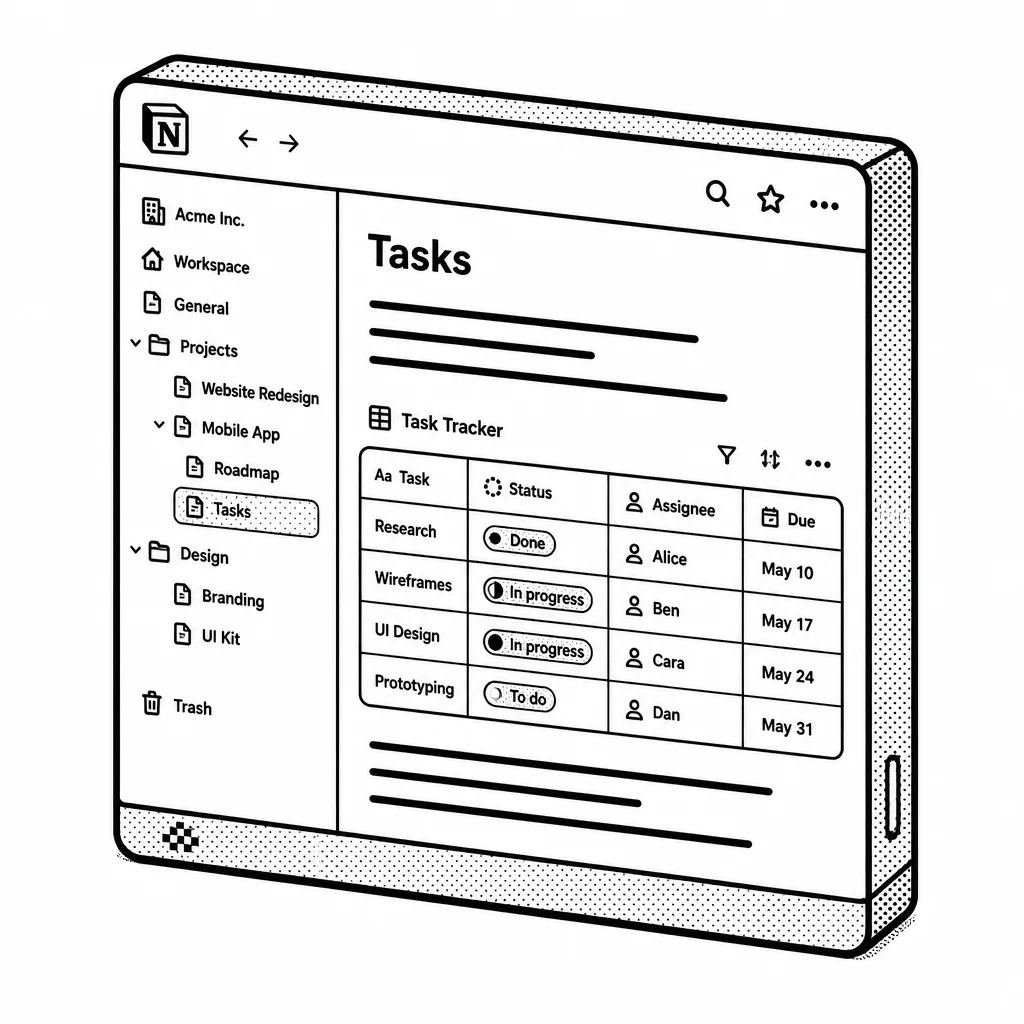
The quirky part is how flexible it is. A page in Notion can be a simple to-do list, a shared wiki, a project tracker, or a lightweight customer database. Users drag blocks around like Lego bricks to build whatever structure they want. That flexibility is why it spread fast among startups, students, and small teams who wanted one cheap tool instead of five. Today it sells to bigger companies too, including teams inside large enterprises, with paid plans priced per user. The business makes money on subscriptions, not ads. Individuals use a free version, and the company earns when people upgrade for more file storage, more guests, and admin controls, or when whole teams and companies pay per seat. Customers choose it over rivals like Microsoft Loop, Alphabet Google Docs, Atlassian Confluence, and Salesforce Slack because everything lives in one connected workspace rather than scattered apps. Notion has also pushed into AI features that summarize and search your workspace, and it bought the calendar app Cron to fold scheduling into the product.
The company is based in San Francisco and remains private, backed by venture capital. One of its founders, Ivan Zhao, famously ran low on money early and had to fly to Japan to keep his visa alive while building the first version. That scrappy origin fits the product's ethos: a small team's tool that grew by word of mouth into something used by millions. The risk is familiar for subscription software — competition is fierce and many features are now bundled free by much larger rivals, so Notion has to keep proving its one-workspace pitch is worth paying for.
Saved answer · last researched 4 Nov 2026
BIG PICTURE
Half of Notion's business customers now pay extra for its AI features
- 50% Business and enterprise customers paying for AI features
- 50% Business and enterprise customers not paying for AI features
Notion says half of its business and enterprise customers now pay for AI features, up from 10 to 20 percent the year before. That matters because AI is how Notion turns a cheap notes app into a bigger bill. The company reached $500 million in yearly recurring revenue in 2025, and it is betting agents and search keep teams paying more each year. Source: CNBC Disruptor 50, data from 2026
Timeline
A Workspace to Replace All Apps
In 2013, Ivan Zhao started Notion in San Francisco with a simple complaint: people's work was scattered across too many apps. His idea was a flexible building-block tool where anyone could shape their own workspace. But the early version was too complicated for normal people, and growth stalled.
Starting Over in Kyoto
The money ran out, and the team had to let people go. The first product had failed. So Zhao and Simon Last moved to Kyoto to live cheaply and rebuilt Notion from scratch. That painful reset gave the product its block-based core, which still powers it today.
Notion 1.0 Arrives
The rebuilt product launched in 2016, putting pages, blocks, and databases into one flexible workspace. Few people noticed at first. But the philosophy was set: one tool you shape yourself, not a pile of separate apps.
Notion 2.0 Goes Viral
The big moment came in 2018, when Notion 2.0 took off on Product Hunt and took the top spot for the day. It was faster, worked on phones, and had better databases and teamwork features. And users began sharing their own templates, which pulled in new users for free, like a snowball rolling downhill.
A Ten Billion Dollar Bet on Remote Work
By 2021, the world was working from home, and Notion was flying. The company raised a huge round led by Coatue and Sequoia at a ten billion dollar valuation, five times what it was worth a year earlier. Viral videos on TikTok helped turn a niche tool into a mainstream habit.
Notion Adds AI
In 2023, Notion put AI inside the workspace. It could help you write, sum things up, and answer questions about your own pages. Later, AI features would bring in more than half of the company's recurring revenue, a sign of how central AI had become.
From Notes to Calendar and Email
Notion began reaching beyond notes. It bought Cron, a scheduling tool, which became Notion Calendar. Then it bought Skiff, a privacy-focused email app, to build Notion Mail. The little workspace was growing into a full productivity suite.
Autonomous Agents and Half a Billion in Revenue
In 2025, Notion launched AI agents that could carry out multi-step tasks across pages, databases, email, and calendars on their own. The business was booming: annual recurring revenue hit five hundred million dollars, and growth was speeding up. Half of its business and enterprise customers now paid for AI, up sharply from the year before.
An Eleven Billion Dollar Tender Offer
Early in 2026, investors bought shares from existing holders in a deal that valued Notion at eleven billion dollars, backed by GIC, Sequoia, and Index Ventures. That was up from its 2021 valuation, and notably, the company raised no new money of its own. It was a strong signal that big investors believed in Notion ahead of a possible public listing.
Notion Becomes a Developer Platform
In 2026, Notion launched a developer platform with Workers, database sync, and connections to outside AI agents. The shift was big: Notion was no longer just a place to write and organize, but a programmable platform where businesses could build and run their own AI systems, taking on workflow automation tools.