Understand any stock in simple English
Enter a ticker to learn what the company does and how it makes money.
Airtable, Inc.
Airtable sells software that lets ordinary people build their own databases and internal apps without writing code.
Airtable is a software company that gives non-engineers a way to build their own database-driven apps — the tracking tools and internal systems that usually require a programmer. You start with something as familiar as a spreadsheet, but each row can hold files, images, links, and dropdowns, and you can flip the same data into a calendar, a kanban board, or a gallery view with a click. Teams use it to run marketing calendars, bug trackers, product roadmaps, hiring pipelines, and thousands of other messy workflows that used to live in a tangle of spreadsheets and email.
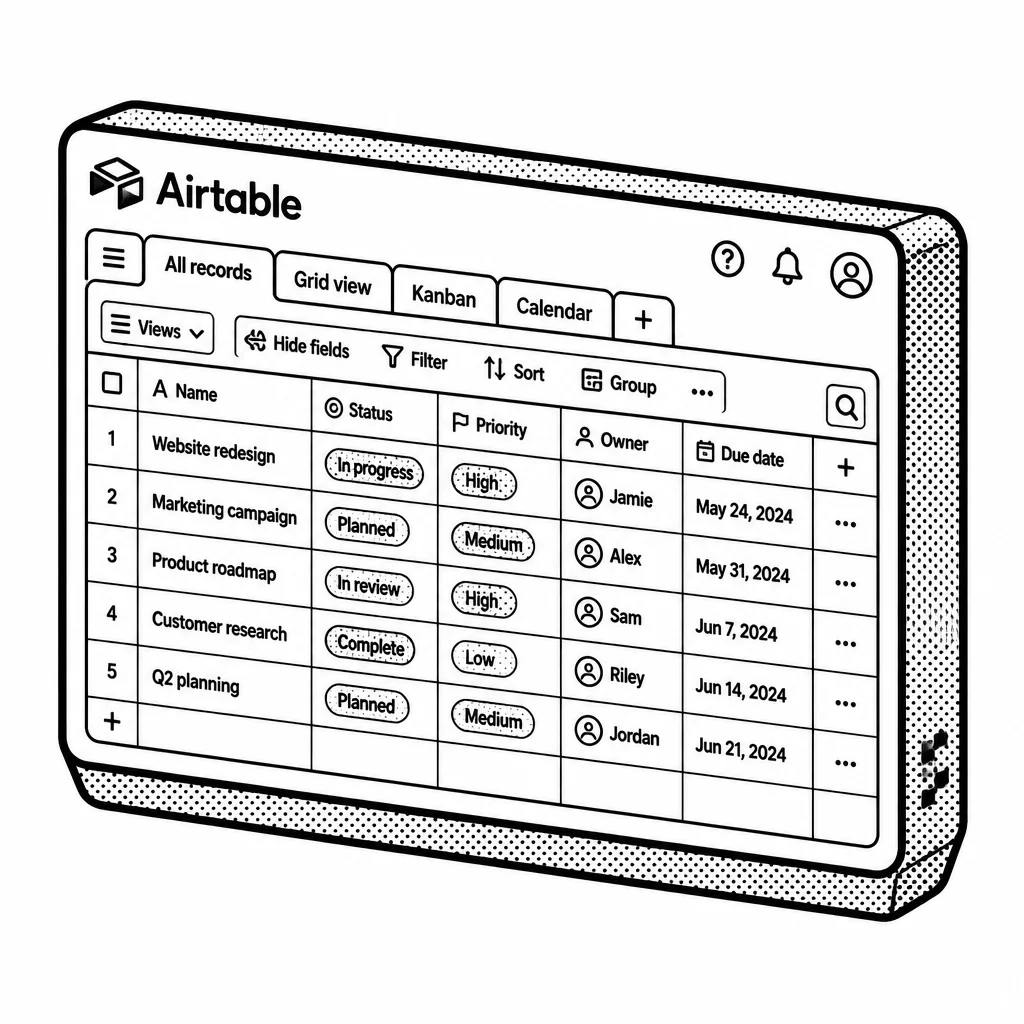
The business model is straightforward subscription software. Airtable runs a generous free tier to pull people in, then charges per seat as teams grow and need more records, more automation, and more admin controls. Its real edge is that it sits between two worlds: simple enough for a marketing manager to use without help, but structured enough that a whole department can run on it. The bet is that as companies pile up more small internal tools, it is cheaper to let the people closest to the problem build them than to queue up for the engineering team. That "no-code" idea turned into a crowded, fast-moving market. Microsoft bundles similar database-and-app tools into its widely used Power Platform, and Notion sells a friendlier all-in-one workspace that overlaps heavily with Airtable's everyday users. Competitors compete mostly on price and habit, which is why Airtable pushes hard on automation, AI-assisted app building, and enterprise features to keep bigger customers from drifting elsewhere.
Airtable is a private company based in San Francisco, backed by venture capital and valued in the billions during the boom years. Like many growth software firms, it raised a lot of money, hired aggressively, and then had to tighten up when the easy funding dried up — a reminder that even beloved products have to prove they can turn subscriptions into sustainable profit. For now, the company's story is a simple one: sell ordinary workers the power to build their own software, one subscription at a time.
Saved answer · last researched 4 Nov 2026
BIG PICTURE
Most companies that pay for Airtable also pay for its rival Notion
- 57.6% Airtable buyers who also pay for Notion
- 42.4% Airtable buyers who do not pay for Notion
Notion competes for the same no-code work, and a September 2026 review of software purchasing found that 57.6% of companies paying for Airtable also pay for Notion. Many customers run the two side by side, so Airtable often wins a slice of a budget rather than the whole thing. Notion ranks 18th by adoption, far ahead of Airtable at 51st. Source: Cledara Data Hub, data from 2026
Timeline
Three Founders Bet on Databases for Everyone
Howie Liu, Andrew Ofstad, and Emmett Nicholas founded Airtable to make the relational database something ordinary people could use, not just developers. The idea came from Liu's time at Salesforce after his startup Etacts was acquired, where he saw a tool that let non-programmers build software and wondered why everyone couldn't have that. The team then spent nearly three years working in secret before showing anything to the public.
Airtable Launches on Hacker News
Airtable finally launched publicly in March 2015, debuting on Hacker News, and raised a small seed round plus a few million more from CRV. Then something better than any ad happened: people started using it on their own and bringing it into their workplaces, spreading it company by company from the bottom up.
Airtable Blocks Turns Users Into Builders
A few years later Airtable raised a much bigger round and launched Blocks, a way for non-coders to build their own little software tools on top of Airtable. That was the moment the company stopped being just a fancy spreadsheet-database hybrid and started calling itself a platform.
A Peak Valuation of $11.7 Billion
In 2021, during the wild high-growth software era, Airtable raised a huge round that pushed its valuation to $11.7 billion. It was the kind of number that makes a company feel unstoppable.
Layoffs Hit Airtable
The good times did not last. Airtable laid off a fifth of its workforce and lost three executives, then cut more people the following year. The company that had seemed unstoppable was now shrinking to survive.
Airtable Relaunches as an AI Platform
In June 2025 Airtable relaunched itself as an AI-native app platform, with Howie Liu calling it a refounding moment. Its first big AI bet, Cobuilder, let people describe an app in plain language and have it built from Airtable's building blocks. The company moved roughly half of its engineering and product teams onto AI work.
DeepSky Acquisition and a New CTO
That same year Airtable bought DeepSky, a small AI research startup, and brought in David Azose, formerly of OpenAI, as its new chief technology officer. The pieces were being put in place for something bigger.
Superagent Becomes a Standalone Product
In January 2026 Airtable launched Superagent, later renamed Hyperagent, its first standalone product in 13 years. Built on the technology it had acquired with DeepSky, the system coordinates specialized AI agents working side by side on research and analysis tasks.
Bending Spoons Buys Airtable
Bending Spoons announced it would buy Airtable for an enterprise value of about $1.3 billion, roughly 2.7 times revenue and far below that $11.7 billion peak. Before the sale, the Hyperagent business was moved into a separate company of its own.
Liu Leaves to Run Hyperagent
The acquisition closed in September 2026, and Howie Liu stepped down as CEO to run the spun-out Hyperagent Inc. full-time. A new product lead, Alessandro Savarese, came in to guide development under Bending Spoons.