Understand any stock in simple English
Enter a ticker to learn what the company does and how it makes money.
Beijing Moonshot AI Technology Co., Ltd.
Moonshot AI builds the Kimi chatbot and the large language models behind it, and it sells access to those models to companies and developers.
Moonshot AI is a Chinese artificial intelligence company best known for Kimi, a chatbot that people use to read long documents, search the web, and answer questions. It is one of China's most closely watched AI startups, part of a small group of young labs trying to build frontier models that can compete with the biggest players in the United States.
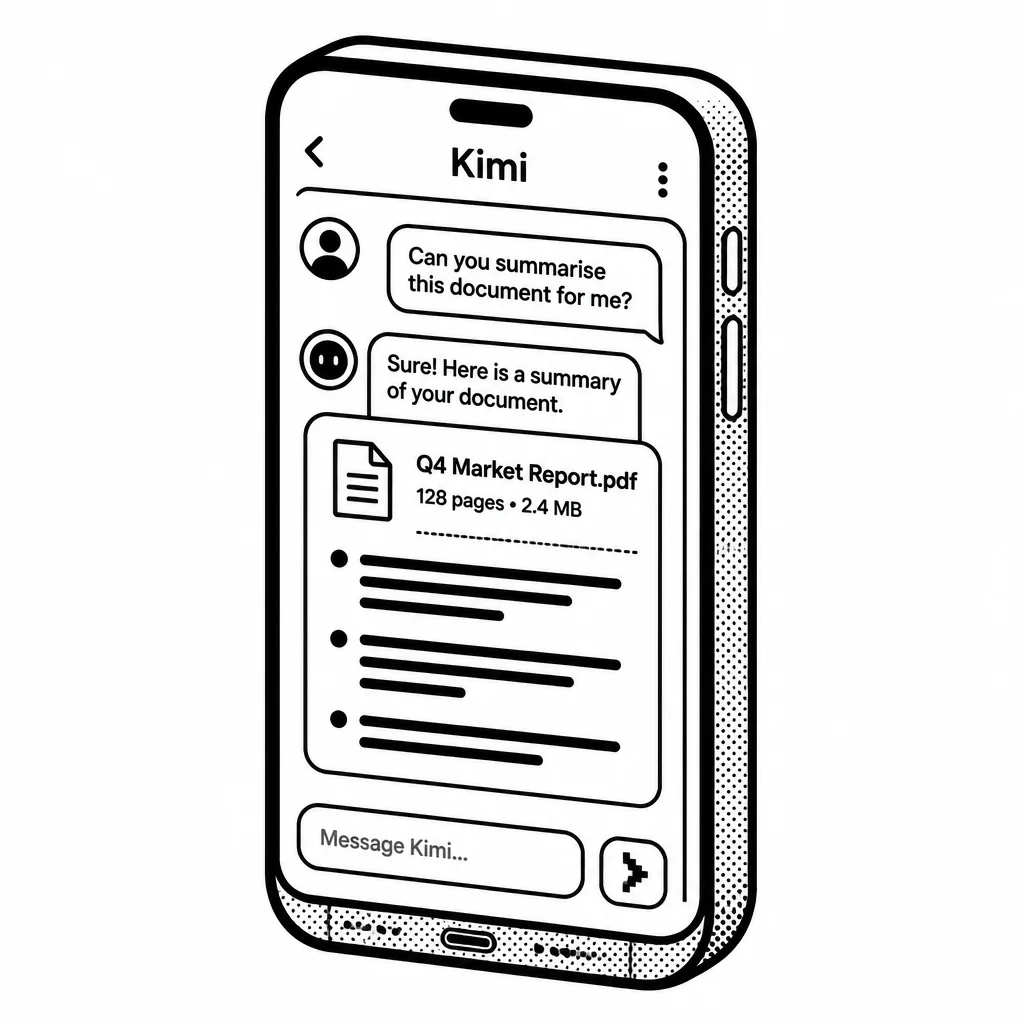
The company makes money in two main ways. Regular users get Kimi for free, which builds the audience and the brand. The real business is on the other side: Moonshot sells access to its models to companies and developers through an API, so other businesses can build their own products on top of Moonshot's brains. It also offers enterprise versions of Kimi for workplaces. Customers pick Moonshot because its models are strong at handling very long text — Kimi became famous for being able to swallow huge documents and books in one go — and because, for Chinese companies, it is a domestic alternative to relying on American AI. Moonshot was founded in 2023 by Yang Zhilin, a young researcher who had worked at Google and at a Chinese AI lab before striking out on his own. The company raised money fast from big investors, including a large round led by Alibaba, and it became one of China's "AI tiger" startups alongside several rivals. Those rivals include DeepSeek, whose cheap and capable models shook the industry in early 2025, and other well-funded labs backed by Chinese tech giants. The competition is brutal: models improve quickly, prices for API access keep falling, and everyone is burning cash on computing power.
The big question hanging over Moonshot is the same one facing every AI lab: can it turn excitement into a durable business? Training cutting-edge models is extraordinarily expensive, and the company must keep raising money to stay in the race. It has leaned on efficiency — doing more with less computing power — and on open-sourcing some of its models to win developers and attention. Whether that translates into lasting profits is still unproven, which is exactly the bet investors are making.
Saved answer · last researched 10 Nov 2026
BIG PICTURE
Kimi takes 61% of what companies spend on open-source AI models
- 61% Moonshot AI's Kimi
- 15% DeepSeek
- 11% Z.ai's GLM
- 7% Meta's Llama
- 6% Others
When businesses pay for open-source AI models, most of that money goes to one Chinese family of models: Kimi. It holds 61% of global enterprise spending in that category, ahead of DeepSeek at 15% and Z.ai's GLM at 11%. Moonshot earns its money by selling access to these models to companies and developers, so that lead is the core of its business. Source: Menlo Ventures, State of Enterprise AI report, data from 2026
Timeline
Three Founders and a Dark Side of the Moon
In March 2023, Yang Zhilin, Zhou Xinyu, and Wu Yuxin started a company in Beijing. Yang had helped build some of the key ideas behind modern AI, and he had spent years thinking about how to make AI read very long pieces of text without forgetting the beginning. The company launched on the 50th anniversary of Pink Floyd's The Dark Side of the Moon, which gave it its Chinese name: the dark side of the moon. The bet was simple: most chatbots had short memories, and a machine that could hold a whole book in its head would be genuinely useful.
Kimi Chat Opens With a Huge Memory
That fall, the company released Kimi Chat, which could read about 200,000 characters at once, far more than most Chinese chatbots of the time. That meant you could hand it an entire report or novel and it would keep the thread. The name came from Yang's own English nickname, which then became both the chatbot and the model line. It was a small, clear product with one big idea behind it.
Alibaba Leads a Billion-Dollar Round
Early in 2024, Kimi's long memory caught the market's attention, and investors piled in. Alibaba and HongShan led a round of more than a billion dollars, the largest ever for a Chinese AI model startup at the time, with Alibaba taking the biggest outside stake. A month later the company pushed the context window to two million characters, ten times the launch figure, and demand briefly overwhelmed its servers. The company was now flush with cash and famous, and the question was whether the attention would last.
DeepSeek Collides With Kimi
Then, in January 2025, DeepSeek released a model that shocked the entire AI world and knocked Kimi off its perch. The company made a hard pivot: instead of keeping its models closed, it would give the weights away. In July 2025 it released Kimi K2, a huge open-weight model, and rebuilt the company around Western developers who wanted to build on top of it. K2 topped global rankings for open models and gave the company a second life, this time through builders rather than casual users.
Kimi K3 and a Bet on Open Models
The following summer, the company shipped Kimi K3, a model with nearly three trillion parameters and a million-token context window, trading blows with the best closed systems in the world. It released the full weights shortly after, cementing the belief that open models can match the closed frontier. It also launched a Kimi Enterprise tier, priced deliberately at Anthropic's mid-tier, a clear signal that it now wanted to sell to businesses, not just win leaderboards.
The Money Rolls In as Users Walk Out
By mid-2026, the company was raising again, opening a round at a $31.5 billion pre-money valuation, its third raise in six months after a May round at $20 billion. Revenue was reported at over $300 million a year, unaudited and investor-sourced, from a team of only about 300 people. But there was a strange split underneath: the Kimi consumer app's China users had collapsed by more than half over the previous year, so the company's value now rested on developers, not everyday users. The money was real, but the story had changed.
A Fifty-Billion-Dollar Dash to Hong Kong
By October 2026 the company closed a final pre-IPO round at about a $50 billion valuation, up sharply from the summer. It is targeting a Hong Kong IPO in early 2027, though the underwriting path is still unresolved after Bank of America stepped out as coordinator. Two clouds hang over the filing: a $700 million compensation dispute tied to the company's founding, and the risk of US sanctions over restricted Nvidia chips. The company that started with a chatbot and a long memory is now racing to become public, with its future resting on whether open models and developers can carry it there.