Understand any stock in simple English
Enter a ticker to learn what the company does and how it makes money.
Mercuria Energy Group Ltd.
Mercuria is a giant commodity trading house that buys, sells, stores, and ships energy and raw materials around the world.
Mercuria is one of the world's biggest commodity trading houses, a middleman that moves physical stuff — oil, gas, power, metals, and agricultural goods — from where it is cheap to where it is needed. It doesn't own most of what it trades for long. Instead, it buys cargoes, arranges ships and storage, and sells them on, earning a thin margin on enormous volumes. Think of it as a global logistics and risk machine built on top of oil.
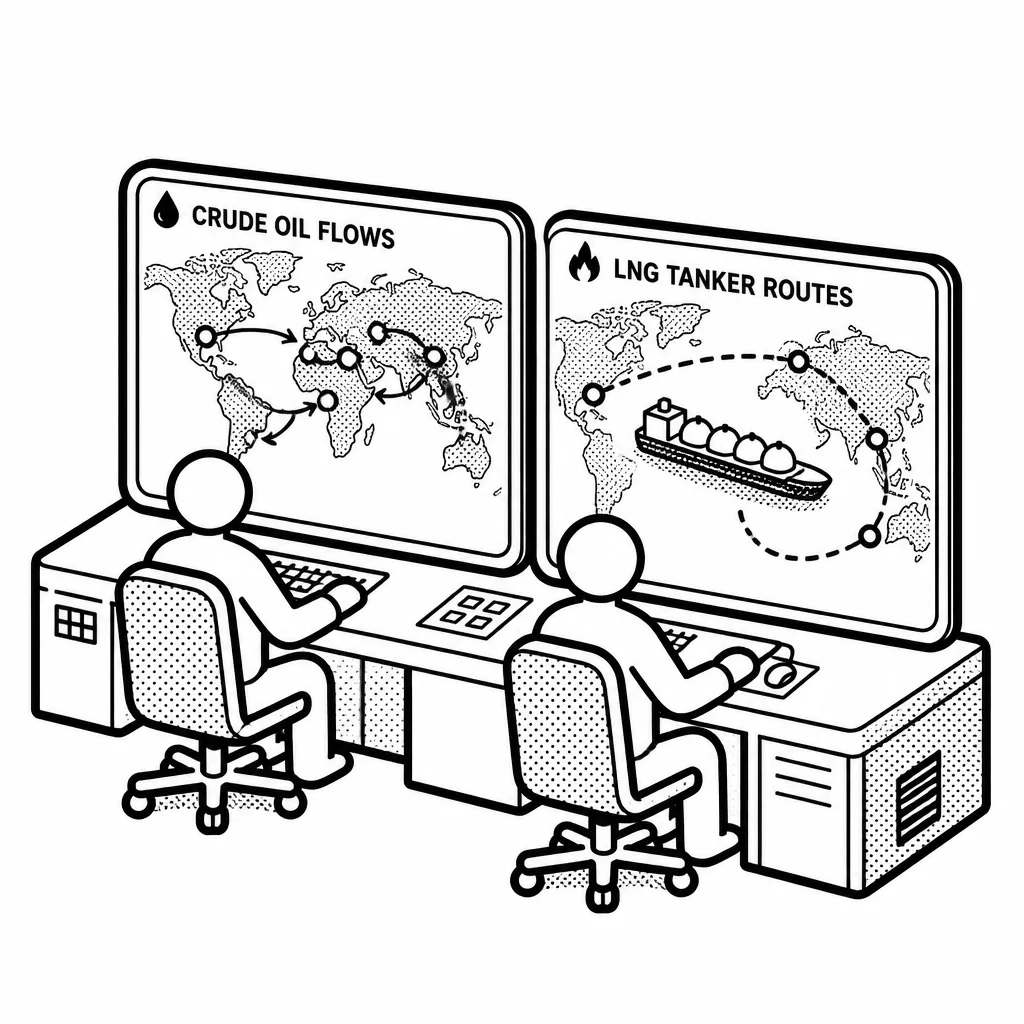
Its heart is oil. Mercuria started in 2004 as an oil trader and grew into one of the handful of firms — alongside Vitol, Trafigura, and Glencore — that dominate the secretive, trillion-dollar business of physical commodity trading. It later expanded into natural gas, power, and renewables, and it has pushed into metals and minerals, including the raw materials for batteries. Customers are the oil majors, refiners, utilities, and industrial firms that want to buy or sell in bulk without handling the logistics and price swings themselves. The money comes from doing many deals with razor-thin margins. Mercuria might buy a tanker of crude in one port, charter a ship, insure the cargo, hedge the price, and deliver it to a refinery weeks later — pocketing a small spread on each move. Because the volumes are vast, small spreads add up. It also stores commodities and uses its market knowledge to trade around price differences between regions and time periods. The business is capital-hungry: it borrows heavily to fund cargoes, and its lenders watch it closely.
Mercuria is privately held, co-founded by Marco Dunand and Daniel Jaeggi, and headquartered in Geneva. The risks are real and worth naming. Trading houses live and die on credit and trust: a wrong bet, a fraud, or a sudden price crash can wipe out years of thin margins, and the 2020 oil-price collapse and the 2022 energy crisis both tested the sector hard. There is also growing pressure to clean up, since trading fossil fuels sits awkwardly with the shift to greener energy — which is exactly why Mercuria has been investing in renewables, battery metals, and carbon markets. It is a business that thrives on chaos and connections, and stays out of the spotlight on purpose.
Saved answer · last researched 10 Nov 2026