Understand any stock in simple English
Enter a ticker to learn what the company does and how it makes money.
Groq, Inc.
Groq designs specialized chips and sells cloud access to them so companies can run AI models extremely fast.
Groq is an AI chip company that sells speed. When you ask an AI chatbot a question, the answer usually trickles out one word at a time because the computers behind it are built for training models, not for instantly serving them. Groq's bet is that a different kind of chip can spit out entire answers almost instantly, and that this speed is worth paying for. Customers — mostly developers and companies building AI products — rent access to Groq's chips through its cloud service rather than buying the hardware themselves. That rental business is the main way Groq makes money today.
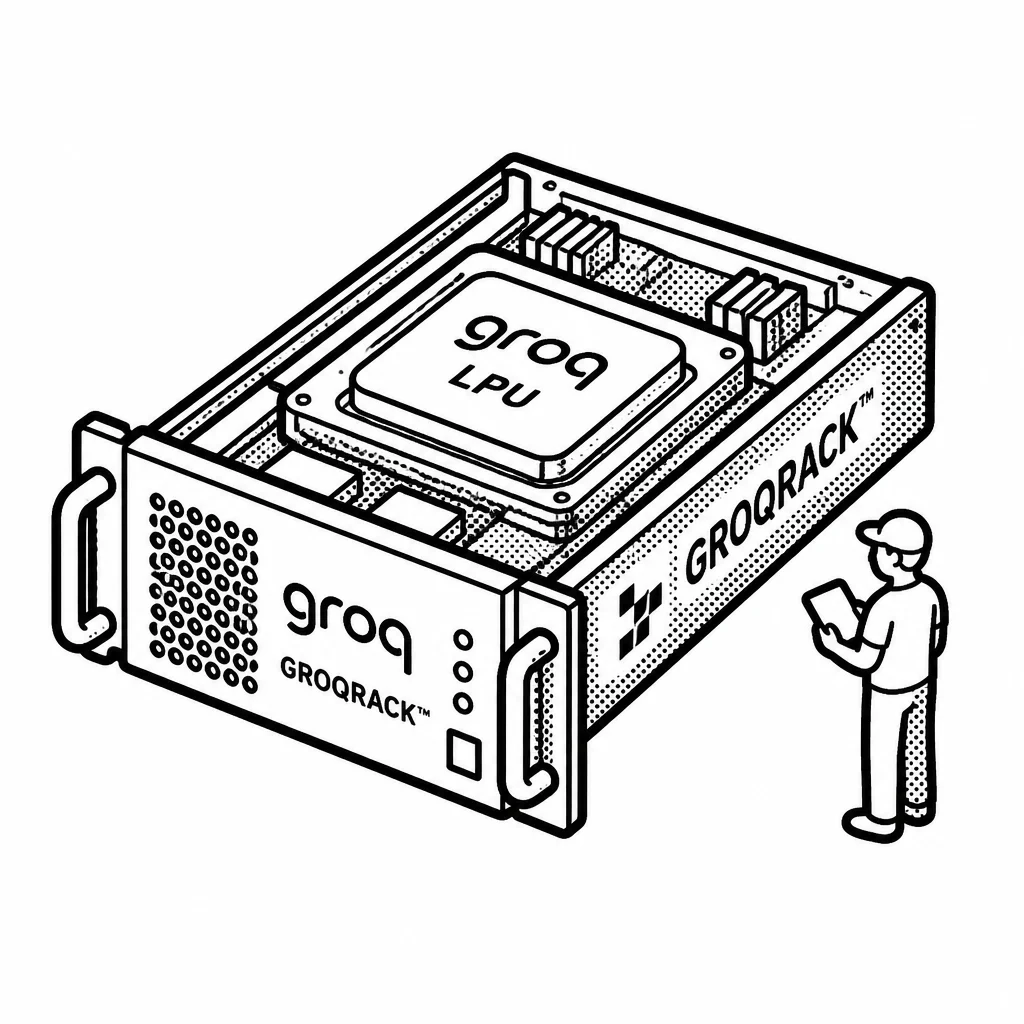
The key technology is something Groq calls the Language Processing Unit, or LPU. Most AI work today happens on graphics chips, which are flexible but somewhat inefficient at the specific job of generating text one token at a time. Groq's chip is built from the ground up for exactly that job, with a design that keeps data moving in a predictable rhythm instead of constantly fetching from memory. The result, Groq claims, is dramatically faster responses. Groq doesn't manufacture the chips itself — it designs them and has them built by a foundry partner, then installs them in its own data centers. The company was founded in 2016 by Jonathan Ross, who had previously helped start Google's AI chip effort, the project that became the Tensor Processing Unit. For years Groq operated quietly, raising money and building its first hardware. It became widely known in early 2024 when it demonstrated open-source AI models running at blazing speeds, and millions of people tried the demo. Since then it has scaled up its cloud business and raised large sums from investors, making it one of the most closely watched private companies in AI.
Groq's strengths are speed and focus: it owns its entire stack, from chip design to the cloud service, so it can tune everything for latency. Its weaknesses are size and dependence on outsiders. It competes against giants like Nvidia, whose chips dominate AI computing, and against cloud providers such as Amazon and Microsoft that sell their own AI capacity. Groq also depends on foundries and memory suppliers to build its hardware, and on continued investor funding to expand. The whole business rests on a simple wager: that for many AI applications, being first to answer matters more than anything else.
Saved answer · last researched 4 Nov 2026
BIG PICTURE
Nvidia holds about 70% of the AI chip market; Groq holds around 10%
- 10% Groq
- 70% Nvidia
- 20% Others
Groq sells cloud access to chips built for running AI models, and it does so in a market where Nvidia controls roughly 70%. Groq's own slice is about 10%. That gap explains both the opportunity and the risk: Groq wins customers by promising faster responses, but most buyers still pick the giant, and Nvidia has already licensed Groq's technology and hired key people. Source: AI副業ラボ (reporting on U.S. DOJ review of the Nvidia-Groq deal), data from 2026
Timeline
Jonathan Ross Founds Groq
Jonathan Ross had helped design Google's specialized AI chip, the TPU, and he came away convinced that regular processors were the wrong tool for modern AI. So in 2016 he gathered a group of former Google engineers and started Groq to build a completely new kind of chip. Douglas Wightman, an engineer from Google X, came on as the first CEO.
Groq Becomes a Unicorn
The idea was expensive to build, so Groq raised money from investors. In 2021 a funding round of $300 million, led by Tiger Global and D1 Capital Partners, pushed the company's value past $1 billion and made it what people call a unicorn. That cash went into developing its AI inference chip.
Groq Buys Maxeler
A year later Groq bought Maxeler Technologies, a company with deep knowledge of dataflow systems, a way of moving data through chips efficiently. The deal added high-performance computing and AI expertise to Groq's engineering team, and Maxeler kept its own brand.
Samsung's Texas Fab Chosen
Groq needed someone to actually manufacture its next chip, and it picked Samsung's brand-new factory in Taylor, Texas, built on a 4nm process. It was the first foundry order for that plant, and it secured advanced manufacturing for Groq's second-generation chip, the LPU.
GroqCloud Launches
Then Groq made a quiet but important shift: it opened a developer platform called GroqCloud, letting people use its API and rent time on its chips. It bought Definitive Intelligence to strengthen that platform. This was the start of Groq selling inference computing as a service rather than just chips.
A $640 Million Round
The cloud push attracted big money. In 2024 Groq raised $640 million led by BlackRock's private equity arm, valuing the company at $2.8 billion. Investors were betting on Groq as a challenger to Nvidia in AI inference.
Saudi Arabia's $1.5 Billion Bet
The next year Saudi Arabia committed $1.5 billion to expand Groq's inference infrastructure, including a new data center in Dammam. By then Groq had more than ten data centers across the US, Canada, the Middle East and Europe.
Nvidia Licenses Groq's Technology
Then came the deal that changed everything. Nvidia agreed to license Groq's inference technology in a non-exclusive deal reported at around $20 billion, its largest ever. Nvidia also hired founder Jonathan Ross, president Sunny Madra and many staff, while Groq insisted it would keep operating on its own. In effect, the upstart challenger was absorbed into the giant it had been taking on.
Groq Pivots to the Cloud
With Ross gone, co-founder Doug Wightman stepped up as CEO and Groq turned its focus to a new cloud inference business. It raised $650 million from existing investors to fund the transition and now ran 13 data centers across four regions, serving more than 5 million developers.
Nvidia Ships Groq 3 LPX
In 2026 Nvidia announced full mass production of its Groq 3 LPX architecture, built from the technology it had licensed. The design boosts how fast AI systems generate tokens and improves inference performance. Cloud provider Nebius became the first to adopt it, a sign that Groq's original idea now lives on inside Nvidia's ecosystem.