Understand any stock in simple English
Enter a ticker to learn what the company does and how it makes money.
Cerebras Systems Inc.
Cerebras builds enormous computer chips designed to train artificial intelligence models faster and more simply than the standard hardware used today.
Cerebras is a chip company that makes the biggest computer chip in the world and sells computers built around it to companies training artificial intelligence. The core problem it attacks is simple: modern AI models are so large that the standard approach — stitching thousands of small chips together with wires and networking — creates bottlenecks, because data has to shuttle back and forth between chips that can't see each other's memory. Cerebras's answer is to cram a whole dinner-table-sized slab of silicon onto one wafer, so the entire brain of the machine lives on a single chip with memory right next to the compute. The company calls it the Wafer-Scale Engine, and it makes a rack of these machines called the CS-3, plus a cloud service where customers can rent the computing power instead of buying it.
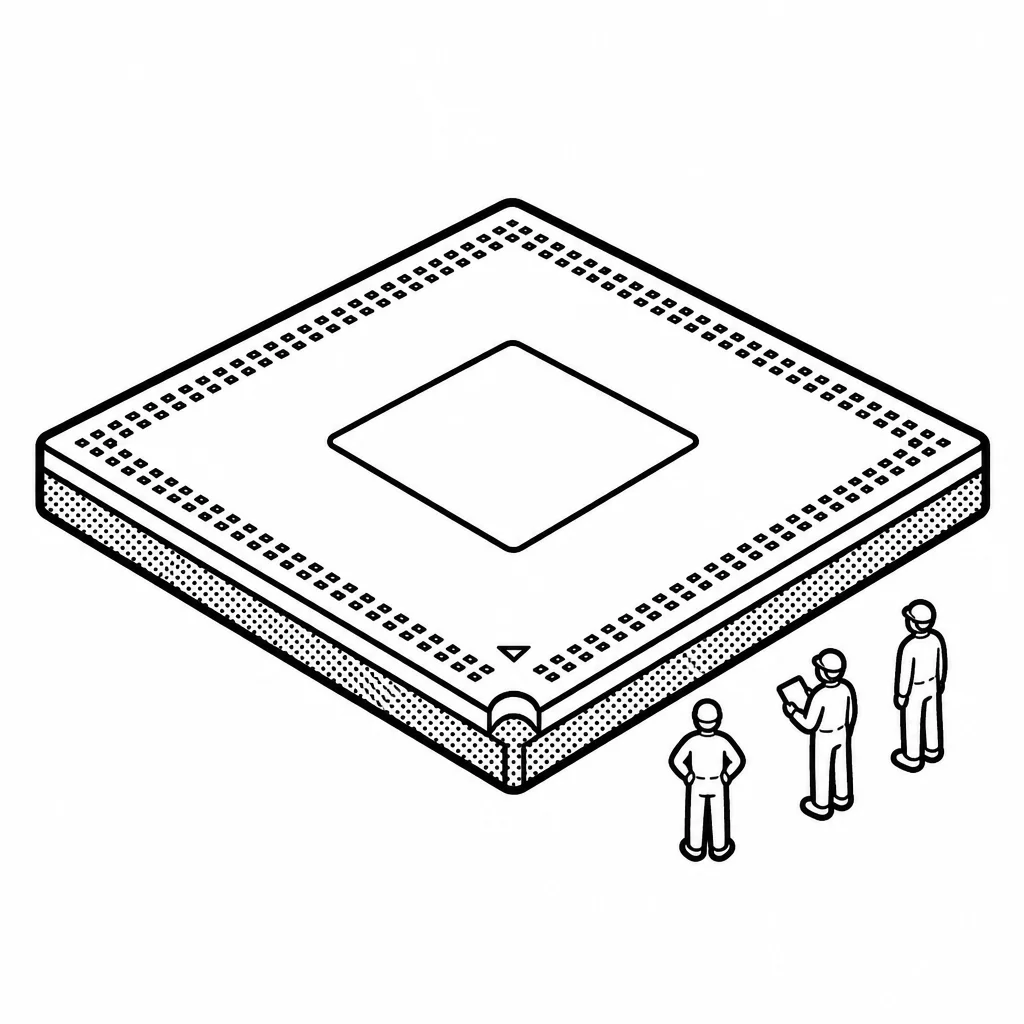
Who pays? Mostly a mix of a few giant customers and governments. In 2024, a large share of Cerebras's revenue came from a single customer in the United Arab Emirates called G42, and the company has signed substantial deals with cloud and AI infrastructure firms. Cerebras also runs its own inference cloud — the idea being that once an AI model is trained, you still need cheap, fast computing to answer queries, and Cerebras chips are unusually quick at that. It has disclosed revenue around $136 million for 2024, up roughly 77% from the prior year, while continuing to lose money. The business is a bet against the dominant player in AI chips, Nvidia, which sells the GPUs that nearly everyone uses and wraps them in its own software ecosystem called CUDA. Cerebras's pitch is that its hardware is easier to program because a model fits on one chip without the painful work of splitting it across thousands of GPUs. But building custom silicon at massive scale is brutally expensive and technically hard, and depending on one or two mega-customers is risky. The company raised money from investors including G42 and venture funds, went public on Nasdaq in 2025, and now faces the classic question: can it turn a clever engineering trick into a durable, profitable business before the giant it's racing figures out an answer?
Its biggest potential vulnerability is concentration. If a flagship customer slows spending or a government export rule cuts off a market, revenue wobbles fast. And Nvidia is not standing still — its chips keep improving, its software moat is deep, and it is now selling whole systems too. Cerebras's bet is that raw speed and simplicity are worth paying for, especially for the growing crowd of companies trying to run open AI models cheaply. Whether that's a niche or a fortune is the whole story.
Saved answer · last researched 10 Nov 2026
Timeline
Feldman's Dinner-Plate Chip
Andrew Feldman, who had already built and sold a chip company, started Cerebras in 2015 with a bet that AI needed a completely different kind of chip than the graphics chips everyone else was using. Instead of slicing a silicon wafer into many small chips and wiring them back together, he etched all the computing into one wafer-sized chip, the Wafer-Scale Engine, about the size of a dinner plate. From day one, the goal was hardware built for AI.
Five Engineers Leave AMD
A year later, five Silicon Valley engineers who left AMD formally set up the company, with a first big check of $27 million led by Benchmark. They were betting on this giant chip before the Transformer architecture even existed, back when mainstream AI hardware was still clusters of GPUs. The founders were asking a basic question: if AI becomes a whole new kind of computing load, can we redesign the machine for it?
The Wafer Chip Finally Works
That bet nearly killed them. After three years and nearly $300 million spent, the chip still did not work and the company was close to bankruptcy, until the first-generation WSE finally reached production and worked. In 2019 Cerebras came out of stealth and unveiled a chip with hundreds of thousands of AI cores and a huge amount of memory right on the chip, plus a complete computer system around it, and closed a $272 million round that made it a unicorn. The gamble had paid off, for now.
G42 Becomes the Biggest Backer
The second-generation chip moved to a newer manufacturing process at TSMC, more than doubling everything that mattered: transistors, compute density, on-chip memory and bandwidth. That caught the eye of G42, a cloud provider in the UAE, which quickly became Cerebras' largest financier. By mid-2023 the company had orders worth $900 million for nine supercomputing sites built with G42, a mountain of business that would soon shape its fate in ways both good and bad.
Inference Becomes the Business
Up to mid-2024 Cerebras focused mostly on training AI models, then launched a small inference-as-a-service offering to rival Groq and SambaNova. Inference means running a finished model to answer users, and the chip's massive on-chip memory turned out to be great at it, making Cerebras one of the fastest providers around. Inference grew into a much bigger business than expected and reshaped how the company made money.
The IPO Is Pulled
Cerebras filed to go public in September 2024, and the paperwork showed something uncomfortable: G42 was responsible for 87 percent of revenues. Almost exactly a year later Feldman quietly withdrew the filing, delaying the IPO so the inference business could show better financial results. It was the company's second attempt at an IPO, and the pulled offering left the big question hanging: could Cerebras grow beyond one giant customer?
Revenue Jumps and Cash Pours In
Then the numbers turned. In 2025 Cerebras reported $510 million in revenue, up 76 percent, and swung to a $237.8 million net profit. It raised $1.1 billion in October 2025 and another $1 billion in February 2026, reaching a $23 billion valuation, with growth driven by the inference platform and big-name customer wins. The business that started as a side offering was now the engine.
The Biggest AI IPO of the Year
In May 2026 Cerebras listed on Nasdaq, pricing at $185 a share and raising $5.55 billion in the largest US IPO of the year. The stock opened at $350, peaked at $386, and closed its first day up 68 percent, with the company briefly worth more than $80 billion. It was the largest pure-AI IPO on Wall Street and seemed to validate the wafer-scale bet once and for all.
The Stock Falls Back to Earth
The celebration did not last. By early November 2026 the stock had fallen about 77 percent from its first-day peak to roughly $90. Cloud and services had grown to 70 percent of revenue while hardware sales declined for two straight quarters, and the company's extreme token-generation speed failed to translate into pricing power. The cloud model also required heavy capital spending, and investors began to wonder what kind of company Cerebras really was.
Microsoft Joins the Customer List
Still, the underlying business kept growing. In the third quarter of 2026 Cerebras reported core revenue of $230.9 million, up 70 percent, and positive adjusted profit of $30 million ahead of schedule. It signed a cloud deal with Microsoft, joining AWS and Oracle as three hyperscalers using its platform within six months, and raised its full-year guidance, while management stuck to a target of tripling revenue in 2027 with the next-generation CS-5 chip expected that summer. The stock had crashed, but the customers kept coming.