Understand any stock in simple English
Enter a ticker to learn what the company does and how it makes money.
Glean, Inc.
Glean sells enterprise AI search software that connects to a company's apps and data so employees can find answers and information in one place.
Glean is an enterprise AI search company. It sits on top of all the software a company already uses — email, chat, documents, wikis, customer records — and lets an employee type one question and get one answer, instead of hunting through a dozen apps one by one.
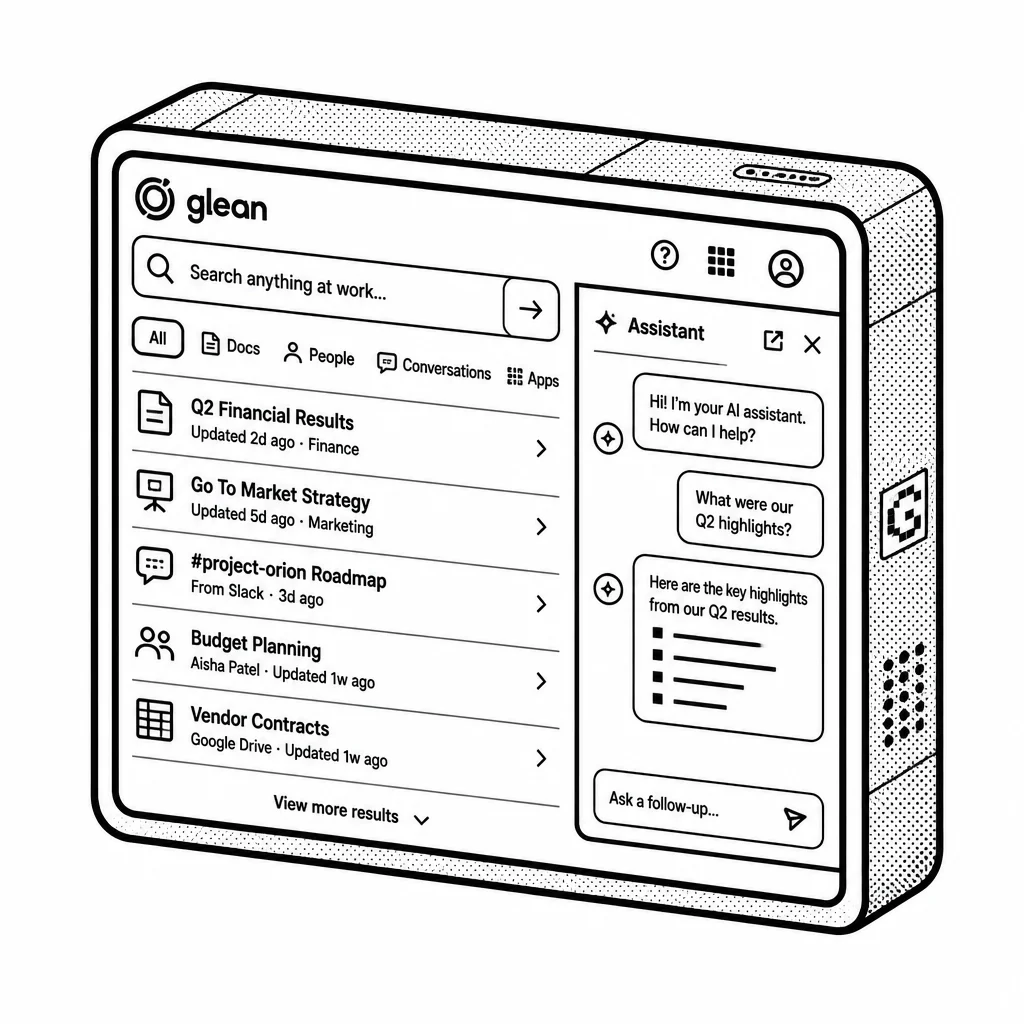
Most workplace knowledge is scattered. A policy lives in a shared drive, a decision lives in a chat thread, a customer's history lives in a sales tool. Glean connects to those systems, indexes what is inside them, and learns how each company works: who its experts are, what its acronyms mean, which documents are current. So when someone searches "parental leave policy" or "who owns the billing migration," they get a relevant answer with the right permissions respected, rather than a pile of links. It also builds on that base with AI assistants and agents that can answer questions and take actions across those connected tools. Glean makes money by selling subscriptions to companies, priced per employee seat, with bigger tiers for more advanced AI features. Its customers skew toward large organizations — technology firms, banks, retailers, universities — because the value grows with the number of apps and people a company has. That is also the source of its strength and its vulnerability: the product gets stickier as it spreads, but it competes against giants bundling similar tools into suites they already sell, including Microsoft with Copilot and Google with Gemini for Workspace, plus other enterprise search players.
The company was founded in 2019 by Arvind Jain, a former Google engineer who also co-founded Rubrik, alongside three other ex-Google engineers who had lived the problem of finding information inside big companies. It raised venture money at a reported valuation of $4.6 billion in 2025, a sign investors expect AI search inside the enterprise to be a large market. Its bet is that being neutral — working across all of a customer's apps rather than favoring one vendor's ecosystem — is exactly what large, messy organizations need.
Saved answer · last researched 4 Nov 2026
BIG PICTURE
Only 13% of workers say AI has significantly improved their company's performance
- 13% Workers who say AI significantly improved company performance
- 87% Workers who say it has not
Glean's own research finds a gap between using AI and getting anything out of it. Among 6,000 workers surveyed across the U.S., U.K. and Australia, 87% use AI on the job, yet just 13% say it has significantly improved how their company performs. Glean sells software meant to close that gap by feeding AI the right company context, so the gap is both its pitch and its risk. Source: Glean Work AI Institute, Work AI Index, data from 2026
Timeline
Four Founders Build Search for Work
At Rubrik, Arvind Jain watched smart people waste time hunting for information that should have been easy to find. He looked for a product that solved this and found none, so he decided to build it himself. He started Glean with T.R. Vishwanath, Piyush Prahladka, and Tony Gentilcore, raised early funding, and then went quiet — building in secret for two years.
Glean Comes Out of Stealth
When Glean finally showed itself, the product was already in use at more than 40 companies. That early traction proved something important: the problem of finding knowledge at work wasn't one team's annoyance — it was a company-wide pain.
Glean Joins the Unicorn Club
Less than a year after launching publicly, Glean raised a big round led by Sequoia at a billion-dollar valuation. Around the same time, its first workplace study put a number on the problem it was chasing: employees spend roughly a quarter of their workweek just searching for information.
Glean Adds Generative AI
Glean built generative AI search that stayed grounded in each company's own context and permissions, and launched Glean Chat. Later that year it laid out a bigger vision — a platform where AI is grounded in company knowledge, not just a search box.
From Search Tool to Work AI Platform
With Glean Apps and APIs, companies could build their own AI experiences on top of their enterprise context, and the pitch widened to "Work AI for all." Investors bought in: across two rounds the company raised more than $460M and doubled its valuation from $2.2B to $4.6B.
Agents Arrive and Revenue Doubles
Glean launched Glean Agents and held its first user conference, Glean:GO. The business was accelerating fast — annual recurring revenue doubled from $100M to $200M in just nine months — and a new funding round pushed its valuation to $7.2B.
Glean Makes Its First Acquisition
Glean bought its first company, Aryn, a platform for agentic document intelligence. The deal pushed Glean beyond the data sitting in workplace apps and into PDFs, contracts, forms, and records, making its Assistant and Agents smarter about documents.
Glean Reaches $300M in ARR
Glean hit $300M in annual recurring revenue just 15 months after reaching $100M, shipping over 250 new features and nearly doubling its Fortune 500 customers year over year. As enterprises hunted for ways to cut AI compute costs and tech giants crowded in, Glean's context graph and token efficiency became a real selling point.