Understand any stock in simple English
Enter a ticker to learn what the company does and how it makes money.
Exa Labs Inc.
Exa builds a search engine for artificial intelligence, helping AI apps find the right information on the web.
Exa is a search company built for machines rather than people. When you type into Google, you get a list of links to click. When an AI assistant needs to answer a question, it can't click anything — it needs a clean feed of the most relevant pages, delivered fast, so it can read them and write an answer. Exa sells that feed.
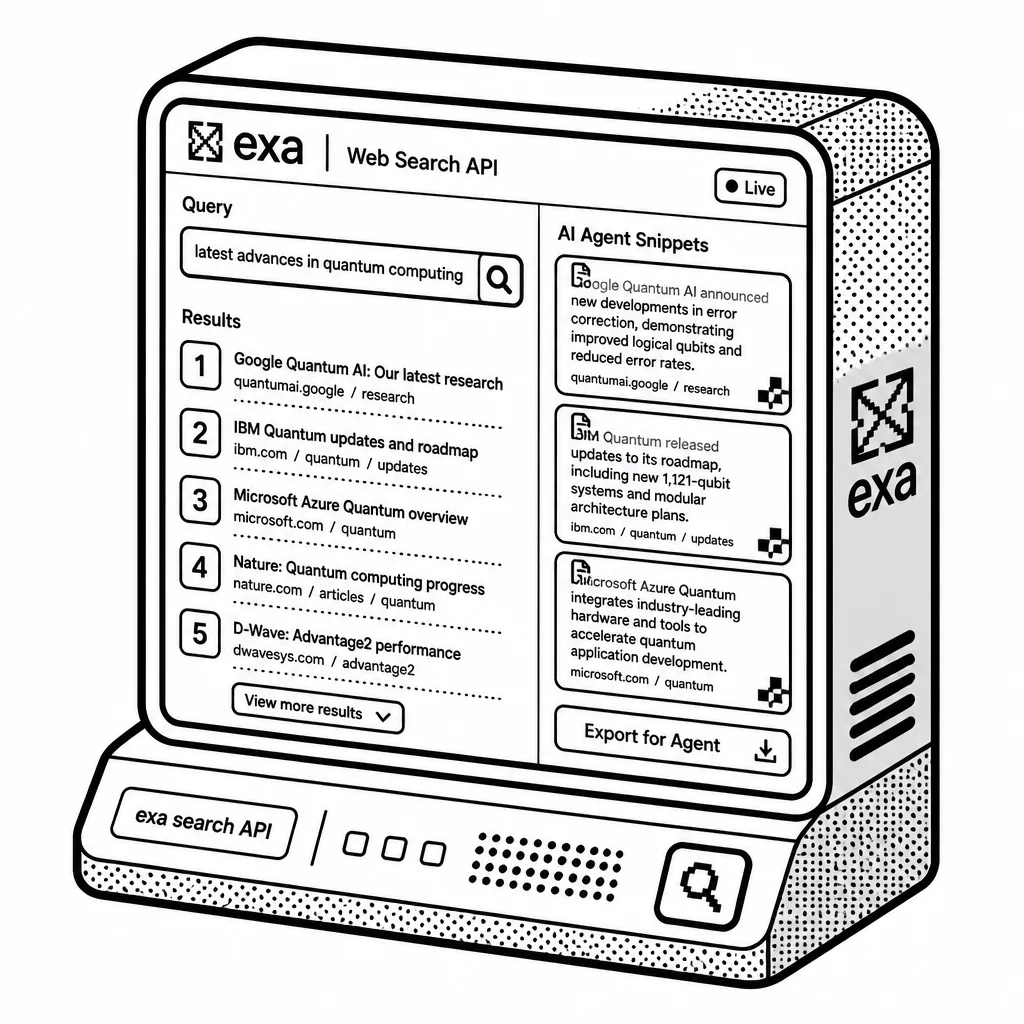
The company's main product is a web search API. A developer sends a query — sometimes plain words, sometimes a description of what they want — and Exa returns ranked results, full page text, and similar-page suggestions. Its trick is using AI models, called embeddings, that turn the meaning of a page into numbers, so the engine can match on intent rather than just keywords. Customers pay per search and per page of content they pull back. Its buyers are AI startups, research labs, and bigger companies building assistants and agents that need fresh, real information from the open web. The competition is fierce. Google and Microsoft's Bing dominate the plumbing of web search, and a wave of startups sell similar developer tools. Exa's pitch is quality and speed for AI use cases specifically, plus features like finding pages semantically similar to a given one — useful for research, recommendations, and gathering training data. The market it serves is growing quickly as more companies build AI products that need to look things up.
Exa was founded in 2021 by Will Bryk and Jeff Wang, who met at Harvard, and it went through startup accelerator Y Combinator. Its early bet — that search would increasingly be done by software on behalf of software — has drawn venture funding and attention as AI agents became a mainstream idea. The risk is real: search is expensive to run, giants are moving into the same territory, and the company must keep its index fresh and its results trustworthy. But if AI assistants become the front door to the internet, the company feeding them the web could matter a lot.
Saved answer · last researched 9 Nov 2026
BIG PICTURE
Coding agents pick Exa in 14% of AI search sessions, more than any of its 41 rivals
- 14% Sessions where coding agents chose Exa
- 86% Sessions where agents chose another search service
When five popular coding agents needed to search the web, they picked Exa in 14% of 639 test sessions, first among 42 search services. The agents disagree sharply: Codex chose it 26% of the time, Claude Code only 4%. That gap matters because Exa sells its search to the companies building these tools, so a single agent's default setting can swing a big chunk of demand. Source: Armature, data from 2026
Timeline
Two Friends Take On Google
Will Bryk and Jeffrey Wang, friends from Harvard, started a company in 2021 with a wildly ambitious goal: build a search engine better than Google. To get there, they bought a cluster of graphics chips and built a large system for indexing the web. The problem they were chasing was simple to state and brutal to solve — Google already had the whole web in its grip.
The Metaphor Days
At first the company went by a different name, Metaphor Systems, or just Metaphor. The name change to Exa came later. For now, the team was still a small startup with a big idea and no product yet.
A Launch Two Weeks Before ChatGPT
The first search engine launched in late 2022. Then, just two weeks later, ChatGPT arrived and changed everything. Suddenly people were building AI apps, and those builders started asking Exa for API access to its search — a demand the founders had not planned for.
A Pivot Toward AI
Early in 2023, Exa made a hard turn. Instead of competing for human eyeballs with a consumer search engine, it rebuilt itself around an API-first model for AI applications. It launched the first web search API designed for AI — a quiet admission that the real customer was not a person typing a query, but a machine doing the searching.
Search Built for Machines
The demand from AI products kept growing, and Exa answered it with its AI-focused web search API. This was the bet paying off: AI builders needed a way to fetch high-quality web results, and Exa was selling exactly that.
Benchmark Leads the Series B
By 2025, Exa raised an $85 million Series B led by Benchmark, valuing the company at $700 million. The founders framed it as entering "stage two" of building the search engine for AIs — a signal that the early gamble had turned into a real business.
A16z Triples the Valuation
Less than a year later, in 2026, Exa raised a $250 million Series C led by a16z at a $2.2 billion valuation — roughly tripling its worth in under a year. The money was earmarked to expand indexing beyond the open web, train next-generation models, and scale its infrastructure.
Partnership With Google
By 2026, Exa served more than 5,000 businesses and over 400,000 developers, and customer queries had grown from about 100 million to about a billion per month in a single year. Then came a striking twist: a partnership with Google itself, letting Gemini access Exa's search through Vertex AI and the Gemini Agent Marketplace. The startup that set out to beat Google was now working with it.