Understand any stock in simple English
Enter a ticker to learn what the company does and how it makes money.
Tavily
Tavily sells a search tool built for artificial intelligence apps, so AI models can look things up on the live web.
Tavily is a private software company that sells a search engine designed for artificial intelligence, not for people. Its customers are mostly developers and companies building AI assistants, agents, and research tools. When one of those AI programs needs current information from the web, it asks Tavily, and Tavily returns clean, organized results that the AI can read and use right away. That is different from a normal search engine, which is built to show links to a human. Think of it as a research desk built for robots instead of people.
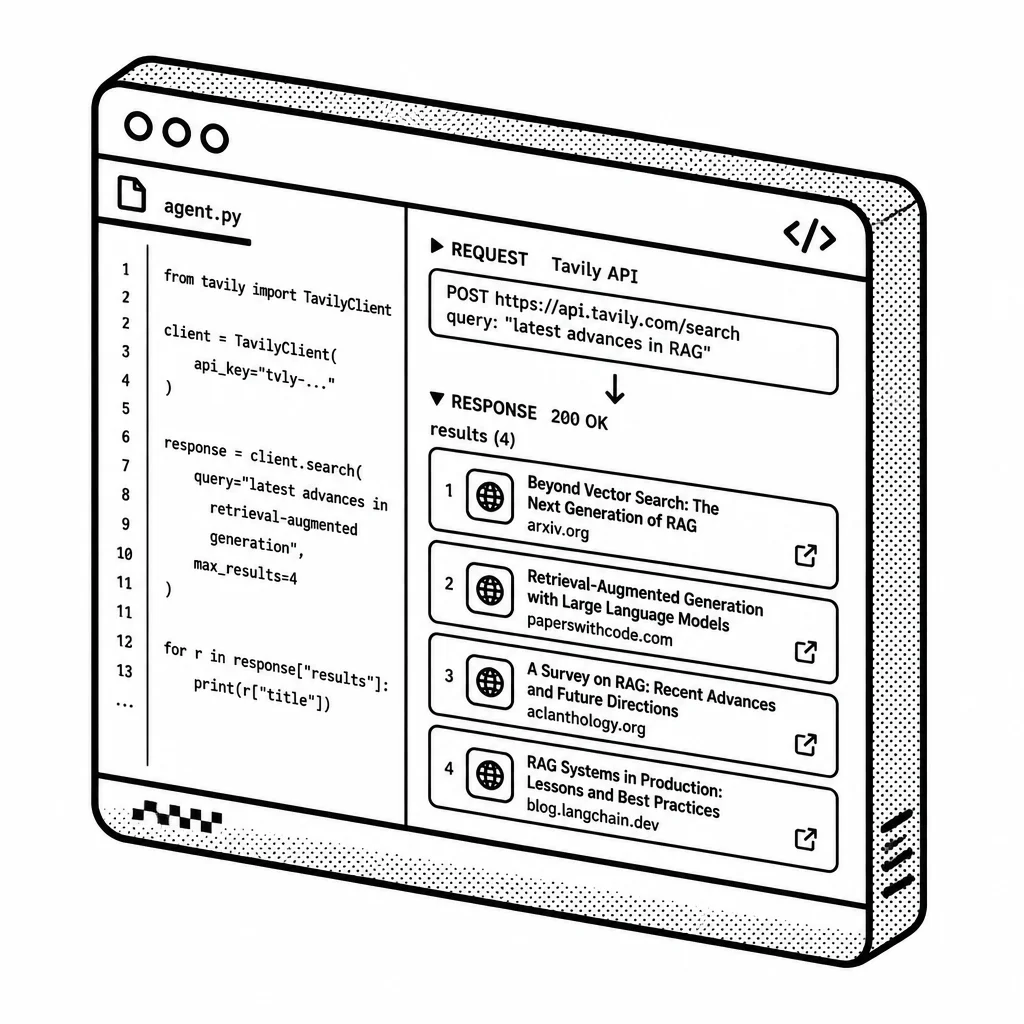
The company makes money by charging for access to its search tool, typically based on how many searches a customer runs, with free tiers to get developers started and paid plans that scale up. This "search for AI" niche has grown fast as more businesses build AI agents that need fresh facts rather than stale training data, and Tavily has become one of the better-known names in that space, raising venture money and adding enterprise features like deeper research modes and controls for companies.
Tavily was founded in 2024 by a small team including Rotem Weiss, and it grew out of earlier work on AI research tools. Its bet is simple: as AI agents multiply, they will all need a reliable way to check the web, and whoever provides that plumbing gets paid every time an AI has a question. The main risks are competition from big search providers and the fact that this is still an early, fast-changing market.
Saved answer · last researched 18 Oct 2026
BIG PICTURE
Coding agents picked Tavily in only 6% of sessions run for senior engineers
- 6% Senior engineer sessions that chose Tavily
- 94% Senior engineer sessions that chose another tool or none
When coding agents were asked to pick a search tool for a senior engineer, they went with Tavily in 6% of sessions. The same agents chose it 22% of the time when the request came from a junior developer. Tavily sells itself as the simple, agent-friendly way to give AI apps live web access, so it wins on easy setup. Among engineers who check the details, it often loses. Source: Armature, data from 2026
Timeline
A Researcher With No Live Web
In 2023, a data scientist named Rotem Weiss kept running into the same wall: ChatGPT couldn't reach the live internet, so its answers were stuck in the past. His fix was a small open-source project called GPT Researcher, which went out and fetched real-time web data first. It caught fire almost overnight, collecting close to 20,000 GitHub stars, and proved something useful: people badly wanted AI grounded in what was actually happening on the web.
From Notebook to Business
That demand had a catch, though. Soon ChatGPT and other AI models learned to search the web themselves, and the consumer tool lost its edge. So Weiss pivoted, launching Tavily as a company aimed at businesses instead. Instead of researching for you, Tavily gave companies' AI agents a toolkit to search, crawl, and pull clean, structured facts out of public and private sources.
Twenty Million to Feed the Agents
The bet was that a flood of AI agents would soon need one thing even more than humans do: a way to find and read the right information. Insight Partners led a $20 million funding round, bringing a one-year-old Tavily to $25 million raised in total. The money went toward a big ambition, onboarding the next billion AI agents to the web, with customers like Groq, Cohere, MongoDB, and Writer already using it.
Nebius Buys Tavily
The bet paid off. Nebius agreed to buy Tavily in a deal estimated at around $275 million, according to Bloomberg. The idea was a neat fit: Tavily's search layer for AI agents would sit right inside Nebius's AI cloud, next to its Token Factory service that runs the models themselves. Tavily kept its own brand, and Weiss joined Nebius to lead product development.