Understand any stock in simple English
Enter a ticker to learn what the company does and how it makes money.
ElevenLabs, Inc.
ElevenLabs sells software that turns text into realistic human-sounding speech and other audio.
ElevenLabs is an artificial intelligence company that makes voices. Give its software a piece of text and it will read it back out loud in a voice that sounds like a real person, not a robot. People use it for audiobooks, video narration, video games, customer service phone lines, and dubbing movies and shows into other languages. The company is widely credited with helping push AI voice quality from obviously fake to genuinely hard to tell apart from a human recording.
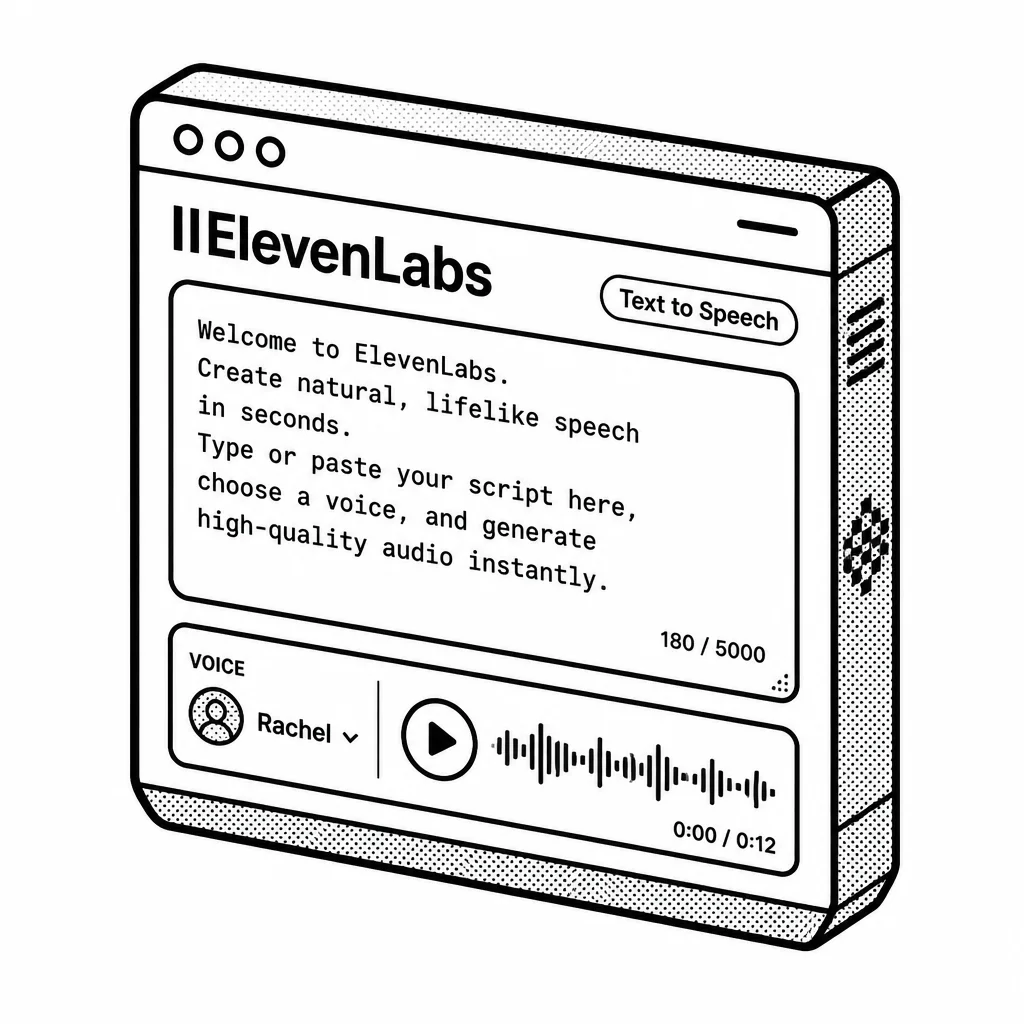
The core product is text-to-speech, but the business has grown into a small family of audio tools. Its voice cloning feature can recreate a person's voice from a short sample, which is powerful and also a little unsettling. It sells dubbing that swaps actors' voices into new languages while trying to keep the original performance intact. It also offers a studio tool for producing long-form audio like audiobooks, and a marketplace where voice actors can license their voices and get paid when others use them. Most customers pay through subscriptions, with free tiers to pull people in and paid plans for creators, small teams, and large enterprises. The company was founded in 2022 by Piotr Dąbkowski and Mati Staniszewski, and it grew fast on the back of the generative AI boom. It is private, backed by venture capital, and its investors have valued it at several billion dollars, which makes it one of the more closely watched AI startups. Its headquarters are split between New York and London, and it is a genuinely global business, with customers spread around the world. Being private means there is no stock to buy and no quarterly reports to read, so outsiders mostly learn about it through funding announcements and product launches.
Its biggest challenge is not technology but trust. A tool that can clone almost any voice is a gift to scammers and a headache for everyone else, so the company has had to build safeguards like verification for cloned voices and detection tools for fake audio. It also faces stiff competition from much larger players, including Microsoft, whose Azure speech tools compete for enterprise customers, and a crowd of other AI voice startups. ElevenLabs' bet is that being the best at voice, and the most careful about how it is used, will keep customers coming back.
Saved answer · last researched 4 Nov 2026
BIG PICTURE
Microsoft leads AI video dubbing with 31.4%, but ElevenLabs is already second at 18.1%
- 31.4% Microsoft
- 18.1% ElevenLabs
- 16.8% Google
- 10.9% Tencent
- 8.9% Baidu
- 13.9% Others
In the market for AI video dubbing, Microsoft holds the biggest slice at 31.4%, yet ElevenLabs sits in second place with 18.1%, ahead of Google. A pure voice company beating two of the largest technology firms in the world says something about how it earns its money: creators and studios pay for speech that sounds human, and that skill is the product. Source: douge.com, data from 2026
Timeline
Two Polish Friends Start ElevenLabs
Mati Staniszewski and Piotr Dabkowski grew up together in Poland, where foreign films were dubbed by a single voice reading every part — flat and lifeless. That annoyance became the seed of an idea: what if a machine could read a script with real emotion, the way a person does? They quit steady jobs at Palantir and Google DeepMind and got to work, betting that making speech sound human was a problem of understanding meaning, not just processing sound.
The Public Launch
When ElevenLabs opened to the public, people could type words and get back a voice that sounded warm and alive, or clone a voice from a sample. Word spread fast, and a few thousand early testers turned into hundreds of thousands in weeks, swept up in the excitement that followed ChatGPT. The big cloud players could generate speech too, but theirs sounded robotic next to this.
A Unicorn One Year In
Investors put in $80 million, valuing the young company at over a billion dollars barely a year after launch. The money came with a preview of what was next: a studio for dubbing films into other languages, a marketplace for voices, and a mobile app that reads to you.
The Pivot Beyond Voice
Then came a surprising admission from the CEO: the real money isn't in voice anymore. Voice, he argued, would soon be a cheap commodity anyone could copy, so the company pushed into conversational AI agents and a broader platform for businesses — with voice as the way in, not the destination.
Sequoia Leads a Bigger Round
The pivot paid off. Sequoia led a $500 million round that valued ElevenLabs at $11 billion — more than triple its value a year earlier — as big companies like Deutsche Telekom, Square and Revolut started buying. The cash went straight into the enterprise platform for voice and conversational AI.
Employees Cash Out at $22 Billion
A $300 million sale of employee shares doubled the company's value again, to $22 billion, led by Wellington and T. Rowe Price and giving early staff a payday before a possible IPO. By then most of the revenue came from businesses, and its agents were handling over 15 million conversations a week.